


Page 537 - Clinical Application of Mechanical Ventilation
P. 537
Critical Care Issues in Mechanical Ventilation  503


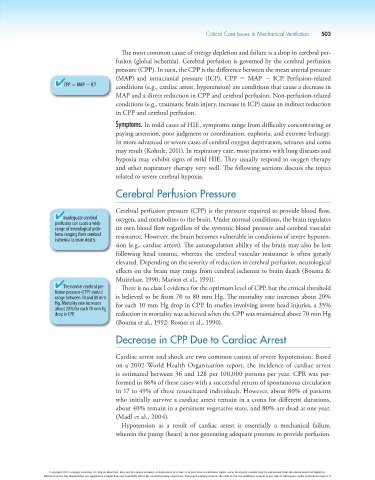
                                               The most common cause of energy depletion and failure is a drop in cerebral per-
                                             fusion (global ischemia). Cerebral perfusion is governed by the cerebral perfusion
                                             pressure (CPP). In turn, the CPP is the difference between the mean arterial pressure
                                             (MAP)  and  intracranial  pressure  (ICP).  CPP  5  MAP  2  ICP.  Perfusion-related
                            CPP 5 MAP 2 ICP  conditions (e.g., cardiac arrest, hypotension) are conditions that cause a decrease in
                                             MAP and a direct reduction in CPP and cerebral perfusion. Non-perfusion-related
                                             conditions (e.g., traumatic brain injury, increase in ICP) cause an indirect reduction
                                             in CPP and cerebral perfusion.

                                             Symptoms. In mild cases of HIE, symptoms range from difficulty concentrating or
                                             paying attention, poor judgment or coordination, euphoria, and extreme lethargy.
                                             In more advanced or severe cases of cerebral oxygen deprivation, seizures and coma
                                             may result (Kohnle, 2011). In respiratory care, most patients with lung diseases and
                                             hypoxia may exhibit signs of mild HIE. They usually respond to oxygen therapy
                                             and other respiratory therapy very well. The following sections discuss the topics
                                             related to severe cerebral hypoxia.

                                             Cerebral Perfusion Pressure


                                             Cerebral perfusion pressure (CPP) is the pressure required to provide blood flow,
                            Inadequate cerebral   oxygen, and metabolites to the brain. Under normal conditions, the brain regulates
                          perfusion can cause a wide
                          range of neurological prob-  its own blood flow regardless of the systemic blood pressure and cerebral vascular
                          lems ranging from cerebral   resistance. However, the brain becomes vulnerable in conditions of severe hypoten-
                          ischemia to brain death.
                                             sion (e.g., cardiac arrest). The autoregulation ability of the brain may also be lost
                                             following head trauma, whereas the cerebral vascular resistance is often greatly
                                             elevated. Depending on the severity of reduction in cerebral perfusion, neurological
                                             effects on the brain may range from cerebral ischemia to brain death (Bouma &
                                             Muizelaar, 1990; Marion et al., 1991).
                            The normal cerebral per-  There is no class I evidence for the optimum level of CPP, but the critical threshold
                          fusion pressure (CPP) should
                          range between 70 and 80 mm   is believed to be from 70 to 80 mm Hg. The mortality rate increases about 20%
                          Hg. Mortality rate increases   for each 10 mm Hg drop in CPP. In studies involving severe head injuries, a 35%
                          about 20% for each 10 mm Hg
                          drop in CPP.       reduction in mortality was achieved when the CPP was maintained above 70 mm Hg
                                             (Bouma et al., 1992; Rosner et al., 1990).

                                             Decrease in CPP Due to Cardiac Arrest


                                             Cardiac arrest and shock are two common causes of severe hypotension. Based
                                             on a 2002 World Health Organization report, the incidence of cardiac arrest
                                             is estimated between 36 and 128 per 100,000 persons per year. CPR was per-
                                             formed in 86% of these cases with a successful return of spontaneous circulation
                                             in 17 to 49% of these resuscitated individuals. However, about 80% of patients
                                             who initially survive a cardiac arrest remain in a coma for different durations,
                                             about 40% remain in a persistent vegetative state, and 80% are dead at one year.
                                             (Madl et al., 2004).
                                               Hypotension  as  a  result  of  cardiac  arrest  is  essentially  a  mechanical  failure,
                                             wherein the pump (heart) is not generating adequate pressure to provide perfusion.


                        Copyright 2013 Cengage Learning. All Rights Reserved. May not be copied, scanned, or duplicated, in whole or in part. Due to electronic rights, some third party content may be suppressed from the eBook and/or eChapter(s).
                      Editorial review has deemed that any suppressed content does not materially affect the overall learning experience. Cengage Learning reserves the right to remove additional content at any time if subsequent rights restrictions require it.

