


Page 568 - Clinical Application of Mechanical Ventilation
P. 568
534    Chapter 16


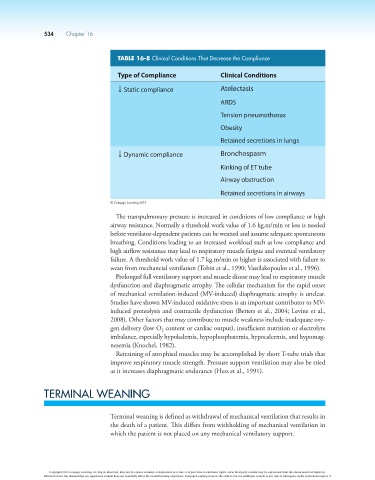
                                              TABLE 16-8 Clinical Conditions That Decrease the Compliance


                                              Type of Compliance                Clinical Conditions

                                              T Static compliance               Atelectasis
                                                                                ARDS

                                                                                Tension pneumothorax
                                                                                Obesity

                                                                                Retained secretions in lungs

                                              T Dynamic compliance              Bronchospasm

                                                                                Kinking of ET tube
                                                                                Airway obstruction

                                                                                Retained secretions in airways
                                            © Cengage Learning 2014
                                             The transpulmonary pressure is increased in conditions of low compliance or high
                                            airway resistance. Normally a threshold work value of 1.6 kg.m/min or less is needed
                                            before ventilator-dependent patients can be weaned and assume adequate spontaneous
                                            breathing. Conditions leading to an increased workload such as low compliance and
                                            high airflow resistance may lead to respiratory muscle fatigue and eventual ventilatory
                                            failure. A threshold work value of 1.7 kg.m/min or higher is associated with failure to
                                            wean from mechancial ventilation (Tobin et al., 1990; Vassilakopoulos et al., 1996).
                                             Prolonged full ventilatory support and muscle disuse may lead to respiratory muscle
                                            dysfunction and diaphragmatic atrophy. The cellular mechanism for the rapid onset
                                            of mechanical ventilation-induced (MV-induced) diaphragmatic atrophy is unclear.
                                            Studies have shown MV-induced oxidative stress is an important contributor to MV-
                                            induced proteolysis and contractile dysfunction (Betters et al., 2004; Levine et al.,
                                            2008). Other factors that may contribute to muscle weakness include inadequate oxy-
                                            gen delivery (low O  content or cardiac output), insufficient nutrition or electrolyte
                                                            2
                                            imbalance, especially hypokalemia, hypophosphatemia, hypocalcemia, and hypomag-
                                            nesemia (Knochel, 1982).
                                             Retraining of atrophied muscles may be accomplished by short T-tube trials that
                                            improve respiratory muscle strength. Pressure support ventilation may also be tried
                                            as it increases diaphragmatic endurance (Hess et al., 1991).


                      TERMINAL WEANING


                                            Terminal weaning is defined as withdrawal of mechanical ventilation that results in
                                            the death of a patient. This differs from withholding of mechanical ventilation in
                                            which the patient is not placed on any mechanical ventilatory support.


                        Copyright 2013 Cengage Learning. All Rights Reserved. May not be copied, scanned, or duplicated, in whole or in part. Due to electronic rights, some third party content may be suppressed from the eBook and/or eChapter(s).
                      Editorial review has deemed that any suppressed content does not materially affect the overall learning experience. Cengage Learning reserves the right to remove additional content at any time if subsequent rights restrictions require it.

