


Page 563 - Clinical Application of Mechanical Ventilation
P. 563
Weaning from Mechanical Ventilation  529


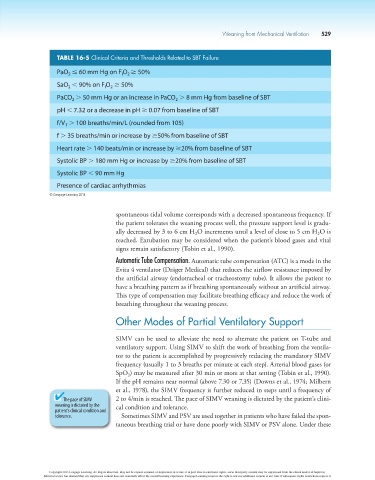
                          TABLE 16-5 Clinical Criteria and Thresholds Related to SBT Failure

                          PaO  # 60 mm Hg on F O $ 50%
                              2
                                               I
                                                 2
                          SaO  , 90% on F O  $ 50%
                                          I
                              2
                                            2
                          PaCO  . 50 mm Hg or an increase in PaCO  . 8 mm Hg from baseline of SBT
                                                                 2
                               2
                          pH , 7.32 or a decrease in pH $ 0.07 from baseline of SBT
                          f/V  . 100 breaths/min/L (rounded from 105)
                             T
                          f . 35 breaths/min or increase by $50% from baseline of SBT
                          Heart rate . 140 beats/min or increase by $20% from baseline of SBT
                          Systolic BP . 180 mm Hg or increase by $20% from baseline of SBT

                          Systolic BP , 90 mm Hg
                          Presence of cardiac arrhythmias
                        © Cengage Learning 2014


                                             spontaneous tidal volume corresponds with a decreased spontaneous frequency. If
                                             the patient tolerates the weaning process well, the pressure support level is gradu-
                                             ally decreased by 3 to 6 cm H O increments until a level of close to 5 cm H O is
                                                                                                               2
                                                                       2
                                             reached. Extubation may be considered when the patient’s blood gases and vital
                                             signs remain satisfactory (Tobin et al., 1990).
                                             Automatic Tube Compensation. Automatic tube compensation (ATC) is a mode in the
                                             Evita 4 ventilator (Dräger Medical) that reduces the airflow resistance imposed by
                                             the artificial airway (endotracheal or tracheostomy tube). It allows the patient to
                                             have a breathing pattern as if breathing spontaneously without an artificial airway.
                                             This type of compensation may facilitate breathing efficacy and reduce the work of
                                             breathing throughout the weaning process.

                                             Other Modes of Partial Ventilatory Support


                                             SIMV can be used to alleviate the need to alternate the patient on T-tube and
                                             ventilatory support. Using SIMV to shift the work of breathing from the ventila-
                                             tor to the patient is accomplished by progressively reducing the mandatory SIMV
                                             frequency (usually 1 to 3 breaths per minute at each step). Arterial blood gases (or
                                             SpO ) may be measured after 30 min or more at that setting (Tobin et al., 1990).
                                                 2
                                             If the pH remains near normal (above 7.30 or 7.35) (Downs et al., 1974; Milbern
                                             et al., 1978), the SIMV frequency is further reduced in steps until a frequency of
                            The pace of SIMV   2 to 4/min is reached. The pace of SIMV weaning is dictated by the patient’s clini-
                          weaning is dictated by the   cal condition and tolerance.
                          patient’s clinical condition and
                          tolerance.           Sometimes SIMV and PSV are used together in patients who have failed the spon-
                                             taneous breathing trial or have done poorly with SIMV or PSV alone. Under these


                        Copyright 2013 Cengage Learning. All Rights Reserved. May not be copied, scanned, or duplicated, in whole or in part. Due to electronic rights, some third party content may be suppressed from the eBook and/or eChapter(s).
                      Editorial review has deemed that any suppressed content does not materially affect the overall learning experience. Cengage Learning reserves the right to remove additional content at any time if subsequent rights restrictions require it.

