


Page 580 - Clinical Application of Mechanical Ventilation
P. 580
546    Chapter 17


                      INTUBATION


                                            In most instances, intubation of the trachea is a necessary part of mechanical ven-
                                            tilation of the neonate. Although this chapter will discuss basics of intubation, it is
                                            beyond the scope of this chapter to cover the procedure in detail. Those interested
                                            in studying the procedure are referred to any of the several excellent neonatal/
                                            pediatric respiratory texts for that information. Here, the indications, equipment,
                                            and general considerations of neonatal intubation are covered.

                                            Indications


                                            Endotracheal intubation of a neonate is indicated when (1) prolonged or inadequate
                          Intubation is indicated in   bag-mask ventilation is present; (2) chest compressions are needed and heart rate
                        (1) inadequate or prolonged
                        bag-mask ventilation; (2) low   remains low; (3) endotracheal administration of epinephrine or surfactant is indi-
                        heart rate during chest com-  cated; (4) meconium is present at delivery and the neonate is nonvigorous, meaning
                        pressions; (3) endotracheal
                        administration of epinephrine   the neonate has a slow heart rate (,100/min), inadequate respirations, and/or poor
                        or surfactant; (4) the presence   muscle tone. Intubation needs to be done as quickly as possible to remove meco-
                        of meconium at delivery in a
                        nonvigorous neonate (slow   nium from the airway before manual ventilation; and (5) the neonate is extremely
                        heart rate (,100/min),   premature and mechanical ventilation is inevitable.
                        inadequate respirations, and/
                        or poor muscle tone); and    Other less common indications may include presence of obstructive lesions such
                        (5) extreme prematurity.
                                            as trachealmalacia, tracheal web, tracheal stenosis, laryngeal paralysis, and extrinsic
                                            masses. Diaphragmatic hernia, removal of pulmonary secretions, maintaining the
                                            airway during surgery, and obtaining tracheal aspirates also require intubation.
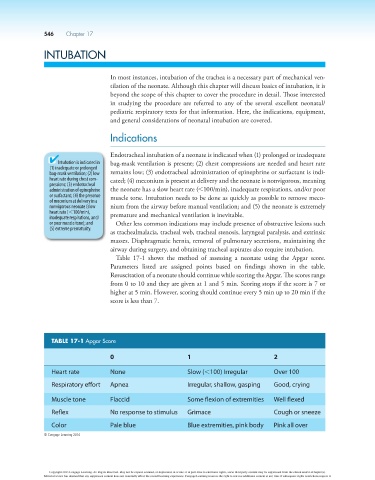
                                             Table  17-1  shows  the  method  of  assessing  a  neonate  using  the  Apgar  score.
                                            Parameters  listed  are  assigned  points  based  on  findings  shown  in  the  table.
                                            Resuscitation of a neonate should continue while scoring the Apgar. The scores range
                                            from 0 to 10 and they are given at 1 and 5 min. Scoring stops if the score is 7 or
                                            higher at 5 min. However, scoring should continue every 5 min up to 20 min if the
                                            score is less than 7.


                        TABLE 17-1 Apgar Score

                                            0                        1                           2

                        Heart rate          None                     Slow (,100) Irregular       Over 100

                        Respiratory effort  Apnea                    Irregular, shallow, gasping  Good, crying

                        Muscle tone         Flaccid                  Some flexion of extremities  Well flexed
                        Reflex              No response to stimulus  Grimace                     Cough or sneeze

                        Color               Pale blue                Blue extremities, pink body  Pink all over
                      © Cengage Learning 2014


                        Copyright 2013 Cengage Learning. All Rights Reserved. May not be copied, scanned, or duplicated, in whole or in part. Due to electronic rights, some third party content may be suppressed from the eBook and/or eChapter(s).
                      Editorial review has deemed that any suppressed content does not materially affect the overall learning experience. Cengage Learning reserves the right to remove additional content at any time if subsequent rights restrictions require it.

