


Page 581 - Clinical Application of Mechanical Ventilation
P. 581
Neonatal Mechanical Ventilation  547


                                             Equipment


                                             The basic equipment and supplies for intubation include a laryngoscope, an ap-
                            Use laryngoscope   propriately sized laryngoscope blade with light, and an endotracheal tube (ETT).
                          blade size 1 for most term
                          newborns, size 0 for preemies   Miller blade sizes of 1, 0, and 00 are used to intubate most term newborns, preemies
                          and size 00 for micropreemies.
                                             and micropreemies, respectively. Selection of an ETT is based on the birth weight
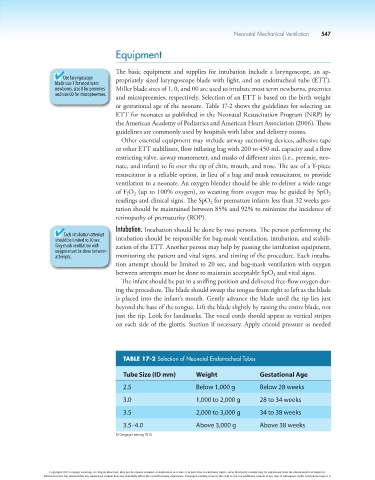
                                             or gestational age of the neonate. Table 17-2 shows the guidelines for selecting an
                                             ETT for neonates as published in the Neonatal Resuscitation Program (NRP) by
                                             the American Academy of Pediatrics and American Heart Association (2006). These
                                             guidelines are commonly used by hospitals with labor and delivery rooms.
                                               Other essential equipment may include airway suctioning devices, adhesive tape
                                             or other ETT stabilizers, flow inflating bag with 200 to 450 mL capacity and a flow
                                             restricting valve, airway manometer, and masks of different sizes (i.e., preemie, neo-
                                             nate, and infant) to fit over the tip of chin, mouth, and nose. The use of a T-piece
                                             resuscitator is a reliable option, in lieu of a bag and mask resuscitator, to provide
                                             ventilation to a neonate. An oxygen blender should be able to deliver a wide range
                                             of F O  (up to 100% oxygen), so weaning from oxygen may be guided by SpO
                                                 I
                                                                                                                   2
                                                   2
                                             readings and clinical signs. The SpO  for premature infants less than 32 weeks ges-
                                                                            2
                                             tation should be maintained between 85% and 92% to minimize the incidence of
                                             retinopathy of prematurity (ROP).
                                             Intubation. Intubation should be done by two persons. The person performing the
                            Each intubation attempt
                          should be limited to 20 sec.   intubation should be responsible for bag-mask ventilation, intubation, and stabili-
                          Bag-mask ventilation with   zation of the ETT. Another person may help by passing the intubation equipment,
                          oxygen must be done between
                          attempts.          monitoring the patient and vital signs, and timing of the procedure. Each intuba-
                                             tion attempt should be limited to 20 sec, and bag-mask ventilation with oxygen
                                             between attempts must be done to maintain acceptable SpO  and vital signs.
                                                                                                 2
                                               The infant should be put in a sniffing position and delivered free-flow oxygen dur-
                                             ing the procedure. The blade should sweep the tongue from right to left as the blade
                                             is placed into the infant’s mouth. Gently advance the blade until the tip lies just
                                             beyond the base of the tongue. Lift the blade slightly by raising the entire blade, not
                                             just the tip. Look for landmarks. The vocal cords should appear as vertical stripes
                                             on each side of the glottis. Suction if necessary. Apply cricoid pressure as needed


                                                TABLE 17-2 Selection of Neonatal Endotracheal Tubes


                                                Tube Size (Id mm)       Weight              Gestational Age
                                                2.5                     Below 1,000 g       Below 28 weeks

                                                3.0                     1,000 to 2,000 g    28 to 34 weeks

                                                3.5                     2,000 to 3,000 g    34 to 38 weeks
                                                3.5–4.0                 Above 3,000 g       Above 38 weeks
                                             © Cengage Learning 2014


                        Copyright 2013 Cengage Learning. All Rights Reserved. May not be copied, scanned, or duplicated, in whole or in part. Due to electronic rights, some third party content may be suppressed from the eBook and/or eChapter(s).
                      Editorial review has deemed that any suppressed content does not materially affect the overall learning experience. Cengage Learning reserves the right to remove additional content at any time if subsequent rights restrictions require it.

