


Page 585 - Clinical Application of Mechanical Ventilation
P. 585
Neonatal Mechanical Ventilation  551


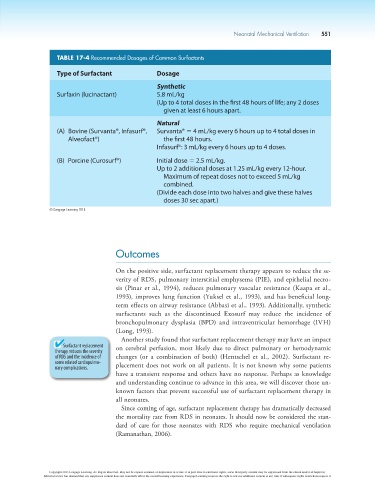
                          TABLE 17-4 Recommended Dosages of Common Surfactants

                          Type of Surfactant               dosage

                                                           Synthetic
                          Surfaxin (lucinactant)           5.8 mL/kg
                                                           (Up to 4 total doses in the first 48 hours of life; any 2 doses
                                                             given at least 6 hours apart.
                                                           Natural
                          (A)   Bovine (Survanta®, Infasurf®,     Survanta® 5 4 mL/kg every 6 hours up to 4 total doses in
                              Alveofact®)                    the first 48 hours.
                                                           Infasurf®: 3 mL/kg every 6 hours up to 4 doses.

                          (B)  Porcine (Curosurf®)         Initial dose 5 2.5 mL/kg.
                                                           Up to 2 additional doses at 1.25 mL/kg every 12-hour.
                                                             Maximum of repeat doses not to exceed 5 mL/kg
                                                             combined.
                                                           (Divide each dose into two halves and give these halves
                                                             doses 30 sec apart.)
                        © Cengage Learning 2014


                                             Outcomes


                                             On the positive side, surfactant replacement therapy appears to reduce the se-
                                             verity of RDS, pulmonary interstitial emphysema (PIE), and epithelial necro-
                                             sis (Pinar et al., 1994), reduces pulmonary vascular resistance (Kaapa et al.,
                                             1993), improves lung function (Yuksel et al., 1993), and has beneficial long-
                                             term effects on airway resistance (Abbasi et al., 1993). Additionally, synthetic
                                             surfactants  such  as  the  discontinued  Exosurf  may  reduce  the  incidence  of
                                             bronchopulmonary  dysplasia  (BPD)  and  intraventricular  hemorrhage  (IVH)
                                             (Long, 1993).
                                               Another study found that surfactant replacement therapy may have an impact
                            Surfactant replacement   on cerebral perfusion, most likely due to direct pulmonary or hemodynamic
                          therapy reduces the severity
                          of RDS and the incidence of   changes  (or  a  combination  of  both)  (Hentschel  et  al.,  2002).  Surfactant  re-
                          some related cardiopulmo-  placement does not work on all patients. It is not known why some patients
                          nary complications.
                                             have a transient response and others have no response. Perhaps as knowledge
                                             and understanding continue to advance in this area, we will discover those un-
                                             known factors that prevent successful use of surfactant replacement therapy in
                                             all neonates.
                                               Since coming of age, surfactant replacement therapy has dramatically decreased
                                             the mortality rate from RDS in neonates. It should now be considered the stan-
                                             dard  of  care  for  those  neonates  with  RDS  who  require  mechanical  ventilation
                                             (Ramanathan, 2006).


                        Copyright 2013 Cengage Learning. All Rights Reserved. May not be copied, scanned, or duplicated, in whole or in part. Due to electronic rights, some third party content may be suppressed from the eBook and/or eChapter(s).
                      Editorial review has deemed that any suppressed content does not materially affect the overall learning experience. Cengage Learning reserves the right to remove additional content at any time if subsequent rights restrictions require it.

