


Page 599 - Clinical Application of Mechanical Ventilation
P. 599
Neonatal Mechanical Ventilation  565


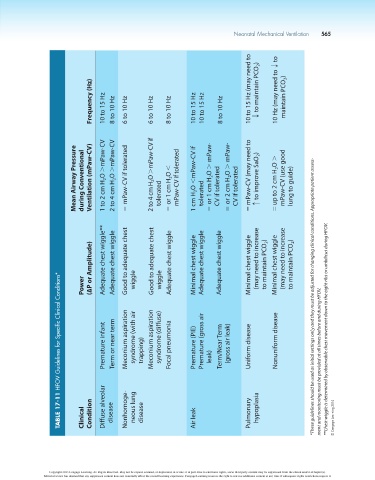
                                     Frequency (Hz)  10 to 15 Hz  8 to 10 Hz  6 to 10 Hz  6 to 10 Hz  8 to 10 Hz  10 to 15 Hz  10 to 15 Hz  8 to 10 Hz  10 to 15 Hz (may need to   T to maintain PCO 2 )  10 Hz (may need to T to   maintain PCO 2 )


                                Mean Airway Pressure   during Conventional   Ventilation (mPaw-CV)  1 to 2 cm H 2 O .mPaw-CV  2 to 4 cm H 2 O .mPaw-CV  5	mPaw-CV if tolerated  2 to 4 cm H 2 O .mPaw-CV if   tolerated  5	or 1 cm H 2 O ,  mPaw-CV if tolerated  1 cm H 2 O ,mPaw-CV if   tolerated  5	or 1 cm H 2 O .	mPaw-  CV if tolerated  5	or 2 cm H 2 O .	mPaw-  CV if tolerated  5	mPaw-CV (may need to   c to improve SaO 2 )  5	up to 2 cm H 2 O .	  mPaw-CV (use good   lung to guide)


                                     (∆P or Amplitude)  Adequate chest wiggle**  Adequate chest wiggle  Good to adequate chest   Good to adequate chest   Adequate chest wiggle  Minimal chest wiggle  Adequate chest wiggle  Adequate chest wiggle  Minimal chest wiggle   (may need to increase   to maintain PCO 2 )  Minimal chest wiggle   (may need to increase   to maintain PCO 2 )


                           HFOV Guidelines for Specific Clinical Conditions*
                                   Power            wiggle  wiggle                                            *These	guidelines	should	be	used	as	initial	settings	onl,y	and	they	must	be	adjusted	for	changing	clinical	conditions.	Appropriate	patient	assess-


                                          Premature infant  Term or near term  Meconium aspiration   syndrome (with air   trapping)  Meconium aspiration   syndrome (diffuse)  Focal pneumonia  Premature (PIE)  Premature (gross air   leak)  Term/Near Term   (gross air leak)  Uniform disease  Nonuniform disease  ment	and	monitoring	must	be	provided	at	all	times	before	and	during	HFOV. **Chest	wiggle	is	determined	by	observable	chest	movement	down	to	the	eight	ribs	or	umbilicus	during	HFOV.


                           TABLE 17-11    Clinical    Condition  Diffuse alveolar   disease  Nonhomoge-  neous lung   disease  Air leak  Pulmonary   hypoplasia  © Cengage Learning 2014


                        Copyright 2013 Cengage Learning. All Rights Reserved. May not be copied, scanned, or duplicated, in whole or in part. Due to electronic rights, some third party content may be suppressed from the eBook and/or eChapter(s).
                      Editorial review has deemed that any suppressed content does not materially affect the overall learning experience. Cengage Learning reserves the right to remove additional content at any time if subsequent rights restrictions require it.

