


Page 594 - Clinical Application of Mechanical Ventilation
P. 594
560    Chapter 17


                                            volume. This requires that time constants be low to allow exhalation and prevent
                          HFPPV increases the risk   air trapping. Continuous monitoring of PaCO  and PaO  will help the practitioner
                        of barotrauma and cardiac                                  2        2
                        compromise.         achieve the frequency needed to attain the desired minute ventilation.
                                            Hazards. As the frequency of positive pressure breaths increases, the mean airway
                                            pressure (mPaw) increases concurrently. The increasing mPaw greatly heightens
                      mean airway pressure (mPaw):   the risk for barotrauma and cardiac compromise. The neonate is also at a higher risk
                      The average airway pressure during
                      a complete respiratory cycle. It is   of developing intracranial bleeding with increasing mPaw. The ability to suction the
                      directly affected by the respiratory   airway is diminished, as even short-term removal from the ventilator may result in
                      frequency, inspiratory time, peak
                      inspiratory pressure, and positive   severe hypoxemia and hypercapnia.
                      end-expiratory pressure.
                                                         f * I time
                                             mPaw = s a           b * (PIP - PEEP2 t + PEEP
                                                            60
                          See Appendix 1 for
                        example.             mPaw: Mean airway pressure
                                             f: respiratory frequency
                                             I time: Inspiratory time
                                             PIP: Peak inspiratory pressure
                                             PEEP: Positive end-expiratory pressure
                                            High Frequency Jet Ventilation (HFJV)


                                            High frequency jet ventilators generally operate at frequencies between 240 and
                      high frequency jet ventilation
                      (HFJV): Ventilation through a spe-  660/min (4 to 11 Hz). The high frequency jet ventilator delivers a high pressure
                      cially designed endotracheal tube,
                      generally at a frequency between   pulse of gas to the patient’s airway. This is done through a special adaptor attached
                      240 and 660/min (4 to 11 Hz).  to the endotracheal tube, or through a specially designed endotracheal tube that
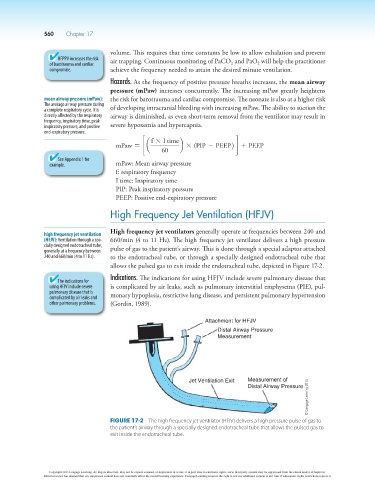
                                            allows the pulsed gas to exit inside the endotracheal tube, depicted in Figure 17-2.
                                            Indications. The indications for using HFJV include severe pulmonary disease that
                          The indications for
                        using HFJV include severe   is complicated by air leaks, such as pulmonary interstitial emphysema (PIE), pul-
                        pulmonary disease that is
                        complicated by air leaks and   monary hypoplasia, restrictive lung disease, and persistent pulmonary hypertension
                        other pulmonary problems.  (Gordin, 1989).


                                                                           Attachment for HFJV
                                                                               Distal Airway Pressure
                                                                               Measurement


                                                                     Jet Ventilation Exit  Measurement of
                                                                                                            © Cengage Learning 2014
                                                                                        Distal Airway Pressure


                                            Figure 17-2  The high frequency jet ventilator (HFJV) delivers a high pressure pulse of gas to
                                            the patient’s airway through a specially designed endotracheal tube that allows the pulsed gas to
                                            exit inside the endotracheal tube.


                        Copyright 2013 Cengage Learning. All Rights Reserved. May not be copied, scanned, or duplicated, in whole or in part. Due to electronic rights, some third party content may be suppressed from the eBook and/or eChapter(s).
                      Editorial review has deemed that any suppressed content does not materially affect the overall learning experience. Cengage Learning reserves the right to remove additional content at any time if subsequent rights restrictions require it.

