


Page 596 - Clinical Application of Mechanical Ventilation
P. 596
562    Chapter 17


                                                                                                  Gas Flow
                                                                                                  to Patient


                                                                        Inspiration


                                                                                                  Gas Flow
                                                                                                  from Patient
                                                                                                             © Cengage Learning 2014


                                                                        Expiration
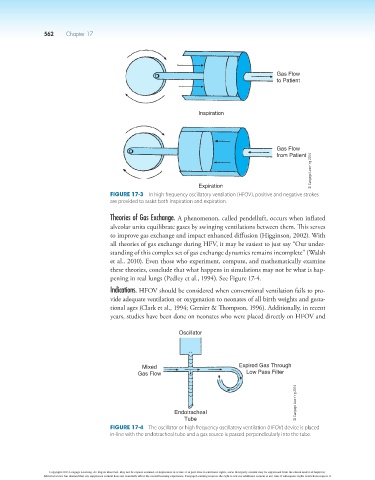
                                            Figure 17-3  In high frequency oscillatory ventilation (HFOV), positive and negative strokes
                                            are provided to assist both inspiration and expiration.


                                            Theories of Gas Exchange. A phenomenon, called pendelluft, occurs when inflated
                                            alveolar units equilibrate gases by swinging ventilations between them. This serves
                                            to improve gas exchange and impact enhanced diffusion (Higginson, 2002). With
                                            all theories of gas exchange during HFV, it may be easiest to just say “Our under-
                                            standing of this complex set of gas exchange dynamics remains incomplete” (Walsh
                                            et al., 2010). Even those who experiment, compute, and mathematically examine
                                            these theories, conclude that what happens in simulations may not be what is hap-
                                            pening in real lungs (Pedley et al., 1994). See Figure 17-4.
                                            Indications. HFOV should be considered when conventional ventilation fails to pro-
                                            vide adequate ventilation or oxygenation to neonates of all birth weights and gesta-
                                            tional ages (Clark et al., 1994; Grenier & Thompson, 1996). Additionally, in recent
                                            years, studies have been done on neonates who were placed directly on HFOV and

                                                                  Oscillator


                                                      Mixed                           Expired Gas Through
                                                     Gas Flow                           Low Pass Filter

                                                                                                        © Cengage Learning 2014


                                                                 Endotracheal
                                                                    Tube
                                            Figure 17-4  The oscillator or high frequency oscillatory ventilation (HFOV) device is placed
                                            in-line with the endotracheal tube and a gas source is passed perpendicularly into the tube.


                        Copyright 2013 Cengage Learning. All Rights Reserved. May not be copied, scanned, or duplicated, in whole or in part. Due to electronic rights, some third party content may be suppressed from the eBook and/or eChapter(s).
                      Editorial review has deemed that any suppressed content does not materially affect the overall learning experience. Cengage Learning reserves the right to remove additional content at any time if subsequent rights restrictions require it.

