


Page 598 - Clinical Application of Mechanical Ventilation
P. 598
564    Chapter 17


                                            hyperinflation of the alveoli, high levels of PEEP may compromise cardiac output
                          During HFJV and HFOV,   and lead to a higher risk of developing barotrauma (Milner & Hoskins, 1989).
                        cardiopulmonary assessment   There are several technical problems encountered in the use of HFOV. One prob-
                        of the patient is difficult.
                        Signs of pallor, cyanosis,   lem is in the measurement of pressure at the distal end of the endotracheal tube. It
                        bradycardia, hypotension, and
                        increased respiratory effort   is likely that alveolar pressures are quite different from those measured at the carina.
                        indicate a worsening of status.  An additional problem is a general lack of HFOV devices and training for their use
                                            in level I and level II nurseries.


                                            Initial HFOV Settings


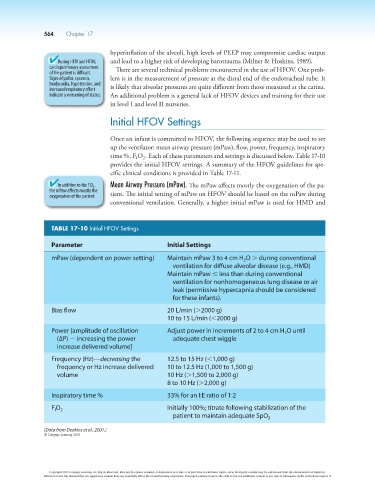
                                            Once an infant is committed to HFOV, the following sequence may be used to set
                                            up the ventilator: mean airway pressure (mPaw), flow, power, frequency, inspiratory
                                            time %, F O . Each of these parameters and settings is discussed below. Table 17-10
                                                    I
                                                      2
                                            provides the initial HFOV settings. A summary of the HFOV guidelines for spe-
                                            cific clinical conditions is provided in Table 17-11.
                          In addition to the F I O 2 ,   Mean Airway Pressure (mPaw). The mPaw affects mostly the oxygenation of the pa-
                        the mPaw affects mostly the
                        oxygenation of the patient.  tient. The initial setting of mPaw on HFOV should be based on the mPaw during
                                            conventional ventilation. Generally, a higher initial mPaw is used for HMD and


                        TABLE 17-10 Initial HFOV Settings

                        Parameter                             Initial Settings

                        mPaw (dependent on power setting)     Maintain mPaw 3 to 4 cm H O . during conventional
                                                                                       2
                                                                ventilation for diffuse alveolar disease (e.g., HMD)
                                                              Maintain mPaw # less than during conventional
                                                                ventilation for nonhomogeneous lung disease or air
                                                                leak (permissive hypercapnia should be considered
                                                                for these infants).

                        Bias flow                             20 L/min (.2000 g)
                                                              10 to 15 L/min (,2000 g)

                        Power [amplitude of oscillation       Adjust power in increments of 2 to 4 cm H O until
                                                                                                    2
                          (∆P) 2 increasing the power           adequate chest wiggle
                          increase delivered volume]
                        Frequency (Hz)—decreasing the         12.5 to 15 Hz (,1,000 g)
                          frequency or Hz increase delivered   10 to 12.5 Hz (1,000 to 1,500 g)
                          volume                              10 Hz (.1,500 to 2,000 g)
                                                              8 to 10 Hz (.2,000 g)

                        Inspiratory time %                    33% for an I:E ratio of 1:2
                        F O 2                                 Initially 100%; titrate following stabilization of the
                         I
                                                                patient to maintain adequate SpO 2

                      (Data	from	Deakins	et	al.,	2001.)
                      © Cengage Learning 2014


                        Copyright 2013 Cengage Learning. All Rights Reserved. May not be copied, scanned, or duplicated, in whole or in part. Due to electronic rights, some third party content may be suppressed from the eBook and/or eChapter(s).
                      Editorial review has deemed that any suppressed content does not materially affect the overall learning experience. Cengage Learning reserves the right to remove additional content at any time if subsequent rights restrictions require it.

