


Page 632 - Clinical Application of Mechanical Ventilation
P. 632
598    Chapter 18


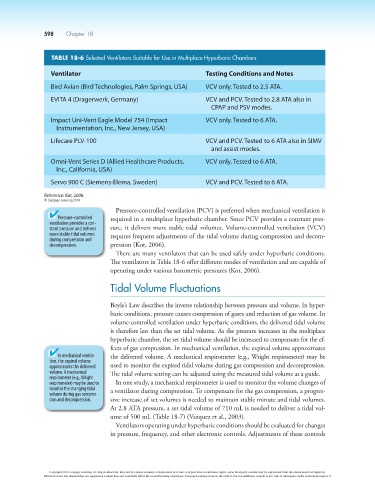
                        TABLE 18-6 Selected Ventilators Suitable for Use in Multiplace Hyperbaric Chambers

                        Ventilator                                         Testing Conditions and Notes

                        Bird Avian (Bird Technologies, Palm Springs, USA)  VCV only. Tested to 2.5 ATA.

                        EVITA 4 (Dragerwerk, Germany)                      VCV and PCV. Tested to 2.8 ATA also in
                                                                             CPAP and PSV modes.

                        Impact Uni-Vent Eagle Model 754 (Impact            VCV only. Tested to 6 ATA.
                          Instrumentation, Inc., New Jersey, USA)
                        Lifecare PLV-100                                   VCV and PCV. Tested to 6 ATA also in SIMV
                                                                             and assist modes.
                        Omni-Vent Series D (Allied Healthcare Products,    VCV only. Tested to 6 ATA.
                          Inc., California, USA)
                        Servo 900 C (Siemens-Elema, Sweden)                VCV and PCV. Tested to 6 ATA.

                      Reference: Kot, 2006.
                      © Cengage Learning 2014
                                             Pressure-controlled ventilation (PCV) is preferred when mechanical ventilation is
                          Pressure-controlled   required in a multiplace hyperbaric chamber. Since PCV provides a constant pres-
                        ventilation provides a con-
                        stant pressure and delivers   sure, it delivers more stable tidal volumes. Volume-controlled ventilation (VCV)
                        more stable tidal volumes   requires frequent adjustments of the tidal volume during compression and decom-
                        during compression and
                        decompression.      pression (Kot, 2006).
                                             There are many ventilators that can be used safely under hyperbaric conditions.
                                            The ventilators in Table 18-6 offer different modes of ventilation and are capable of
                                            operating under various barometric pressures (Kot, 2006).


                                            Tidal Volume Fluctuations


                                            Boyle’s Law describes the inverse relationship between pressure and volume. In hyper-
                                            baric conditions, pressure causes compression of gases and reduction of gas volume. In
                                            volume-controlled ventilation under hyperbaric conditions, the delivered tidal volume
                                            is therefore less than the set tidal volume. As the pressure increases in the multiplace
                                            hyperbaric chamber, the set tidal volume should be increased to compensate for the ef-
                                            fects of gas compression. In mechanical ventilation, the expired volume approximates
                          In mechanical ventila-  the delivered volume. A mechanical respirometer (e.g., Wright respirometer) may be
                        tion, the expired volume
                        approximates the delivered   used to monitor the expired tidal volume during gas compression and decompression.
                        volume. A mechanical   The tidal volume setting can be adjusted using the measured tidal volume as a guide.
                        respirometer (e.g., Wright
                        respirometer) may be used to   In one study, a mechanical respirometer is used to monitor the volume changes of
                        monitor the changing tidal   a ventilator during compression. To compensate for the gas compression, a progres-
                        volume during gas compres-
                        sion and decompression.   sive increase of set volumes is needed to maintain stable minute and tidal volumes.
                                            At 2.8 ATA pressure, a set tidal volume of 710 mL is needed to deliver a tidal vol-
                                            ume of 500 mL (Table 18-7) (Vazquez et al., 2003).
                                             Ventilators operating under hyperbaric conditions should be evaluated for changes
                                            in pressure, frequency, and other electronic controls. Adjustments of these controls


                        Copyright 2013 Cengage Learning. All Rights Reserved. May not be copied, scanned, or duplicated, in whole or in part. Due to electronic rights, some third party content may be suppressed from the eBook and/or eChapter(s).
                      Editorial review has deemed that any suppressed content does not materially affect the overall learning experience. Cengage Learning reserves the right to remove additional content at any time if subsequent rights restrictions require it.

