


Page 79 - Clinical Application of Mechanical Ventilation
P. 79
Effects of Positive Pressure Ventilation  45


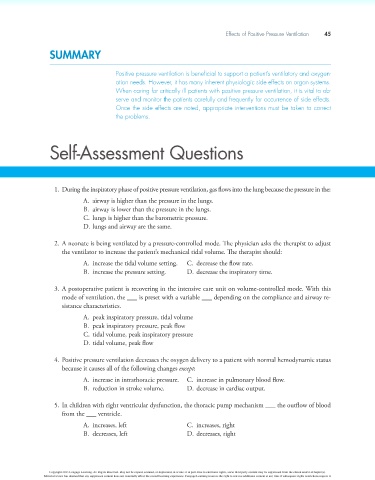
                        SUMMARY


                                             Positive pressure ventilation is beneficial to support a patient’s ventilatory and oxygen-
                                             ation needs. However, it has many inherent physiologic side effects on organ systems.
                                             When caring for critically ill patients with positive pressure ventilation, it is vital to ob-
                                             serve and monitor the patients carefully and frequently for occurrence of side effects.
                                             Once the side effects are noted, appropriate interventions must be taken to correct
                                             the problems.


                        Self-Assessment Questions


                          1.  During the inspiratory phase of positive pressure ventilation, gas flows into the lung because the pressure in the:
                                   A.  airway is higher than the pressure in the lungs.
                                   B.  airway is lower than the pressure in the lungs.
                                   C.  lungs is higher than the barometric pressure.
                                   D. lungs and airway are the same.

                          2. A neonate is being ventilated by a pressure-controlled mode. The physician asks the therapist to adjust
                            the ventilator to increase the patient’s mechanical tidal volume. The therapist should:
                                   A.  increase the tidal volume setting.   C.  decrease the flow rate.
                                   B.  increase the pressure setting.   D. decrease the inspiratory time.

                          3. A postoperative patient is recovering in the intensive care unit on volume-controlled mode. With this
                            mode of ventilation, the ___ is preset with a variable ___ depending on the compliance and airway re-
                            sistance characteristics.
                                   A.  peak inspiratory pressure, tidal volume
                                   B.  peak inspiratory pressure, peak flow
                                   C.  tidal volume, peak inspiratory pressure
                                   D. tidal volume, peak flow


                          4. Positive pressure ventilation decreases the oxygen delivery to a patient with normal hemodynamic status
                            because it causes all of the following changes except:

                                   A.  increase in intrathoracic pressure.  C.  increase in pulmonary blood flow.
                                   B.  reduction in stroke volume.   D. decrease in cardiac output.


                          5. In children with right ventricular dysfunction, the thoracic pump mechanism ___ the outflow of blood
                            from the ___ ventricle.
                                   A.  increases, left               C.  increases, right
                                   B.  decreases, left               D. decreases, right


                        Copyright 2013 Cengage Learning. All Rights Reserved. May not be copied, scanned, or duplicated, in whole or in part. Due to electronic rights, some third party content may be suppressed from the eBook and/or eChapter(s).
                      Editorial review has deemed that any suppressed content does not materially affect the overall learning experience. Cengage Learning reserves the right to remove additional content at any time if subsequent rights restrictions require it.

