


Page 77 - Clinical Application of Mechanical Ventilation
P. 77
Effects of Positive Pressure Ventilation  43


                                             proportion to the increase of CO  production. This is particularly important in
                                                                           2
                                             patients with impaired ventilatory reserves.


                        NEUROLOGIC CONSIDERATIONS


                                             Among many other monitoring systems that influence the respiratory drive, the
                                             central and peripheral chemoreceptors respond rapidly to the levels of CO , H ,
                                                                                                                  1
                                                                                                              2
                                             and O  in the blood. For this reason, the degree of ventilation (CO , H ) and oxy-
                                                                                                          1
                                                                                                      2
                                                   2
                                             genation (O ) can affect the normal functions of the brain.
                                                        2
                                             Hyperventilation
                                             Carbon dioxide acts as a vasodilator in cerebral blood vessels. During mechanical
                                             ventilation, intentional hyperventilation is sometimes used to constrict these blood
                                             vessels, and thus minimize intracranial pressure in patients with head trauma. Sus-
                            Sustained hyperventila-  tained hyperventilation of less than 24 hours causes respiratory alkalosis, reducing
                          tion of less than 24 hours
                          causes respiratory alkalosis   cerebral blood flow and intracranial pressure. After 24 hours, the buffer systems
                          and reduces cerebral blood   of the body return the pH toward normal, negating the vasoconstrictor effect of
                          flow and intracranial pressure.
                                             controlled hyperventilation.
                                               If  hyperventilation  is  prolonged,  cerebral  tissue  hypoxia  may  result  due  to
                                             the leftward shift of the oxyhemoglobin curve. A left shift causes higher oxygen
                                             affinity for hemoglobin but reduced oxygen release to tissues. Sustained hyper-
                                             ventilation  also  produces  significant  hypophosphatemia  because  of  movement
                                             of  phosphate  into  the  cells.  Hypophosphatemia  interferes  with  cerebral  tissue
                            2, 3-bisphosphoglycerate   metabolism by reducing ATP stores and 2,3-BPG levels, which further increases
                          (2, 3-BPG) is also known as   the  leftward  shift  of  the  oxyhemoglobin  curve  (Jozefowicz,  1989). Table  2-10
                          2,3-diphosphoglycerate
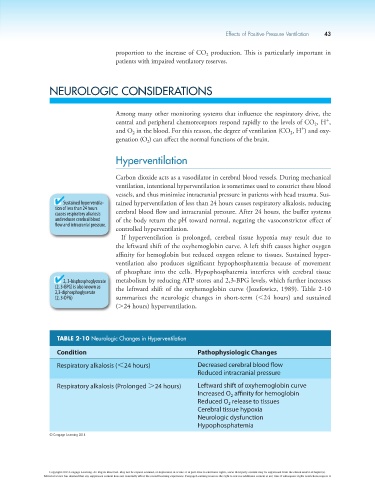
                          (2, 3-DPG)         summarizes  the  neurologic  changes  in  short-term  (,24  hours)  and  sustained
                                             (.24 hours) hyperventilation.


                          TABLE 2-10 Neurologic Changes in Hyperventilation

                          Condition                                     Pathophysiologic Changes

                          Respiratory alkalosis (,24 hours)             Decreased cerebral blood flow
                                                                        Reduced intracranial pressure

                          Respiratory alkalosis (Prolonged .24 hours)   Leftward shift of oxyhemoglobin curve
                                                                        Increased O  affinity for hemoglobin
                                                                                   2
                                                                        Reduced O  release to tissues
                                                                                  2
                                                                        Cerebral tissue hypoxia
                                                                        Neurologic dysfunction
                                                                        Hypophosphatemia
                        © Cengage Learning 2014


                        Copyright 2013 Cengage Learning. All Rights Reserved. May not be copied, scanned, or duplicated, in whole or in part. Due to electronic rights, some third party content may be suppressed from the eBook and/or eChapter(s).
                      Editorial review has deemed that any suppressed content does not materially affect the overall learning experience. Cengage Learning reserves the right to remove additional content at any time if subsequent rights restrictions require it.

