


Page 78 - Clinical Application of Mechanical Ventilation
P. 78
44     Chapter 2


                                            Ventilatory and Oxygenation Failure


                                            Ventilatory and oxygenation failure has serious and detrimental effects on the
                                            central nervous system (CNS). Such failure may occur in patients on mechani-
                                            cal ventilation because of preexisting clinical conditions, making ventilation
                                            and oxygenation extremely difficult to accomplish in spite of high F O  and
                                                                                                             2
                                                                                                           I
                                            PEEP.
                                             Abnormalities in ventilation and gas exchange can cause hypercapnia (increase in
                                            PaCO ), respiratory acidosis (decrease in pH as a result of the increased PaCO ),
                                                 2
                                                                                                                2
                                            hypoxemia (decrease in PaO ), secondary polycythemia (increase in red blood cell
                                                                    2
                                            concentration  and  thus  hemoglobin  level),  and  electrolyte  disturbances.  These
                                            changes may lead to neurologic impairment.


                                            Indicators of Neurologic Impairment


                                            When neurologic functions are impaired due to ventilatory and oxygenation fail-
                          Headache, mental status
                        changes, motor disturbances,   ure, the patient may experience headache, mental status changes, motor distur-
                        and ocular abnormalities   bances, and ocular abnormalities (Jozefowicz, 1989).
                        may be signs of neurologic
                        impairment.          The patient usually describes the headache as “pressure in the head,” having a
                                            higher intensity during night and early morning hours. The headache is the result
                                            of cerebral vasodilation in response to hypoventilation and CO  retention during
                                                                                                  2
                                            sleep.
                                             Hypoxia, hypercapnia, and acidosis are responsible for the changes in a patient’s
                                            mental  status.  Early  mental  disturbances  include  drowsiness,  forgetfulness,  and
                                            irritability. In severe or chronic cases of hypoxia and hypercapnia, stupor and coma
                                            may occur.
                                             Hypercapnia  may  also  cause  muscle  tremor  and  ocular  abnormalities.  Muscle
                                            tremor  is  the  result  of  excessive  stimulation  of  the  sympathetic  nervous  system
                                            and catecholamine release from the adrenal medulla. Ocular abnormalities such as
                                            papilledema, swelling of the area where the optic nerve exits the back of the eye,
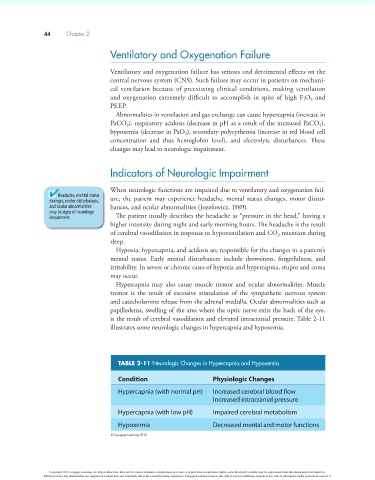
                                            is the result of cerebral vasodilation and elevated intracranial pressure. Table 2-11
                                            illustrates some neurologic changes in hypercapnia and hypoxemia.


                                              TABLE 2-11 Neurologic Changes in Hypercapnia and Hypoxemia


                                              Condition                      Physiologic Changes
                                              Hypercapnia (with normal pH)   Increased cerebral blood flow
                                                                             Increased intracranial pressure
                                              Hypercapnia (with low pH)      Impaired cerebral metabolism

                                              Hypoxemia                      Decreased mental and motor functions
                                            © Cengage Learning 2014


                        Copyright 2013 Cengage Learning. All Rights Reserved. May not be copied, scanned, or duplicated, in whole or in part. Due to electronic rights, some third party content may be suppressed from the eBook and/or eChapter(s).
                      Editorial review has deemed that any suppressed content does not materially affect the overall learning experience. Cengage Learning reserves the right to remove additional content at any time if subsequent rights restrictions require it.

