


Page 74 - Clinical Application of Mechanical Ventilation
P. 74
40     Chapter 2


                      GASTROINTESTINAL CONSIDERATIONS


                                            Positive pressure ventilation is associated with many organ-system complications,
                      gastrointestinal (GI): Organ
                      system including the stomach and   one of which involves the gastrointestinal (GI) tract. GI complications in patients
                      intestines.           who are being mechanically ventilated include erosive esophagitis, stress-related
                                            mucosal damage (SRMD), diarrhea, decreased bowel sounds, high gastric residu-
                                            als, and constipation (Mutlu et al., 2000). These conditions are likely caused by
                          GI complications may   a decrease of perfusion to the GI tract and medications commonly used during
                        be caused by a decrease of
                        perfusion to the GI tract and   mechanical ventilation. Morphine sulfate is a medication commonly used for pain
                        medications that are com-  control. Some of the GI side effects of morphine include constipation and vomiting.
                        monly used in mechanically
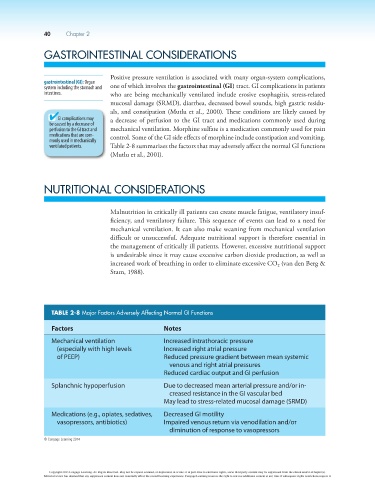
                        ventilated patients.  Table 2-8 summarizes the factors that may adversely affect the normal GI functions
                                            (Mutlu et al., 2001).


                      NUTRITIONAL CONSIDERATIONS


                                            Malnutrition in critically ill patients can create muscle fatigue, ventilatory insuf-
                                            ficiency, and ventilatory failure. This sequence of events can lead to a need for
                                            mechanical ventilation. It can also make weaning from mechanical ventilation
                                            difficult or unsuccessful. Adequate nutritional support is therefore essential in
                                            the management of critically ill patients. However, excessive nutritional support
                                            is undesirable since it may cause excessive carbon dioxide production, as well as
                                            increased work of breathing in order to eliminate excessive CO  (van den Berg &
                                                                                                  2
                                            Stam, 1988).


                        TABLE 2-8 Major Factors Adversely Affecting Normal GI Functions

                        Factors                              Notes

                        Mechanical ventilation               Increased intrathoracic pressure
                          (especially with high levels       Increased right atrial pressure
                          of PEEP)                           Reduced pressure gradient between mean systemic
                                                               venous and right atrial pressures
                                                             Reduced cardiac output and GI perfusion

                        Splanchnic hypoperfusion             Due to decreased mean arterial pressure and/or in-
                                                               creased resistance in the GI vascular bed
                                                             May lead to stress-related mucosal damage (SRMD)

                        Medications (e.g., opiates, sedatives,   Decreased GI motility
                          vasopressors, antibiotics)         Impaired venous return via venodilation and/or
                                                               diminution of response to vasopressors
                      © Cengage Learning 2014


                        Copyright 2013 Cengage Learning. All Rights Reserved. May not be copied, scanned, or duplicated, in whole or in part. Due to electronic rights, some third party content may be suppressed from the eBook and/or eChapter(s).
                      Editorial review has deemed that any suppressed content does not materially affect the overall learning experience. Cengage Learning reserves the right to remove additional content at any time if subsequent rights restrictions require it.

