


Page 122 - Cardiac Nursing
P. 122
0:4
                              0/0
                              0/0
                                     1
                                     1
                                      0:4
                                6/2
                          q
                           xd
                          q
                           xd
                              3
                             3
                                  009
                      7-1
                                               e 9
                                                8 A
                        10.
                        10.
                      7-1
                                        0 A
                                            Pa
                                            Pa
                                              g
                                          M
                                          M
                                          M
                                                   ta
                                                   ta
                                                     ra
                                                   p
                                                   p
                                                   p
                                                     ra
         LWBK340-c04_
         LWB
         LWB K34 0-c 04_ p p pp097-110.qxd  30/06/2009  10:40 AM  Page 98 Aptara
                 04_
               0-c
            K34
                                              g
                                               e 9
                                        0 A
                    09
                    09
                                              g
                                6/2
                          q
                                                8 A
                             3
                                  009
                  98    PA R T  I I / Physiologic and Pathologic Responses
                   DISPLAY 4-1 Definitions
                    Amino acids. The building block for proteins. Humans  before it is threaded into ribosomes for translation into
                     require 20 amino acids as building blocks.         protein.
                    Chromosome. An arrangement of tightly packed and coiled  Mutation. An alteration in a gene or segment of DNA; muta-
                     DNA and protein. Diploid cells such as the human body  tions are largely accidental and unproductive. On rare oc-
                     cells have 23 sets of chromosomes; haploid cells such as  casions, mutations can be dangerous and/or even benefi-
                     gametes—-sperm or ova—-have only a single set of chro-  cial. Thus, mutations can lead to variation in the
                     mosomes.                                           phenotype of an organism.
                    DNA. Deoxyribonucleic acid, the double helix, which codes  Phenotype. The physical structure and/or composition of an
                     for the proteins and other elements necessary to   organism, or group of organisms. Genotypes expressed in
                     construct an organism.                             and operating in the context of a given environment(s)
                    Exon. Regions of DNA that are expressed, coding for RNA  determine phenotype.
                     and/or protein.                                  Protein. Genes often encode for proteins, which help form
                    Gamete. A sex cell, such as egg or sperm, capable of joining  and regulate all organisms. Proteins are molecular
                     with an opposite gamete (egg plus sperm) to make a  machines composed of strings of 20 different types of
                     zygote.                                            amino acids. Proteins can in turn form complexes,
                    Gene. A gene is a segment of DNA or RNA that performs a  which interact to perform more complex actions and
                     specific function; usually, it is a segment of DNA that  functions.
                     codes for some molecular product, often a protein. Aside  Ribosomes. Ribosomes are complexes of RNA and protein,
                     from the nucleotides that code for the protein, a gene  which use the information encoded in mRNA to assemble
                     also consists of segments that determine the type, quan-  specific proteins out of amino acids via a process termed
                     tity, and timing of protein expression. Genes can produce  translation.
                     different combinations of proteins under different stimuli.  RNA. Ribonucleic acid; an intermediate, complementary
                    Genome. The sum total of genetic material in an individual  copy of DNA. mRNA is used by ribosomes as templates
                     organism.                                          for the construction of proteins.
                    Genotype. A relative term that can refer to a particular nu-  Sex chromosomes. In humans, the X and Y chromosomes.
                     cleotide position, or even an entire segment of DNA. A  Two X chromosomes result in a female gender, while an X
                     genotype has two components, one from the same posi-  chromosome and a Y chromosome result in a male gen-
                     tion on each chromosome.                           der. Other species have different types of sex
                    Intron. In most eukaryotic cells, introns are segments of  chromosomes.
                     DNA that are a component of gene structure but do not  Synteny. Segments of chromosomes, which contain the
                     generally code for proteins. Introns are processed out of  same sequence of genes, which are shared between differ-
                     transcribed messenger RNA (mRNA), or spliced out,  ent organisms.
                  each of us unique. DNA is an exquisitely small yet extremely long  around proteins called histones. DNA in the human genome is
                  molecule that lacks the tensile strength to remain unprotected dur-  arranged into 24 distinct chromosomes (i.e., 22 autosomes and two
                  ing cell division. Accordingly, DNA molecules are packaged into  sex chromosomes), physically separate molecules that range in length
                  tightly coiled units called chromosomes, found in the nucleus of every  from about 50 million to 250 million base pairs. The two sex chro-
                  cell. Chromosomes consist of the double helix of DNA wrapped  mosomes determine gender; two copies of the “X” chromosome re-
                                                                      sult in female gender, while one copy each of the “X” and “Y” chro-
                                                                      mosomes determines male gender (Fig. 4-3). There are 23 pairs of
                                                                      chromosomes in the normal diploid genome in humans (i.e., 22
                                                                                Sugar
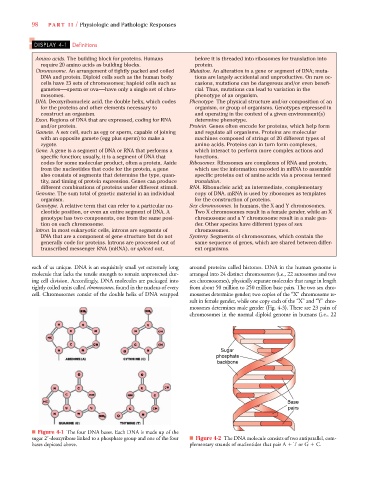
                  ■ Figure 4-1 The four DNA bases. Each DNA is made up of the
                  sugar 2 -deoxyribose linked to a phosphate group and one of the four  ■ Figure 4-2 The DNA molecule consists of two antiparallel, com-
                  bases depicted above.                               plementary strands of nucleotides that pair A
 T or G
 C.

