


Page 136 - Cardiac Nursing
P. 136
9/0
                               0
                                    009
                                  9/2
                       1-1
                    p11
                           qxd
                         31.
                                        8:2
                                                    12
                                                  e 1
                                                         ara
                                                       Apt
                                             M
                                           4 A
                                                 g
                                               P
         LWB
         LWB K34 0-c 05_ p11 1-1 31. qxd  0 9/0 9/2 009  0 0 8:2 4 A M  P a a g e 1 12  Apt ara
         LWBK340-c05_p111-131.qxd  09/09/2009  08:24 AM  Page 112 Aptara
               0-c
            K34
                 05_
                  112    PA R T  I I / Physiologic and Pathologic Responses
                                                                      vascular endothelium located between the vascular lumen and
                                EXERCISE        ANGINA
                                                                      smooth muscle cells also releases vasoactive substances that ulti-
                     ACUTE                                            mately regulate vascular tone. These substances are known as
                    EXERCISE O DEMAND             O 2  SUPPLY         prostacyclin, nitric oxide, endothelial-derived relaxing factor, and
                              2
                             Heart rate           coronary vasoconstriction  hyperpolarizing factor are potent vasodilators. 6,13,20–23  In addition,

                                                                      endothelin-1, a potent vasoconstrictor, causes a reduction of Na -/

                             Afterload            blood flow redistribution  K -ATPase activity. ATPases are impaired by anoxia and produce
                                                                      superoxides and free radicals. Thus, decreased oxygen leads to a pro-
                                                 n
                                                o o o o o ro ro ro ro ro ro ro ro ro ro r
                                              cor nary
                                                n
                                                 o
                                                n
                                                n
                                                n
                                                n
                             Pre-load         stenosis                duction of superoxides and hydrogen peroxide, which are highly
                                                n
                                                n
                                                 o
                                                 o
                                                 o
                                                 o
                                                 o
                                                  s
                                                 o
                                                 o
                                                 o
                                                 o
                                                 o
                                                 o
                                                 o
                                                 o
                                                 o
                                                 o
                                                                      diffusible and induce cell damage. Early or chronic atherosclerosis
                             Contractility  ischemic                  and factors such as dyslipidemia, hypertension, diabetes mellitus,
                                            zone
                                                                      cigarette smoking, menopause, hyperhomocystinemia, and muta-
                                                                      tions in nitric oxide synthetase, may inhibit mediator effects and
                                  DEMAND         SUPPLY
                                                                      impair arterial endothelial function, causing increased permeability
                                                                      of blood lipids and monocytes. 6,17,21,22,24  Further discussion of ath-
                                     O deficit  angina                erosclerosis is mentioned below.
                                      2
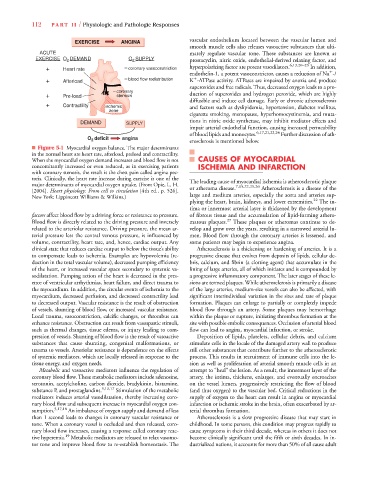
                  ■ Figure 5-1 Myocardial oxygen balance. The major determinants
                  in the normal heart are heart rate, afterload, preload and contractility.
                  When the myocardial oxygen demand increases and blood flow is not  CAUSES OF MYOCARDIAL
                  concomitantly increased or even reduced, as in exercising patients  ISCHEMIA AND INFARCTION
                  with coronary stenosis, the result is the chest pain called angina pec-
                  toris. Clinically, the heart rate increase during exercise is one of the  The leading cause of myocardial ischemia is atherosclerotic plaque
                  major determinants of myocardial oxygen uptake. (From Opie, L. H.  7,15,22,25,26
                  [2004]. Heart physiology: From cell to circulation [4th ed., p. 526].  or atheroma disease.  Atherosclerosis is a disease of the
                  New York: Lippincott Williams & Wilkins.)           large and medium arteries, especially the aorta and arteries sup-
                                                                                                              22
                                                                      plying the heart, brain, kidneys, and lower extremities. The in-
                                                                      tima or innermost arterial layer is thickened by the development
                  factors affect blood flow by a driving force or resistance to pressure.  of fibrous tissue and the accumulation of lipid-forming athero-
                  Blood flow is directly related to the driving pressure and inversely  matous plaques. 27  These plaques or atheromas continue to de-
                  related to the arteriolar resistance. Driving pressure, the mean ar-  velop and grow over the years, resulting in a narrowed arterial lu-
                  terial pressure less the central venous pressure, is influenced by  men. Blood flow through the coronary arteries is lessened, and
                  volume, contractility, heart rate, and, hence, cardiac output. Any  some patients may begin to experience angina.
                  clinical state that reduces cardiac output to below the tissue’s ability  Atherosclerosis is a thickening or hardening of arteries. It is a
                  to compensate leads to ischemia. Examples are hypovolemia (re-  progressive disease that evolves from deposits of lipids, cellular de-
                  duction in the total vascular volume), decreased pumping efficiency  bris, calcium, and fibrin (a clotting agent) that accumulate in the
                  of the heart, or increased vascular space secondary to systemic va-  lining of large arteries, all of which initiates and is compounded by
                  sodilatation. Pumping action of the heart is decreased in the pres-  a progressive inflammatory component. The later stages of these le-
                  ence of ventricular arrhythmias, heart failure, and direct trauma to  sions are termed plaques. While atherosclerosis is primarily a disease
                  the myocardium. In addition, the circular events of ischemia to the  of the large arteries, medium-size vessels can also be affected, with
                  myocardium, decreased perfusion, and decreased contractility lead  significant interindividual variation in the sites and rate of plaque
                  to decreased output. Vascular resistance is the result of obstruction  formation. Plaques can enlarge to partially or completely impede
                  of vessels, shunting of blood flow, or increased vascular resistance.  blood flow through an artery. Some plaques may hemorrhage
                  Local trauma, vasoconstriction, calcific changes, or thrombus can  within the plaque or rupture, initiating thrombus formation at the
                  enhance resistance. Obstruction can result from vasospastic stimuli,  site with possible embolic consequences. Occlusion of arterial blood
                  such as thermal changes, tissue edema, or injury leading to com-  flow can lead to angina, myocardial infarction, or stroke.
                  pression of vessels. Shunting of blood flow is the result of vasoactive  Deposition of lipids, platelets, cellular debris, and calcium
                  substances that cause shunting, congenital malformations, or  stimulate cells in the locale of the damaged artery wall to produce
                  trauma to vessels. Arteriolar resistance is dependence on the effects  still other substances that contribute further to the atherosclerotic
                  of systemic mediators, which are locally released in response to the  process. This results in recruitment of immune cells into the le-
                  tissue energy, and oxygen needs.                    sion as well as proliferation of arterial smooth muscle cells in an
                     Metabolic and vasoactive mediators influence the regulation of  attempt to “heal” the lesion. As a result, the innermost layer of the
                  coronary blood flow. These metabolic mediators include adenosine,  artery, the intima, thickens, enlarges, and eventually encroaches
                  serotonin, acetylcholine, carbon dioxide, bradykinin, histamine,  on the vessel lumen, progressively restricting the flow of blood
                  substance P, and prostaglandins. 5,13,17  Stimulation of the metabolic  (and thus oxygen) to the vascular bed. Critical reductions in the
                  mediators induces arterial vasodilatation, thereby increasing coro-  supply of oxygen to the heart can result in angina or myocardial
                  nary blood flow and subsequent increase in myocardial oxygen con-  infarction or ischemic stroke in the brain, often exacerbated by ar-
                  sumption. 5,17,18 An imbalance of oxygen supply and demand of less  terial thrombus formation.
                  than 1 second leads to changes in coronary vascular resistance or  Atherosclerosis is a slow progressive disease that may start in
                  tone. When a coronary vessel is occluded and then released, coro-  childhood. In some persons, this condition may progress rapidly to
                  nary blood flow increases, causing a response called coronary reac-  cause symptoms in their third decade, whereas in others it does not
                             19
                  tive hyperemia. Metabolic mediators are released to relax vasomo-  become clinically significant until the fifth or sixth decades. In in-
                  tor tone and improve blood flow to re-establish homeostasis. The  dustrialized nations, it accounts for more than 50% of all cause adult

