


Page 140 - Cardiac Nursing
P. 140
LWBK340-c05_p111-131.qxd  09/09/2009  08:24 AM  Page 116 Aptara


                  116    PA R T  II / Physiologic and Pathologic Responses

                                                                      changes affect the vulnerability of the plaque and propensity for
                  Table 5-1 ■ TECHNOLOGIES PERMITTING EARLIER         thrombosis. 10  Superimposed thrombosis on the ruptured, ulcer-
                  DETECTION AND ESTIMATION OF LESION VOLUME           ated plaque can impede blood flow and the delivery of nutrients
                  ARE LISTED                                          to the myocardium.
                                                                        As lesions progress, disruptions of the lesion surface may pres-
                  Method             Features Detected
                                                                      ent as fissures or even ulcerations and are highly variable in their
                  B-mode ultrasonography   Permits measurement of the severity of stenosis  severity and scope. Fissures of the lesion surface vary in length and
                    and Doppler flow   in peripheral arteries          depth and most likely reseal, leading to lesion progression by in-
                  Intravascular ultrasound  Produces cross-sectional images of the vascular   corporating hematoma and thrombus. 42,43  Ulcerations can range
                                      wall, revealing lesion composition and
                                      lumen contour                   from minor focal loss of a microscopic portion of the endothelial
                  Magnetic resonance   A noninvasive alternative to angiography,  cell layer to deep ulcerations that can expose lipid cores and release
                    angiography       permitting study of major vessels (the aorta  lipid and other components that activate the coagulation cascade.
                                      and carotid arteries and coronary arteries)  Atheromatous lesions (types IV and Va) are particularly prone to
                  Angioscopy         Direct vascular vascularization detects specific  intimal disruptions and ultimately thrombosis. 42–45  This suscep-
                                      morphological features such as thrombus
                  Ultrafast computed   A noninvasive method detecting coronary   tibility is caused in part by the presence of activated inflammatory
                    tomography        artery calcium                  cells within the lesions, 46,47  the release of proteolytic enzymes by
                                                                      macrophages within the lesions, 42,48,49  coronary spasm, 50  struc-
                                                                                                       45
                  While angiography is the definitive method for evaluation of the vascular lumen, it can-  tural weakness related to lesion composition, the release of toxic
                    not detail the vascular wall. The sensitivity of coronary angiography for early detec-  factors from cell death (necrosis), and shear stress. 39,51  In addition
                    tion of atherosclerosis may be increased by these methods. Emerging methodologies
                    that may allow noninvasive monitoring of atherosclerosis include magnetic resonance  to intimal hematoma caused by tearing of the lesion surface, some
                    spectroscopy, labeled antiplatelet monoclonal antibody imaging and radiolabeling of  hemorrhage may  begin internally  from  disruption of newly
                    low-density lipoproteins and monocytes.           formed vessels within the lesion. 52

                                                                      Thrombosis
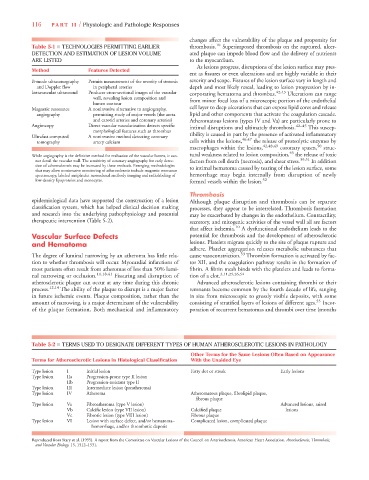
                  epidemiological data have supported the construction of a lesion  Although plaque disruption and thrombosis can be separate
                  classification system, which has helped clinical decision making  processes, they appear to be interrelated. Thrombosis formation
                  and research into the underlying pathophysiology and potential  may be exacerbated by changes in the endothelium. Contractility,
                  therapeutic intervention (Table 5-2).               secretory, and mitogenic activities of the vessel wall all are factors
                                                                      that affect ischemia. 10  A dysfunctional endothelium leads to the
                  Vascular Surface Defects                            potential for thrombosis and the development of atherosclerotic
                  and Hematoma                                        lesions. Platelets migrate quickly to the site of plaque rupture and
                                                                      adhere. Platelet aggregation releases metabolic substances that
                                                                                       53
                  The degree of luminal narrowing by an atheroma has little rela-  cause vasoconstriction. Thrombin formation is activated by fac-
                  tion to whether thrombosis will occur. Myocardial infarctions of  tor XII, and the coagulation pathway results in the formation of
                  most patients often result from atheromas of less than 50% lumi-  fibrin. A fibrin mesh binds with the platelets and leads to forma-
                  nal narrowing or occlusion. 11,18,41  Fissuring and disruption of  tion of a clot. 3,11,25,26,54
                  atherosclerotic plaque can occur at any time during this chronic  Advanced atherosclerotic lesions containing thrombi or their
                  process. 12,14  The ability of the plaque to disrupt is a major factor  remnants become common by the fourth decade of life, ranging
                  in future ischemic events. Plaque composition, rather than the  in size from microscopic to grossly visible deposits, with some
                  amount of narrowing, is a major determinant of the vulnerability  consisting of stratified layers of lesions of different ages. 55  Incor-
                  of the plaque formation. Both mechanical and inflammatory  poration of recurrent hematomas and thrombi over time (months


                  Table 5-2 ■ TERMS USED TO DESIGNATE DIFFERENT TYPES OF HUMAN ATHEROSCLEROTIC LESIONS IN PATHOLOGY
                                                                      Other Terms for the Same Lesions Often Based on Appearance
                  Terms for Atherosclerotic Lesions in Histological Classification  With the Unaided Eye

                  Type lesion  I    Initial lesion                    Fatty dot or streak           Early lesions
                  Type lesion  IIa  Progression-prone type II lesion
                              IIb   Progression-resistant type II
                  Type lesion  III  Intermediate lesion (preatheroma)
                  Type lesion  IV   Atheroma                          Atheromatous plaque, fibrolipid plaque,
                                                                        fibrous plaque
                  Type lesion  Va   Fibroatheroma (type V lesion)                                   Advanced lesions, raised
                              Vb    Calcific lesion (type VII lesion)  Calcified plaque                lesions
                              Vc    Fibrotic lesion (type VIII lesion)  Fibrous plaque
                  Type lesion  VI   Lesion with surface defect, and/or hematoma–  Complicated lesion, complicated plaque
                                      hemorrhage, and/or thrombotic deposit

                  Reproduced from Stary et al. (1995). A report from the Committee on Vascular Lesions of the Council on Arteriosclerosis, American Heart Association. Arteriosclerosis, Thrombosis,
                    and Vascular Biology, 15, 1512–1531.

