


Page 137 - Cardiac Nursing
P. 137
9/0
                               0
                                    009
                                  9/2
                       1-1
                    p11
                           qxd
                         31.
                                        8:2
                                                    13
                                                  e 1
                                                         ara
                                                       Apt
                                             M
                                           4 A
                                                 g
                                               P
            K34
         LWB
                 05_
               0-c
         LWBK340-c05_p111-131.qxd  09/09/2009  08:24 AM  Page 113 Aptara
         L L LWB K34 0-c 05_ p11 1-1 31. qxd  0 9/0 9/2 009  0 0 8:2 4 A M  P a a g e 1 13  Apt ara
                                               C HAPTER  5 / Atherosclerosis, Inflammation, and Acute Coronary Syndrome  113
                   mortality. However, the underlying complexity of the disease has  and histochemically (by staining for lipid deposits) in the intima.
                                                                                                                   34
                   made precise delineation of the cellular and molecular mechanisms  Type I lesions are most often observed in infants and children, al-
                   involved difficult. Over the past decade, new investigative tools have  though they are readily identifiable in adults with little atheroscle-
                   contributed to a clearer picture of the molecular mechanisms under-  rosis or in areas of the vasculature not prone to arteriosclerosis.
                   lying the development of atherosclerotic plaque. It is clear that ath-  These lesions occur in regions of the intima that display adaptive in-
                   erosclerosis is not simply an inevitable consequence of ageing.  timal thickening caused by the hemodynamic force of blood flow.
                                                                       These regions eventually evolve into types II and III lesions. Al-
                   American Heart Association Lesion                   though more common in early adulthood, the occurrence of type
                                                                                                                34,35
                   Classification System                                III lesions has been reported as early as the first year of life.  The
                                                                       accumulation of intimal foam cells is a consequence and a marker
                   More than a decade ago, the American Heart Association (AHA)  of pathological accumulation of atherogenic lipoproteins.
                   endeavored to provide an organized system for the categorization
                   of lesions based on histological and morphological data. 28  This  Type II Lesions
                   system has helped standardize research in atherosclerosis, though  Type II lesions, also known as fatty streaks that are visible on gross
                   modifications have been proposed. 29                 inspection, are yellow spots or streaks on arterial intima. The trans-
                     Coronary artery lesions can be grouped into seven major types  migration of macrophages into the subendothelial space and their
                   (I to VII). 28,30–33  Consistent morphologic data would seem to in-  subsequent transformation into foam cells produces an adaptive in-
                   dicate that each lesion type is relatively stable and will not progress  timal thickening, which may obscure the fatty streak, potentially
                   to the next lesion type without additional factors or pressures.  leading to an underestimate of the extent of these lesions. Recruit-
                   While the advanced lesions (types IV to VII) can manifest clini-  ment of macrophages to the intima marks one of the defining
                   cally, the early lesions (types I to III) are clinically silent and can  events in the initiation of the atherosclerotic lesion. Specific adhe-
                   be organized temporally. Types I and II are generally found in  sion molecules expressed on the surface of vascular endothelial cells
                   children, whereas type III tends to occur later and bridges early  mediate leucocyte adhesion. In addition, modified lipoproteins
                   and advanced lesions. Perhaps the most important observation is  contain oxidized phospholipids that induce the expression of adhe-
                   that the clinically silent lesions (types I to III) have been shown  sion molecules and cytokines implicated in early atherogenesis. 22
                   capable of regression in animal models. Advanced lesions are gen-  Progression of atheroma involves accumulation of smooth mus-
                   erally disorganized and lead to thickening and eventual compro-  cle cells that elaborate extracellular matrix macromolecules. Micro-
                   mise of the vessel wall. Lipid-laden macrophages (termed “foam  scopic examination of type II lesions reveals that the foam cells are
                   cells”) are the predominant cellular components of type I lesions.  more organized, stratifying into layers, and that smooth muscle cells
                   In types II and III lesions, intimal smooth muscle cells dominate,  also begin to show signs of intracellular lipid accumulation. The
                   with minimal involvement of lymphocytes, plasma cells, and mast  properties of these lesions results in continued recruitment of
                   cells in the pathological processes. This group of inflammatory  macrophage and evidence suggests that T-lymphocytes and mast
                   cells becomes quite active in advanced (types IV and V) lesions.  cells (components of the immune system) begin to invade the le-
                   Figures 5-2 and 5-3 summarize the essential characteristics and  sion. 30,36,37  At this stage, the preponderance of the lipid in type II
                   temporal occurrence of atherosclerotic lesions.     lesions resides in cells, with the majority found in foam cells. A lim-
                                                                       ited amount of extracellular lipid (droplets) can also be detected.
                   Type I Lesions                                        Consistent colocalization of type II lesions to specific portions
                   Type I lesions, often termed the “initial lesion,” are the earliest de-  of the arterial tree is characteristic. 38  Additionally, subgroups of
                   tectable lesion type. The lesion can only be observed microscopically  type II lesions can be described dependent on their location and
                                                                       the lipoprotein profile of the individual. Type IIa lesions represent
                                                                       the subset of lesions that may potentially progress to type III le-
                                                                       sions over time or with increases in atherogenic (triglyceride- and
                                                         Complicated
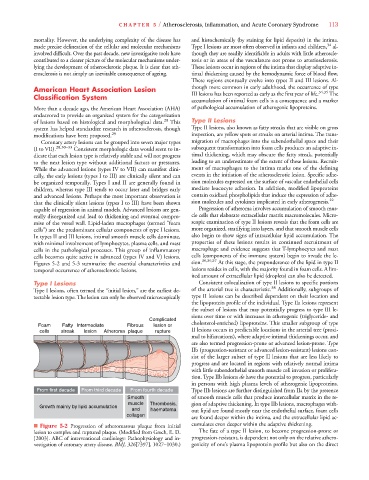
                    Foam    Fatty Intermediate    Fibrous  lesion or   cholesterol-enriched) lipoproteins. This smaller subgroup of type
                     cells  streak  lesion  Atheroma  plaque  rupture  II lesions occurs in predictable locations in the arterial tree (proxi-
                                                                       mal to bifurcations), where adaptive intimal thickenings occur, and
                                                                       are also termed progression-prone or advanced lesion-prone. Type
                                                                       IIb (progression-resistant or advanced lesion-resistant) lesions con-
                                                                       sist of the larger subset of type II lesions that are less likely to
                                                                       progress and are located in regions with relatively normal intima
                                                                       with little subendothelial smooth muscle cell invasion or prolifera-
                                                                       tion. Type IIb lesions do have the potential to progress, particularly
                                                                       in persons with high plasma levels of atherogenic lipoproteins.
                    From first decade  From third decade  From fourth decade  Type IIb lesions are further distinguished from IIa by the presence
                                                  Smooth               of smooth muscle cells that produce intercellular matrix in the re-
                                                  muscle  Thrombosis,  gion of adaptive thickening. In type IIb lesions, macrophages with-
                     Growth mainly by lipid accumulation
                                                   and   haematoma     out lipid are found mostly near the endothelial surface, foam cells
                                                 collagen
                                                                       are found deeper within the intima, and the extracellular lipid ac-
                   ■ Figure 5-2 Progression of atheromatous plaque from initial   cumulates even deeper within the adaptive thickening.
                   lesion to complex and ruptured plaque. (Modified from Grech, E. D.  The fate of a type II lesion, to become progression-prone or
                   [2003]. ABC of interventional cardiology: Pathophysiology and in-  progression-resistant, is dependent not only on the relative athero-
                   vestigation of coronary artery disease. BMJ, 326[7397], 1027–1030.)6  genicity of one’s plasma lipoprotein profile but also on the direct
                                                   6

