


Page 157 - Cardiac Nursing
P. 157
33
                                                    33
                                                  e 1
                                               P
                                                 g
                                        8:2
                                    009
                                               P
                                           5 A
                                             M
                                                       Apt
                           qxd
                               0
                                  9/2
                                9/0
                    p13
                                                         ara
                       2-1
                         52.
                         52.
            K34
               0-c
                 06_
            K34
         L L LWB K34 0-c 06_ p13 2-1 52. qxd  0 9/0 9/2 009  0 0 8:2 5 A M  P a a g e 1 33  Apt ara
         LWB
         LWBK340-c06_06_p132-152.qxd  09/09/2009  08:25 AM  Page 133 Aptara
                                                               C HAPTER  6 / Hematopoiesis, Coagulation, and Bleeding  133
                                                                                                               Neutr rophils
                                                                                             CFU–GM
                                                      T cell
                                                                                                               Mono ocytes
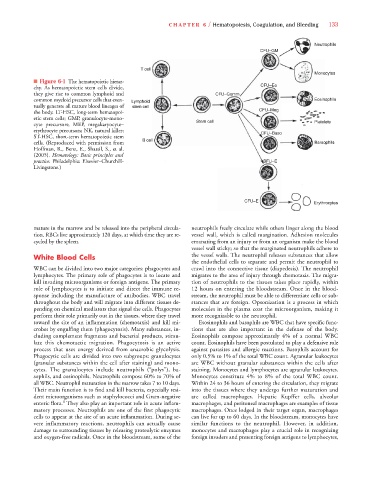
                   ■ Figure 6-1 The hematopoietic hierar-
                                                                                             CFU–Eo
                   chy. As hematopoietic stem cells divide,
                   they give rise to common lymphoid and                      CFU–Gemm
                   common myeloid precursor cells that even-  Lymphoid                                         Eosin ophils
                   tually generate all mature blood lineages of  stem cell
                   the body. LT-HSC, long-term hematopoi-                                    CFU–Meg
                   etic stem cells; GMP, granulocyte-mono-              Stem cell                              Platel ets
                                   P
                                   P
                   cyte precursors; MEP, megakaryocyte–
                   erythrocyte precursors; NK, natural killer;                               CFU–Baso
                   ST-HSC, short-term hematopoietic stem  B cell l
                   cells. (Reproduced with permission from                                                     Barso ophils
                   Hoffman, R., Benz, E., Shattil, S., et al.
                   (2005). Hematology: Basic principles and
                   practice. Philadelphia: Elsevier–Churchill-                                BFU–E
                   Livingstone.)
                                                                                        CFU–E
                                                                                                               Erythr rocytes
                   mature in the marrow and be released into the peripheral circula-  neutrophils freely circulate while others linger along the blood
                   tion. RBCs live approximately 120 days, at which time they are re-  vessel wall, which is called margination. Adhesion molecules
                   cycled by the spleen.                               emanating from an injury or from an organism make the blood
                                                                       vessel wall sticky; so that the marginated neutrophils adhere to
                   White Blood Cells                                   the vessel walls. The neutrophil releases substances that allow
                                                                       the endothelial cells to separate and permit the neutrophil to
                   WBC can be divided into two major categories: phagocytes and  crawl into the connective tissue (diapedesis). The neutrophil
                   lymphocytes. The primary role of phagocytes is to locate and  migrates to the area of injury through chemotaxis. The migra-
                   kill invading microorganisms or foreign antigens. The primary  tion of neutrophils to the tissues takes place rapidly, within
                   role of lymphocytes is to initiate and direct the immune re-  12 hours on entering the bloodstream. Once in the blood-
                   sponse including the manufacture of antibodies. WBC travel  stream, the neutrophil must be able to differentiate cells or sub-
                   throughout the body and will migrate into different tissues de-  stances that are foreign. Opsonization is a process in which
                   pending on chemical mediators that signal the cells. Phagocytes  molecules in theplasma coat the microorganism, making it
                   perform their role primarily out in the tissues, where they travel  more recognizable to the neutrophil.
                   toward the site of an inflammation (chemotaxis) and kill mi-  Esosinophils and basophils are WBC that have specific func-
                   crobes by engulfing them (phagocytosis). Many substances, in-  tions that are also important in the  defense of the  body.
                   cluding complement fragments and bacterial products, stimu-  Eosinophils compose approximately 4% of a normal WBC
                   late this chemotactic migration. Phagocytosis is an active  count. Eosinophils have been postulated to play a defensive role
                   process that uses energy derived from anaerobic  glycolysis.  against parasites and allergic reactions. Basophils account for
                   Phagocytic cells are divided into two subgroups: granulocytes  only 0.5% to 1% of the total WBC count. Agranular leukocytes
                   (granular substances within the cell after staining) and mono-  are WBC without granular substances within the cells after
                   cytes. The  granulocytes include neutrophils (“polys”), ba-  staining. Monocytes and lymphocytes are agranular leukocytes.
                   sophils, and eosinophils. Neutrophils compose 60% to 70% of  Monocytes constitute 4% to 8% of the total  WBC count.
                   all WBC. Neutrophil maturation in the marrow takes 7 to 10 days.  Within 24 to 36 hours of entering the circulation, they migrate
                   Their main function is to find and kill bacteria, especially resi-  into the tissues where they undergo further maturation and
                   dent microorganisms such as staphylococci and Gram-negative  are called macrophages. Hepatic Kupffer cells, alveolar
                             1
                   enteric flora. They also play an important role in acute inflam-  macrophages, and peritoneal macrophages are examples of tissue
                   matory processes. Neutrophils are one of the first phagocytic  macrophages. Once lodged in their target organ, macrophages
                   cells to appear at the site of an acute inflammation. During se-  can live for up to 60 days. In the bloodstream, monocytes have
                   vere inflammatory reactions, neutrophils can actually cause  similar  functions to the neutrophil. However, in addition,
                   damage to surrounding tissues by releasing proteolytic enzymes  monocytes and macrophages play a crucial role in recognizing
                   and oxygen-free radicals. Once in the bloodstream, some of the  foreign invaders and presenting foreign antigens to lymphocytes,

