


Page 159 - Cardiac Nursing
P. 159
LWBK340-c06_p132-152.qxd  09/09/2009  08:25 AM  Page 135 Aptara


                                                               C HAP TE R  6 / Hematopoiesis, Coagulation, and Bleeding  135

                                                                       Vascular Spasm
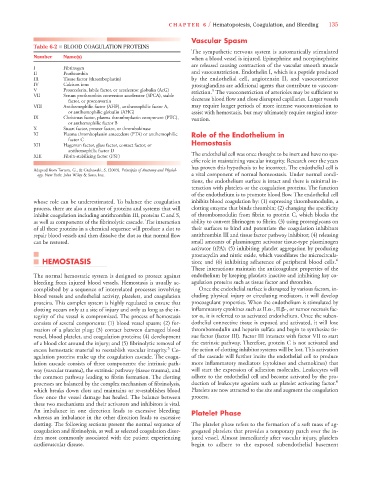
                   Table 6-2 ■ BLOOD COAGULATION PROTEINS
                                                                       The sympathetic nervous system is automatically stimulated
                   Number    Name(s)                                   when a blood vessel is injured. Epinephrine and norepinephrine
                                                                       are released causing contraction of the vascular smooth muscle
                   I         Fibrinogen
                   II        Prothrombin                               and vasoconstriction. Endothelin I, which is a peptide produced
                   III       Tissue factor (thromboplastin)            by the endothelial cell, angiotensin II, and vasoconstrictor
                   IV        Calcium ions                              prostaglandins are additional agents that contribute to vasocon-
                   V         Proaccelerin, labile factor, or accelerator globulin (AcG)  striction. The vasoconstriction of arterioles may be sufficient to
                                                                             5
                   VII       Serum prothrombin conversion accelerator (SPCA), stable
                              factor, or proconvertin                  decrease blood flow and close disrupted capillaries. Larger vessels
                   VIII      Antihemophilic factor (AHF), antihemophilic factor A,  may require longer periods of more intense vasoconstriction to
                              or antihemophilic globulin (AHG)         assist with hemostasis, but may ultimately require surgical inter-
                   IX        Christmas factor, plasma thromboplastin component (PTC),  vention.
                              or anthemophilic factor B
                   X         Stuart factor, prower factor, or thrombokinase
                   XI        Plasma thromboplastin antecedent (PTA) or antihemophilic  Role of the Endothelium in
                              factor C
                   XII       Hageman factor, glass factor, contact factor, or  Hemostasis
                              antihemophilic factor D
                   XIII      Fibrin-stabilizing factor (FSF)           The endothelial cell was once thought to be inert and have no spe-
                                                                       cific role in maintaining vascular integrity. Research over the years
                                                                       has proven this hypothesis to be incorrect. The endothelial cell is
                   Adapted from Tortora, G., & Grabowski, S. (2003). Principles of Anatomy and Physiol-
                    ogy. New York: John Wiley & Sons, Inc.             a vital component of normal homeostasis. Under normal condi-
                                                                       tions, the endothelium surface is intact and there is minimal in-
                                                                       teraction with platelets or the coagulation proteins. The function
                                                                       of the endothelium is to promote blood flow. The endothelial cell
                   whose role can be underestimated. To balance the coagulation  inhibits blood coagulation by: (1) expressing thrombomodulin, a
                   process, there are also a number of proteins and systems that will  clotting enzyme that binds thrombin; (2) changing the specificity
                   inhibit coagulation including antithrombin III, proteins C and S,  of thrombomodulin from fibrin to protein C, which blocks the
                   as well as components of the fibrinolytic cascade. The interaction  ability to convert fibrinogen to fibrin; (3) using proteoglycans on
                   of all these proteins in a chemical sequence will produce a clot to  their surfaces to bind and potentiate the coagulation inhibitors
                   repair blood vessels and then dissolve the clot so that normal flow  antithrombin III and tissue factor pathway inhibitor; (4) releasing
                   can be restored.                                    small amounts of plasminogen activator tissue-type plasminogen
                                                                       activator (tPA); (5) inhibiting platelet aggregation by producing
                                                                       prostacyclin and nitric oxide, which vasodilates the microcircula-
                      HEMOSTASIS                                       tion; and (6) inhibiting adherence of peripheral blood cells. 6
                                                                       These interactions maintain the anticoagulant properties of the
                   The normal hemostatic system is designed to protect against  endothelium by keeping platelets inactive and inhibiting key co-
                   bleeding from injured blood vessels. Hemostasis is usually ac-  agulation proteins such as tissue factor and thrombin.
                   complished by a sequence of interrelated processes involving  Once the endothelial surface is disrupted by various factors, in-
                   blood vessels and endothelial activity, platelets, and coagulation  cluding physical injury or circulating mediators, it will develop
                   proteins. This complex system is highly regulated to ensure that  procoagulant properties. When the endothelium is stimulated by
                   clotting occurs only at a site of injury and only as long as the in-  inflammatory cytokines such as IL -, IL -, or tumor necrosis fac-
                   tegrity of the vessel is compromised. The process of hemostasis  tor  , it is referred to as activated endothelium. Once the suben-
                   consists of several components: (1) blood vessel spasm; (2) for-  dothelial connective tissue is exposed and activated, it will lose
                   mation of a platelet plug; (3) contact between damaged blood  thrombomodulin and heparin sulfate and begin to synthesize tis-
                   vessel, blood platelet, and coagulation proteins; (4) development  sue factor (factor III). Factor III interacts with factor VII to start
                   of a blood clot around the injury; and (5) fibrinolytic removal of  the extrinsic pathway. Therefore, protein C is not activated and
                                                               5
                   excess hemostatic material to reestablish vascular integrity. Co-  the action of clotting inhibitor systems will be lost. This activation
                   agulation proteins make up the coagulation cascade. The coagu-  of the cascade will further incite the endothelial cell to produce
                   lation cascade consists of three components: the intrinsic path-  more inflammatory mediators (cytokines and chemokines) that
                   way (vascular trauma), the extrinsic pathway (tissue trauma), and  will start the expression of adhesion molecules. Leukocytes will
                   the common pathway leading to fibrin formation. The clotting  adhere to the endothelial cell and become activated by the pro-
                   processes are balanced by the complex mechanism of fibrinolysis,  duction of leukocyte agonists such as platelet activating factor. 6
                   which breaks down clots and maintains or re-establishes blood  Platelets are now attracted to the site and augment the coagulation
                   flow once the vessel damage has healed. The balance between  process.
                   these two mechanisms and their activators and inhibitors is vital.
                   An imbalance in one direction leads to excessive bleeding;  Platelet Phase
                   whereas an imbalance in the other direction leads to excessive
                   clotting. The following sections present the normal sequence of  The platelet phase refers to the formation of a soft mass of ag-
                   coagulation and fibrinolysis, as well as selected coagulation disor-  gregated platelets that provides a temporary patch over the in-
                   ders most commonly associated with the patient experiencing  jured vessel. Almost immediately after vascular injury, platelets
                   cardiovascular disease.                             begin to adhere to the exposed subendothelial  basement

