


Page 160 - Cardiac Nursing
P. 160
0
                                9/0
                                               P
                                           5 A
                                        8:2
                                                       Apt
                           qxd
                                                         ara
                                                    36
                                                  e 1
                         52.
                                                    36
                         52.
                                               P
                                             M
                                  9/2
                                    009
                    p13
                                                 g
                       2-1
            K34
               0-c
                 06_
            K34
         LWB K34 0-c 06_ p13 2-1 52. qxd  0 9/0 9/2 009  0 0 8:2 5 A M  P a a g e 1 36  Apt ara
         L L LWB
         LWBK340-c06_06_p132-152.qxd  09/09/2009  08:25 AM  Page 136 Aptara
                  136    PA R T  I I / Physiologic and Pathologic Responses
                  membrane and collagen fibers. Adherent platelets release  The clotting factors are all present in the circulating blood in
                  adenosine diphosphate, which causes platelets to change from  their inactive form until a stimulus for clot formation occurs.
                  their normal disc shape into a spherical form with pseudopods  Twelve different substances have been officially designated as
                  that attach along the surface and allow platelets to clump to-  clotting factors (see Table 6-2). As studied in the laboratory, the
                        5
                  gether. During activation, the platelets become sticky when  coagulation process can be initiated by two different pathways:
                  bridges formed by fibrinogen in the presence of calcium cause  the extrinsic pathway and the intrinsic pathway. Although differ-
                  platelets to adhere to each other, increasing the size of the  entiating between them is helpful for understanding pathologic
                  platelet plug. Adenosine diphosphate and collagen also trigger  mechanisms, medication actions, and coagulation tests, these two
                  formation of arachidonic acid  from phospholipids in the  pathways are functionally inseparable in vivo. The extrinsic path-
                  platelet membrane. Arachidonic acid leads to the formation of  way, whose major mediators are rapidly inactivated, is the pri-
                  thromboxane A 2 , a substance that induces further platelet ag-  mary initiator of the clotting cascade. The intrinsic pathway,
                  gregation. Thromboxane A 2 causes conformational changes in  whose major mediators are more slowly degraded, is thought to
                  glycoprotein IIb/IIIa, a receptor on the platelet surface, which  be important for maintenance and amplification of the clotting
                  exposes fibrinogen-binding sites. Fibrinogen builds bridges to  cascade. Both extrinsic and intrinsic mechanisms eventually lead
                  adjacent platelets, a process called platelet adhesion, which ad-  to the activation of factor X, with the remaining steps of the co-
                  vances platelet aggregation. When these aggregates are rein-  agulation sequence being identical and referred to as the com-
                                                             5
                  forced with fibrin, they are referred to as a thrombus. Ulti-  mon pathway. The sequence of the coagulation process is shown
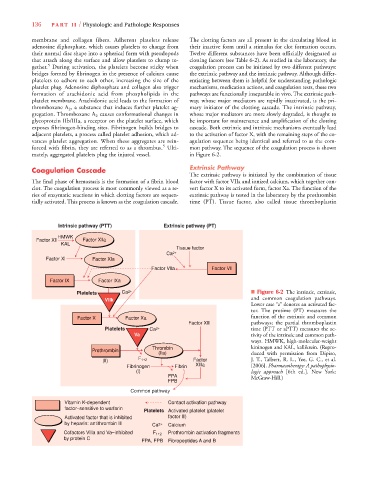
                  mately, aggregated platelets plug the injured vessel.  in Figure 6-2.
                  Coagulation Cascade                                 Extrinsic Pathway
                                                                      The extrinsic pathway is initiated by the combination of tissue
                  The final phase of hemostasis is the formation of a fibrin blood  factor with factor VIIa and ionized calcium, which together con-
                  clot. The coagulation process is most commonly viewed as a se-  vert factor X to its activated form, factor Xa. The function of the
                  ries of enzymatic reactions in which clotting factors are sequen-  extrinsic pathway is tested in the laboratory by the prothrombin
                  tially activated. This process is known as the coagulation cascade.  time (PT).  Tissue  factor, also called tissue thromboplastin
                           Intrinsic pathway (PTT)            Extrinsic pathway (PT)
                           HMWK
                    Factor Xll     Factor Xlla
                            KAL
                                                                  Tissue factor
                                                              Ca 2+
                       Factor Xl      Factor Xla
                                                          Factor Vlla        Factor Vll
                        Factor lX       Factor lXa
                                 Platelets      Ca 2+                                     ■ Figure 6-2 The intrinsic, extrinsic,
                                          Vllk                                            and common coagulation pathways.
                                                                                          Lower case “a” denotes an activated fac-
                                                                                          tor.  The protime (PT) measures the
                                 Factor X        Factor Xa                                function of the extrinsic and common
                                                                      Factor Xlll         pathways; the partial thromboplastin
                                          Platelets      Ca 2+                            time (PTT or aPTT) measures the ac-
                                                    Va                                    tivity of the intrinsic and common path-
                                                                                          ways. HMWK, high-molecular-weight
                                                          Thrombin                        kininogen and KAL, kallikrein. (Repro-
                                      Prothrombin
                                                            (lla)                         duced with  permission from Dipiro,
                                          (ll)       F 1+2             Factor             J. T., Talbert, R. L., Yee, G. C., et al.
                                                 Fibrinogen      Fibrin  Xllla            [2006]. Pharmacotherapy: A pathophysio-
                                                     (l)                                  logic approach  [6th ed.]. New  York:
                                                               FPA                        McGraw-Hill.)
                                                               FPB
                                                   Common pathway
                             Vitamin K-dependent               Contact activation pathway
                             factor–sensitive to warfarin
                                                       Platelets Activated platelet (platelet
                             Activated factor that is inhibited  factor lll)
                             by heparin: antithrombin lll  Ca 2+  Calcium
                             Cofactors Vllla and Va–inhibited  F 1+2  Prothrombin activation fragments
                             by protein C
                                                      FPA, FPB  Fibropeptides A and B

