


Page 217 - Cardiac Nursing
P. 217
6 P
                                   0:1
                                        M
                                     6 P
                                   1
                                /09
                                   0:1
                                   1
                                           g
                                           g
                                            e 1
                                            e 1
                                          Pa
                                        M
                                           g
                                          Pa
                                /09
                    17
                          q
                   p
                    17
                      7-2
                        03.
                        03.
                      7-2
                             6
                             6
                              /29
                              /29
                          q
                          q
                           xd
                           xd
                                                      c.
                 08_
                 08_
                                                    In
                                                    In
                                                      c.
               0-c
         LWB
         LWB
         LWBK340-c08_ p pp177-203.qxd  6/29/09  10:16 PM  Page 193 Aptara Inc.
               0-c
            K34
            K34
                                                 p
                                                 p
                                                A
                                                 p
                                                  t
                                                  t
                                                A
                                                  ara
                                                   a
                                                   a
                                                  ara
                                              93
                                              93
                                                                                             C HAPTER  8 / Sleep   193
                   caused by or may accentuate the underlying health problem. A  Sleep Restriction Therapy
                   fourth goal is to assist patients to learn behavioral patterns that en-  Sleep restriction therapy causes sleep deprivation, and conse-
                   hance the quality of their sleep.                   quently increases the sleep drive. Before beginning sleep restric-
                                                                       tion therapy the individual maintains a sleep log for 2 weeks. This
                                                                       log facilitates estimating the average sleep time versus time spent
                                                                       in bed. The allowed sleep time is the average subjective sleep time,
                      SLEEP PROMOTING                                  but is never less than 5 hours. The time in bed is adjusted by
                      INTERVENTIONS                                    15-minute increments or decrements, depending on the sleep ef-
                                                                       ficiency. Sleep efficiency is defined as the average sleep time or
                                                p
                                      g
                                      g
                        p
                   Nonpharmacological Outpatient                       time in bed multiplied by 100%. If sleep efficiency is greater than
                        p
                   Interventions for the Management of                 90%, the time in bed is increased by 15 minutes, and if it is less
                                                  g
                                                  g
                        p
                   Sleep Disturbances in Patients with                 than 85%, the time is decreased by 15 minutes. 282
                        p
                   Cardiovascular Disease                                Sleep restriction has been shown in one study to increase total
                                                                       sleep time, improve sleep latency, total wake time, sleep efficiency,
                   Nonpharmacological therapies for sleep problems are often effec-
                   tive but underutilized by health care providers. Treatment of sleep  and subjective assessment of insomnia. Using this technique, im-
                   disturbances using nonpharmacological methods involves behav-  provement continued to be significant for all sleep parameters at
                   ioral, cognitive, and physiological interventions. These therapies  36 weeks. The efficacy of sleep restriction alone or in combination
                   may be used alone or in combination and typically are more ef-  with other modalities has also been shown in other controlled
                                                                           162,284,285
                   fective for the long-term management of sleep disturbances than  trials.  However, the use of this technique with cardio-
                   medications alone. 281,282                          vascular patients has not been fully tested and should be used with
                                                                       caution given the vulnerability of the cardiac patient to sleep
                                                                       deprivation.
                   Relaxation Therapy and Imagery
                   Anxiety and related thoughts are often detrimental to sleep and  Sleep Education and Hygiene
                   may prevent or delay sleep onset. Relaxation training originally  Sleep hygiene measures alone are not adequate for the treatment
                   designed to reduce anxiety has also been used successfully for the  of sleep disturbances; however, they may be beneficial when used
                   treatment of sleep onset insomnia. Several relaxation techniques  in conjunction with other therapies. Sleep hygiene includes health
                   are recommended for the treatment of sleep disturbances. These  practices, habits, and environmental factors that influence sleep.
                   techniques include progressive muscle relaxation, autogenic train-  Health care providers need to educate cardiac patients regarding
                   ing, and imagery. Autogenic training focuses on increasing blood  sleep and its disorders. It is important to emphasize that simple
                   flow to the legs and arms. The sensations of warmth and heaviness  lifestyle changes can help in the treatment of their sleep problems.
                   are used to promote somatic relaxation. Positive imagery may also  Some of the sleep-related practices and habits that may impair
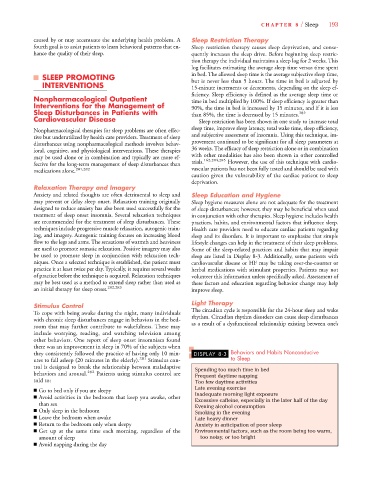
                   be used to promote sleep in conjunction with relaxation tech-  sleep are listed in Display 8-3. Additionally, some patients with
                   niques. Once a selected technique is established, the patient must  cardiovascular disease or HF may be taking over-the-counter or
                   practice it at least twice per day. Typically, it requires several weeks  herbal medications with stimulant properties. Patients may not
                   of practice before the technique is acquired. Relaxation techniques  volunteer this information unless specifically asked. Assessment of
                   may be best used as a method to extend sleep rather than used as  these factors and education regarding behavior change may help
                   an initial therapy for sleep onset. 282,283         improve sleep.
                                                                       Light Therapy
                   Stimulus Control
                   To cope with being awake during the night, many individuals  The circadian cycle is responsible for the 24-hour sleep and wake
                   with chronic sleep disturbances engage in behaviors in the bed-  rhythm. Circadian rhythm disorders can cause sleep disturbances
                   room that may further contribute to wakefulness. These may  as a result of a dysfunctional relationship existing between one’s
                   include worrying, reading, and watching television among
                   other behaviors. One report of sleep onset insomniacs found
                   there was an improvement in sleep in 70% of the subjects when
                   they consistently followed the practice of having only 10 min-  DISPLAY 8-3  Behaviors and Habits Nonconducive
                   utes to fall asleep (20 minutes in the elderly). 281  Stimulus con-  to Sleep
                   trol is designed to break the relationship between maladaptive  Spending too much time in bed
                   behaviors and arousal. 282  Patients using stimulus control are  Frequent daytime napping
                   told to:                                             Too few daytime activities
                   ■ Go to bed only if you are sleepy                   Late evening exercise
                                                                        Inadequate morning light exposure
                   ■ Avoid activities in the bedroom that keep you awake, other
                                                                        Excessive caffeine, especially in the later half of the day
                     than sex                                           Evening alcohol consumption
                   ■ Only sleep in the bedroom
                                                                        Smoking in the evening
                   ■ Leave the bedroom when awake                       Late heavy dinner
                   ■ Return to the bedroom only when sleepy             Anxiety in anticipation of poor sleep
                   ■ Get up at the same time each morning, regardless of the  Environmental factors, such as the room being too warm,
                     amount of sleep                                     too noisy, or too bright
                   ■ Avoid napping during the day

