


Page 219 - Cardiac Nursing
P. 219
p
                    17
                   p
                                            e 1
                                            e 1
                    17
                        03.
                          q
                        03.
                      7-2
                      7-2
                                              95
                                                  t
                                                  t
                                                  ara
                                                   a
                                                  ara
                                                 p
                                                A
                                              95
                                                A
                                                 p
                                                 p
                                     6 P
                                        M
                                     6 P
                                   0:1
                                   0:1
                                        M
                                           g
                                           g
                                           g
                                          Pa
                                          Pa
                                   1
                           xd
                             6
                           xd
                          q
                          q
                             6
                                /09
                                   1
                                /09
                              /29
                              /29
         LWBK340-c08_
         LWB
            K34
                 08_
               0-c
         LWB K34 0-c 08_ pp177-203.qxd  6/29/09  10:16 PM  Page 195 Aptara Inc.
                                                    In
                                                   a
                                                    In
                                                      c.
                                                      c.
                                                                                             C HAPTER  8 / Sleep   195
                   Cognitive Behavioral Therapy                                     Medications Associated with Insomnia
                   for Sleep Disturbances                              DISPLAY 8-4
                   Dysfunctional beliefs and attitudes about sleep contribute to
                   SPD. In particular, cognitive processes such as worry over sleep  Antidepressants
                   and its consequences and automatic or altered beliefs are thought  Tricyclics
                   to play a critical role in the development and maintenance of  Amitriptyline
                   SPD. An example of an altered belief system is the belief in need  Doxepin
                   for 8 hours of sleep per night to feel refreshed. Since the amount  Imipramine
                   of sleep varies among individuals, this belief can exacerbate or  Trimipramine
                   worsen SPD when this expectation is not met. These cognitive  Desipramine
                   processes increase physiological and emotional arousal and in  Nortriptyline
                   some individuals lead to a downward and cyclic trajectory that  Protriptyline
                   perpetuates the underlying. 305–310                  Selective Serotonin Reuptake Inhibitors
                     Nonpharmacologic approaches to management of SPD, par-  Fluoxetine
                   ticularly those emphasizing cognitive behavioral therapy to di-  Paroxetine
                   rectly target faulty beliefs and negative thoughts about sleep, have  Sertraline
                   increased in popularity over the past decade. 306,311  Conceptually,  Fluvoxamine
                   the basis for CBT is that dysfunctional thinking and behaviors as-  Serotonin and Norepinephrine Reuptake Inhibitors
                   sociated with SPD are cognitively mediated. The cognitive com-  Venlafaxine
                   ponent of CBT is tailored to the individual needs of the partici-  Monoamine Oxidase Inhibitors
                   pant to identify, challenge, and change stressful, distorted sleep  Phenelzine
                   thoughts that contribute to SPD. 285,305,310,311  The behavioral as-  Tranylcypromine
                   pects include sleep restriction therapy, modified stimulus control,
                   and use of relaxation techniques which are described in greater  Antihypertensives
                   detail in the section “Sleep Education and Hygiene”.   -Blockers (Lipophilic Blockers)
                     Evidence from SPD research suggests that CBT results in  Propranolol
                   short-term improvements that are as effective as pharmacotherapy  Timolol
                   with sedative-hypnotics. This effect is especially relevant given the
                   adverse events and side effects associated with sedatives and hyp-  Others
                   notics, especially among the elderly. The potentially greatest ad-  Hypolipidemic Drugs
                   vantage of CBT is over time, since it may be more durable than  Atorvastatin
                   pharmacotherapy because the beneficial effects persist after ther-  Lovastatin
                   apy has ended. Therefore, although CBT may be a more costly ap-  Simvastatin
                   proach than pharmacotherapy in the short run, it becomes cost-  Nasal Decongestants
                   effective over 6 months or longer. 312–314           Pseudoephedrine
                     Previous studies of psychological interventions for insomnia  Phenylpropanolamine
                   have primarily used behavioral approaches such as stimulus con-
                   trol and sleep restriction, which focused on modifying maladap-  Bronchodilators
                                                                        Theophylline
                   tive sleep habits. 308  The addition of cognitive restructuring that
                   targets factors known to perpetuate SPDs (i.e., consequences of  Antiparkinsonian Medications
                   not falling asleep), or that reduce compliance with behavioral  Levodopa
                   therapy may improve treatment effectiveness for SPDs. 305  Corticosteroids
                                                                        Prednisone
                   Pharmacological Interventions                       Adapted from Schweitzer, P. K. (2005). Drugs that disturb sleep and wakefulness. In
                                                                        M. H. Kryger, T., Roth, & W. C., Dement (Eds.), Principles and practice of sleep
                   to Promote Sleep                                     medicine (pp. 499–518). Philadelphia: Elsevier Saunders.
                   The consequences and impact of insomnia (difficulty initiating
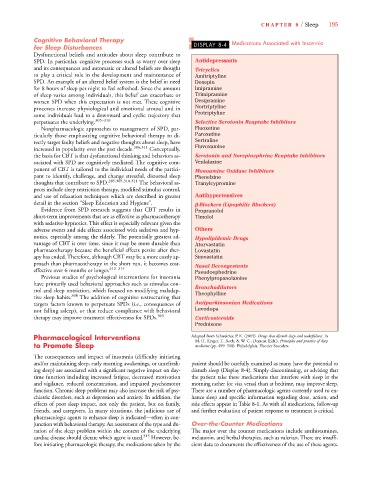
                   and/or maintaining sleep, early morning awakenings, or unrefresh-  patient should be carefully examined as many have the potential to
                   ing sleep) are associated with a significant negative impact on day-  disturb sleep (Display 8-4). Simply discontinuing, or advising that
                   time function including increased fatigue, decreased motivation  the patient take these medications that interfere with sleep in the
                   and vigilance, reduced concentration, and impaired psychomotor  morning rather (or visa versa) than at bedtime, may improve sleep.
                   function. Chronic sleep problems may also increase the risk of psy-  There are a number of pharmacologic agents currently used to en-
                   chiatric disorders, such as depression and anxiety. In addition, the  hance sleep and specific information regarding dose, action, and
                   effects of poor sleep impact, not only the patient, but on family,  side effects appear in Table 8-1. As with all medications, follow-up
                   friends, and caregivers. In many situations, the judicious use of  and further evaluation of patient response to treatment is critical.
                   pharmacologic agents to enhance sleep is indicated—often in con-
                   junction with behavioral therapy. An assessment of the type and du-  Over-the-Counter Medications
                   ration of the sleep problem within the context of the underlying  The major over the counter medications include antihistamines,
                   cardiac disease should dictate which agent is used. 315  However, be-  melatonin, and herbal therapies, such as valerian. There are insuffi-
                   fore initiating pharmacologic therapy, the medications taken by the  cient data to documents the effectiveness of the use of these agents.

