


Page 240 - Cardiac Nursing
P. 240
LWBK340-c10_p211-244.qxd  30/06/2009  10:46 AM  Page 216 Aptara


                  216    PA R T  III / Assessment of Heart Disease

                  ■ Most of the time, do you feel good about yourself?  and Therapeutic Classification (Table 10-2). 11  This classification
                  ■ Have you noticed changes in yourself or your body? Do these  may be helpful in assessing symptom severity and monitoring ef-
                    changes concern you?                              fects of treatment over time. The patient’s functional classification
                                                                      may improve as recovery from an acute event, such as myocardial
                     Roles and Relationships. Collect the following information:
                                                                      infarction, occurs or as intervention is optimized. Conversely, it
                  ■ Do you live alone? With whom do you live?         may decline with worsening or additional disease.
                  ■ Do you have a close friend or confidant?
                  ■ How do you and those close to you feel about your illness?
                  ■ Do you often feel lonely? Do you feel part of the neighborhood
                    in which you live?                                   PHYSICAL ASSESSMENT
                     Sexuality. Collect the following information:
                                                                      Assessment of physical findings confirms or expands data ob-
                  ■ Have you experienced any changes in your sexuality? Problems  tained in the health history. Baseline information is obtained at
                    in sexual relationships?                          the initial encounter, and frequency of subsequent assessments is
                  ■ For women: are you still menstruating? Are you taking hor-  based on the clinical encounter. Change in the data over time doc-
                    mone replacements? Do you have menopausal symptoms (such  uments progression of, or recovery from, acute disease; new dis-
                    as hot flashes and sleep disturbances)?            ease; the effectiveness of current interventions; and the patient’s
                                                                      current functional status. The type, degree, and rate of change as-
                     Coping–Stress. Collect the following information:
                                                                      sist the nurse in identifying or predicting immediate or long-term
                  ■ Do you feel tense or anxious much of the time? What helps? Do  problems, formulating nursing diagnoses, planning care, and es-
                    you use medicines for anxiety?                    tablishing individual patient outcome criteria.
                  ■ When you feel stressed, who is most helpful to you?  In the acutely ill cardiac patient, segments of the physical ex-
                  ■ When you have big problems in your life, how do you handle  amination are performed every 2 to 4 hours or more frequently if
                    them? Does that usually work for you?             indicated. Although some data may be available from monitoring
                                                                      devices, physical examination assists in evaluating the accuracy of
                     Values–Beliefs. Collect the following information:
                                                                      those data. As the acutely ill patient improves, assessments are
                  ■ Are you generally satisfied with your life?        routinely done once per shift or more frequently if indicated. If a
                  ■ Is religion important to you?                     rapid change in patient condition occurs, the initial assessment is
                  ■ Do you hold religious or other beliefs that you wish to observe  problem focused and the complete assessment is done at a later
                    here?                                             time. Because nurses spend 24 hours per day with the hospitalized
                                                                      patient, they are in the best position to identify any changes that
                  Functional and Therapeutic                          occur. It is to the patient’s benefit for changes to be detected early,
                  Classification                                       before serious complications develop. Any changes observed in
                                                                      the examination should be documented in the patient’s record and
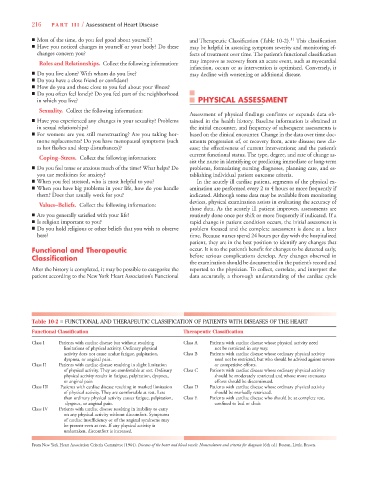
                  After the history is completed, it may be possible to categorize the  reported to the physician. To collect, correlate, and interpret the
                  patient according to the New York Heart Association’s Functional  data accurately, a thorough understanding of the cardiac cycle


                  Table 10-2 ■ FUNCTIONAL AND THERAPEUTIC CLASSIFICATION OF PATIENTS WITH DISEASES OF THE HEART
                  Functional Classification                          Therapeutic Classification
                  Class I  Patients with cardiac disease but without resulting   Class A  Patients with cardiac disease whose physical activity need
                             limitations of physical activity. Ordinary physical   not be restricted in any way.
                             activity does not cause undue fatigue, palpitation,   Class B  Patients with cardiac disease whose ordinary physical activity
                             dyspnea, or anginal pain.                        need not be restricted, but who should be advised against servere
                  Class II  Patients with cardiac disease resulting in slight limitation   or competitive efforts.
                             of physical activity. They are comfortable at rest. Ordinary  Class C  Patients with cardiac disease whose ordinary physical activity
                             physical activity results in fatigue, palpitation, dyspnea,  should be moderately restricted and whose more strenuous
                             or anginal pain                                  efforts should be discontinued.
                  Class III  Patients with cardiac disease resulting in marked limitation  Class D  Patients with cardiac disease whose ordinary physical activity
                             of physical activity. They are comfortable at rest. Less  should be markedly restricted.
                             than ordinary physical activity causes fatigue, palpitation,   Class E  Patients with cardiac disease who should be at complete rest,
                             dyspnea, or anginal pain.                        confined to bed or chair.
                  Class IV  Patients with cardiac disease resulting in inability to carry
                             on any physical activity without discomfort. Symptoms
                             of cardiac insufficiency or of the anginal syndrome may
                             be present even at rest. If any physical activity is
                             undertaken, discomfort is increased.

                  From New York Heart Association Criteria Committee [1964]. Diseases of the heart and blood vessels: Nomenclature and criteria for diagnosis [6th ed.] Boston, Little, Brown.

