


Page 244 - Cardiac Nursing
P. 244
xd
                           xd
                          q
                          q
                          q
                             3
                                6/2
                                6/2
                              0/0
                             3
                              0/0
                                                   p
                    21
                                                    t
                                                     ara
                                                    t
                    21
                        44.
                        44.
                      1-2
                                                   p
                      1-2
                                              g
                                               e 2
                                              g
                                            Pa
                                              g
                                               e 2
                                                  A
                                                   p
                                                  A
                                                20
                                                20
                                     1
                                      0:4
                                     1
                                  009
                                  009
                                      0:4
                                          M
                                            Pa
                                          M
                                        6 A
                                        6 A
                                                     ara
            K34
               0-c
         LWBK340-c10_
         LWB
                 10_
         LWB K34 0-c 10_ p p pp211-244.qxd  30/06/2009  10:46 AM  Page 220 Aptara
                  220    P A R T  III / Assessment of Heart Disease
                                                                        A  Cotton wool
                                                                          patches
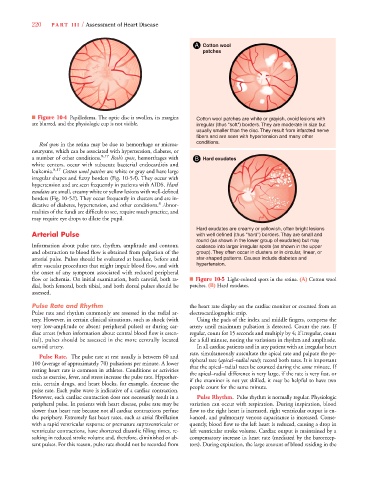
                  ■ Figure 10-4 Papilledema. The optic disc is swollen, its margins  Cotton wool patches are white or grayish, ovoid lesions with
                  are blurred, and the physiologic cup is not visible.  irregular (thus "soft") borders. They are moderate in size but
                                                                        usually smaller than the disc. They result from infarcted nerve
                                                                        fibers and are seen with hypertension and many other
                     Red spots in the retina may be due to hemorrhage or microa-  conditions.
                  neurysms, which can be associated with hypertension, diabetes, or
                  a number of other conditions. 8,17  Roth’s spots, hemorrhages with  B  Hard exudates
                  white centers, occur with subacute  bacterial endocarditis and
                  leukemia. 8,17  Cotton wool patches are white or gray and have large
                  irregular shapes and fuzzy borders (Fig. 10-5A). They occur with
                  hypertension and are seen frequently in patients with AIDS. Hard
                  exudates are small, creamy white or yellow lesions with well-defined
                  borders (Fig. 10-5B). They occur frequently in clusters and are in-B
                                B
                                                            8
                  dicative of diabetes, hypertension, and other conditions. Abnor-
                  malities of the fundi are difficult to see, require much practice, and
                  may require eye drops to dilate the pupil.
                                                                        Hard exudates are creamy or yellowish, often bright lesions
                  Arterial Pulse                                        with well defined (thus "hard") borders. Thay are small and
                                                                        round (as shown in the lower group of exudates) but may
                  Information about pulse rate, rhythm, amplitude and contour,  coalesce into larger irregular spots (as shown in the upper
                  and obstruction to blood flow is obtained from palpation of the  group). They often occur in clusters or in circular, linear, or
                  arterial pulse. Pulses should be evaluated at baseline, before and  star-shaped patterns. Causes include diabetes and
                  after vascular procedures that might impair blood flow, and with  hypertension.
                  the onset of any symptom associated with reduced peripheral
                  flow or ischemia. On initial examination, both carotid, both ra-  ■ Figure 10-5 Light-colored spots in the retina. (A) Cotton wool
                  dial, both femoral, both tibial, and both dorsal pulses should be  patches. (B) Hard exudates.
                  assessed.
                  Pulse Rate and Rhythm                               the heart rate display on the cardiac monitor or counted from an
                  Pulse rate and rhythm commonly are assessed in the radial ar-  electrocardiographic strip.
                  tery. However, in certain clinical situations, such as shock (with  Using the pads of the index and middle fingers, compress the
                  very low-amplitude or absent peripheral pulses) or during car-  artery until maximum pulsation is detected. Count the rate. If
                  diac arrest (when information about central blood flow is essen-  regular, count for 15 seconds and multiply by 4; if irregular, count
                  tial), pulses should be assessed in the more centrally located  for a full minute, noting the variations in rhythm and amplitude.
                  carotid artery.                                       In all cardiac patients and in any patient with an irregular heart
                                                                      rate, simultaneously auscultate the apical rate and palpate the pe-
                     Pulse Rate. The pulse rate at rest usually is between 60 and  ripheral rate (apical–radial rate); record both rates. It is importante e
                  100 (average of approximately 70) pulsations per minute. A lower  that the apical–radial rates be counted during the same minute. If
                  resting heart rate is common in athletes. Conditions or activities  the apical–radial difference is very large, if the rate is very fast, or
                  such as exercise, fever, and stress increase the pulse rate. Hypother-  if the examiner is not yet skilled, it may be helpful to have two
                  mia, certain drugs, and heart blocks, for example, decrease the  people count for the same minute.
                  pulse rate. Each pulse wave is indicative of a cardiac contraction.
                  However, each cardiac contraction does not necessarily result in a  Pulse Rhythm. Pulse rhythm is normally regular. Physiologic
                  peripheral pulse. In patients with heart disease, pulse rate may be  variation can occur with respiration. During inspiration, blood
                  slower than heart rate because not all cardiac contractions perfuse  flow to the right heart is increased, right ventricular output is en-
                  the periphery. Extremely fast heart rates, such as atrial fibrillation  hanced, and pulmonary venous capacitance is increased. Conse-
                  with a rapid ventricular response or premature supraventricular or  quently, blood flow to the left heart is reduced, causing a drop in
                  ventricular contractions, have shortened diastolic filling times, re-  left ventricular stroke volume. Cardiac output is maintained by a
                  sulting in reduced stroke volume and, therefore, diminished or ab-  compensatory increase in heart rate (mediated by the barorecep-
                  sent pulses. For this reason, pulse rate should not be recorded from  tors). During expiration, the large amount of blood residing in the

