


Page 26 - Cardiac Nursing
P. 26
92806_c01.qxd  11/21/11  10:30 AM  Page 2


                     2   PA R T  I / Anatomy and Physiology


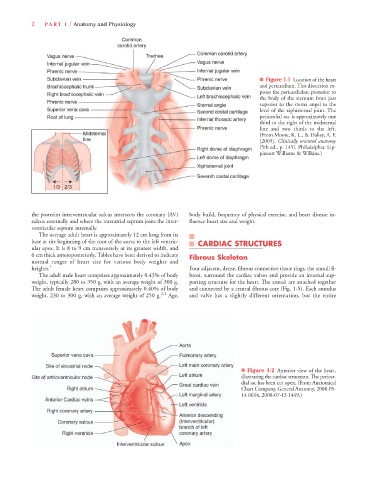
                                                                                               ■ Figure 1-1 Location of the heart
                                                                                               and pericardium. This dissection ex-
                                                                                               poses the pericardialsac posterior to
                                                                                               the body of the sternum from just
                                                                                               superior to the sterna angel to the
                                                                                               level of the xiphisternal joint. The
                                                                                               pericardial sac is approximately one
                                                                                               third to the right of the midsternal
                                                                                               line and two thirds to the left.
                                                                                               (From Moore, K. L., & Dalley, A. F.
                                                                                               [2005]. Clinically oriented anatomy
                                                                                               [5th ed., p. 145]. Philadelphia: Lip-
                                                                                               pincott Williams & Wilkins.)


                     the posterior interventricular sulcus intersects the coronary (AV)  body build, frequency of physical exercise, and heart disease in-
                     sulcus externally and where the interatrial septum joins the inter-  fluence heart size and weight.
                     ventricular septum internally.
                       The average adult heart is approximately 12 cm long from its
                     base at the beginning of the root of the aorta to the left ventric-  CARDIAC STRUCTURES
                     ular apex. It is 8 to 9 cm transversely at its greatest width, and
                     6 cm thick anteroposteriorly. Tables have been derived to indicate  Fibrous Skeleton
                     normal ranges of heart size for various body weights and
                     heights. 1                                         Four adjacent, dense, fibrous connective tissue rings, the annuli fi-
                       The adult male heart comprises approximately 0.43% of body  brosi, surround the cardiac valves and provide an internal sup-
                    weight, typically 280 to 350 g, with an average weight of 300 g.  porting structure for the heart. The annuli are attached together
                    The adult female heart comprises approximately 0.40% of body  and connected by a central fibrous core (Fig. 1-5). Each annulus
                    weight, 230 to 300 g, with an average weight of 250 g. 2,3  Age,  and valve has a slightly different orientation, but the entire


                                                                                         ■ Figure 1-2 Anterior view of the heart,
                                                                                         illustrating the cardiac structures. The pericar-
                                                                                         dial sac has been cut open. (From Anatomical
                                                                                         Chart Company, General Anatomy, 2008-05-
                                                                                         14 0614, 2008-07-13 1449.)

