


Page 27 - Cardiac Nursing
P. 27
92806_c01.qxd  11/21/11  10:30 AM  Page 3


                                                                           CHAPTER 1 / Cardiac Anatomy and Physiology   3


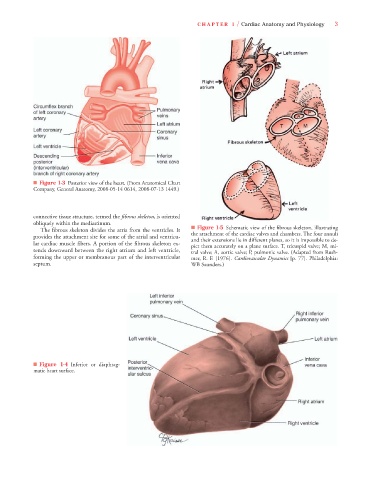
                     ■ Figure 1-3 Posterior view of the heart. (From Anatomical Chart
                     Company, General Anatomy, 2008-05-14 0614, 2008-07-13 1449.)


                     connective tissue structure, termed the fibrous skeleton, is oriented
                     obliquely within the mediastinum.
                        The fibrous skeleton divides the atria from the ventricles. It  ■ Figure 1-5 Schematic view of the fibrous skeleton, illustrating
                     provides the attachment site for some of the atrial and ventricu-  the attachment of the cardiac valves and chambers. The four annuli
                                                                         and their extensions lie in different planes, so it is impossible to de-
                     lar cardiac muscle fibers. A portion of the fibrous skeleton ex-  pict them accurately on a plane surface. T, tricuspid valve; M, mi-
                     tends downward between the right atrium and left ventricle,  tral valve; A, aortic valve; P, pulmonic valve. (Adapted from Rush-
                     forming the upper or membranous part of the interventricular  mer, R. F. [1976]. Cardiovascular Dynamics [p. 77]. Philadelphia:
                     septum.                                             WB Saunders.)


                     ■ Figure 1-4 Inferior or diaphrag-
                     matic heart surface.

