


Page 319 - Cardiac Nursing
P. 319
Pa
                                           g
                                        M
                                          Pa
                                           g
                                            e 2
                                              95
                                           g
                                            e 2
                                   1
                                   1
                                /09
                                /09
                                   0:2
                                     7 P
                                        M
                                   0:2
                                     7 P
                                              95
                                                   a
                                                   a
                                                  ara
                                                   a
                                                   a
                                                      c.
                                                      c.
                                                    In
                                                    In
                                                 p
                                                 p
                                                A
                                                A
                                                 p
                                                  ara
                                                  ara
                                                  t
                                                  t
                      1-2
                      1-2
         LWB K34 0-c 14_ p p pp291-299.qxd  6/29/09  10:27 PM  Page 295 Aptara Inc.
                        99.
                          q
                          q
                        99.
            K34
               0-c
                 14_
         LWBK340-c14_
                    29
                    29
         LWB
                             6
                             6
                              /29
                              /29
                              6
                          q
                           xd
                           xd
                                          C HAPTER 1 4 / Nuclear, Magnetic Resonance, and Computed Tomography Imaging  295
                                                                       stenoses have been performed in research studies, MRI is not
                                                                       commonly performed clinically for that purpose. However, MRI
                                                                       allows descriptions of anomalous coronary artery origins and
                                                                       courses of the arteries near the great vessels. The pericardium can
                                                                       be visualized by MRI, and thus descriptions of pericardial thick-
                                                                       ness and locations of pericardial effusions can be provided. Ven-
                                                                       tricular volumes and function can be obtained by MRI because of
                                                                       the excellent visualization of endocardial borders. 28–31  The right
                                                                       ventricle is seen in limited views with echo and most commonly,
                                                                       the function is described qualitatively. As opposed to echo, quan-
                                                                       titation of RV function can be performed in terms of RV volumes
                                                                       and EFs. Trans-valvular velocities, trans-valvular pressure gradi-
                                                                       ents, and valve areas are all measures of the severity of valvular
                                                                       stenosis. 32–35  Typically, these measures are obtained by echo but
                                                                       can also be evaluated by MRI. Quantitation of the amount
                                                                       of valvular regurgitation (regurgitant volumes) can also be
                                                                       performed. 36,37
                                                                         Myocardial perfusion can be used to assess the presence or ab-
                                                                       sence of flow-limited coronary artery disease. 38,39  Exercise testing
                                                                       is not performed. Instead, perfusion at stress can be assessed with
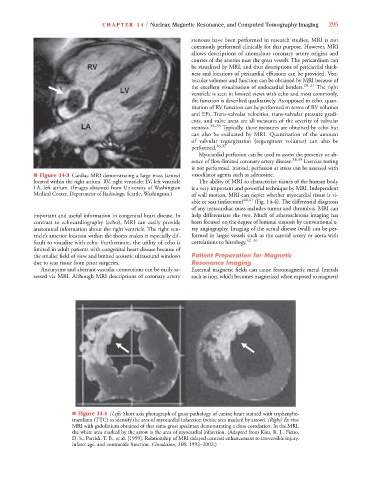
                   ■ Figure 14-3 Cardiac MRI demonstrating a large mass (arrow)  vasodilator agents such as adenosine.
                   located within the right atrium. RV, right ventricle; LV, left ventricle  The ability of MRI to characterize tissues of the human body
                   LA, left atrium. (Images obtained from University of Washington  is a very important and powerful technique by MRI. Independent
                   Medical Center, Department of Radiology, Seattle, Washington.)  of wall motion, MRI can depict whether myocardial tissue is vi-
                                                                       able or scar (infarction) 40,41  (Fig. 14-4). The differential diagnosis
                                                                       of any intracardiac mass includes tumor and thrombus. MRI can
                   important and useful information in congenital heart disease. In  help differentiate the two. Much of atherosclerosis imaging has
                   contrast to echocardiography (echo), MRI can easily provide  been focused on the degree of luminal stenosis by conventional x-
                   anatomical information about the right ventricle. The right ven-  ray angiography. Imaging of the actual disease (wall) can be per-
                   tricle’s anterior location within the thorax makes it especially dif-  formed in larger vessels such as the carotid artery or aorta with
                   ficult to visualize with echo. Furthermore, the utility of echo is  correlations to histology. 42–46
                   limited in adult patients with congenital heart disease because of
                   the smaller field of view and limited acoustic ultrasound windows  Patient Preparation for Magnetic
                   due to scar tissue from prior surgeries.            Resonance Imaging
                     Aneurysms and aberrant vascular connections can be easily as-  External magnetic fields can cause ferromagnetic metal (metals
                   sessed via MRI. Although MRI descriptions of coronary artery  such as iron, which becomes magnetized when exposed to magnets)
                                ■ Figure 14-4 (Left) Short axis photograph of gross pathology of canine heart stained with triphenylte-
                                trazolium (TTC) to identify the area of myocardial infarction (white area marked by arrow). (Right) Ex vivo
                                MRI with gadolinium obtained of that same gross specimen demonstrating a close correlation. In the MRI,
                                the white area marked by the arrow is the area of myocardial infarction. (Adapted from Kim, R. J., Fieno,
                                D. S., Parrish, T. B., et al. [1999]. Relationship of MRI delayed contrast enhancement to irreversible injury,
                                infarct age, and contractile function. Circulation, 100, 1992–2002.)

