


Page 316 - Cardiac Nursing
P. 316
LWBK340-c14_p291-299.qxd  6/29/09  10:27 PM  Page 292 Aptara Inc.


                  292    PA R T  III / Assessment of Heart Disease

                                                                      appropriately dilate in response to increasing myocardial work re-
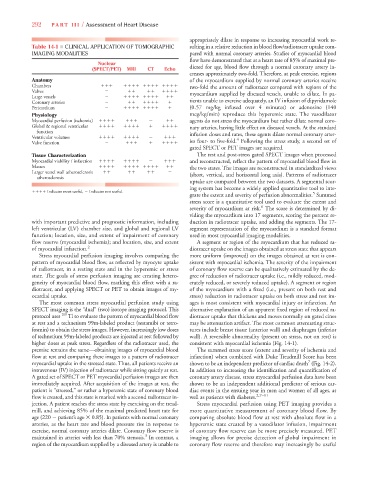
                  Table 14-1 ■ CLINICAL APPLICATION OF TOMOGRAPHIC    sulting in a relative reduction in blood flow/radiotracer uptake com-
                  IMAGING MODALITIES                                  pared with normal coronary arteries. Studies of myocardial blood
                                                                      flow have demonstrated that at a heart rate of 85% of maximal pre-
                                        Nuclear
                                      (SPECT/PET)  MRI  CT    Echo    dicted for age, blood flow through a normal coronary artery in-
                                                                      creases approximately two-fold. Therefore, at peak exercise, regions
                  Anatomy                                             of the myocardium supplied by normal coronary arteries receive
                  Chambers


        two-fold the amount of radiotracer compared with regions of the
                  Valves
                  Large vessels


      myocardium supplied by diseased vessels, unable to dilate. In pa-
                  Coronary arteries


      tients unable to exercise adequately, an IV infusion of dipyridamole
                  Pericardium


      (0.57 mg/kg infused over 4 minutes) or adenosine (140
                  Physiology                                          mcg/kg/min) reproduce this hyperemic state.  The vasodilator
                  Myocardial perfusion (ischemia)


   agents do not stress the myocardium but rather dilate normal coro-
                  Global & regional ventricular


  nary arteries, having little effect on diseased vessels. At the standard
                    function
                  Ventricular volumes


     infusion doses and rates, these agents dilate normal coronary arter-
                                                                                     4
                  Valve function


     ies four- to five-fold. Following the stress study, a second set of
                                                                      gated SPECT or PET images are acquired.
                  Tissue Characterization                               The rest and post-stress gated SPECT images when processed
                  Myocardial viability / infarction


  and reconstructed, reflect the pattern of myocardial blood flow in
                  Masses


      the two states. The images are reconstructed in standardized views
                  Larger vessel wall atherosclerosis
                    atherosclerosis                                   (short, vertical, and horizontal long axis). Patterns of radiotracer
                                                                      uptake are compared between the two datasets. A segmental scor-
                                                                      ing system has become a widely applied quantitative tool to inte-


 Indicates most useful,   Indicates not useful.                                         5
                                                                      grate the extent and severity of perfusion abnormalities. Summed
                                                                      stress score is a quantitative tool used to evaluate the extent and
                                                                                             6
                                                                      severity of myocardium at risk. The score is determined by di-
                                                                      viding the myocardium into 17 segments, scoring the percent re-
                  with important predictive and prognostic information, including  duction in radiotracer uptake, and adding the segments. The 17-
                  left ventricular (LV) chamber size, and global and regional LV  segment representation of the myocardium is a standard format
                  function; location, size, and extent of impairment of coronary  used in most myocardial imaging modalities.
                  flow reserve (myocardial ischemia); and location, size, and extent  A segment or region of the myocardium that has reduced ra-
                  of myocardial infarction. 2                         diotracer uptake on the images obtained at stress state that appears
                     Stress myocardial perfusion imaging involves comparing the  more uniform (improved) on the images obtained at rest is con-
                  pattern of myocardial blood flow, as reflected by myocyte uptake  sistent with myocardial ischemia. The severity of the impairment
                  of radiotracer, in a resting state and in the hyperemic or stress  of coronary flow reserve can be qualitatively estimated by the de-
                  state. The goals of stress perfusion imaging are creating hetero-  gree of reduction of radiotracer uptake (i.e., mildly reduced, mod-
                  geneity of myocardial blood flow, marking this effect with a ra-  erately reduced, or severely reduced uptake). A segment or region
                  diotracer, and applying SPECT or PET to obtain images of my-  of the myocardium with a fixed (i.e., present on both rest and
                  ocardial uptake.                                    stress) reduction in radiotracer uptake on both stress and rest im-
                     The most common stress myocardial perfusion study using  ages is most consistent with myocardial injury or infarction. An
                  SPECT imaging is the “dual” (two) isotope imaging protocol. This  alternative explanation of an apparent fixed region of reduced ra-
                  protocol uses  201 Tl to evaluate the pattern of myocardial blood flow  diotracer uptake that thickens and moves normally on gated cines
                  at rest and a technetium 99m-labeled product (sestamibi or tetro-  may be attenuation artifact. The most common attenuating struc-
                  fosmin) to obtain the stress images. However, increasingly low doses  tures include breast tissue (anterior wall) and diaphragm (inferior
                  of technetium 99m-labeled products are injected at rest followed by  wall). A reversible abnormality (present on stress, not on rest) is
                  higher doses at peak stress. Regardless of the radiotracer used, the  consistent with myocardial ischemia (Fig. 14-1).
                  premise remains the same—obtaining images of myocardial blood  The summed stress score (extent and severity of ischemia and
                  flow at rest and comparing these images to a pattern of radiotracer  infarction) when combined with Duke Treadmill Score has been
                                                                                                             7
                  myocardial uptake in the stressed state. Thus, all patients receive an  shown to be an independent predictor of cardiac death (Fig. 14-2).
                  intravenous (IV) injection of radiotracer while sitting quietly at rest.  In addition to increasing the identification and quantification of
                  A gated set of SPECT or PET myocardial perfusion images are then  coronary artery disease, stress myocardial perfusion data have been
                  immediately acquired. After acquisition of the images at rest, the  shown to be an independent additional predictor of serious car-
                  patient is “stressed,” or rather a hyperemic state of coronary blood  diac events in the ensuing year in men and women of all ages, as
                  flow is created, and this state is marked with a second radiotracer in-  well as patients with diabetes. 2,7–11
                  jection. A patient reaches the stress state by exercising on the tread-  Stress myocardial perfusion using PET imaging provides a
                  mill, and achieving 85% of the maximal predicted heart rate for  more quantitative measurement of coronary blood flow. By
                  age (220   patient’s age   0.85). In patients with normal coronary  comparing absolute blood flow at rest with absolute flow in a
                  arteries, as the heart rate and blood pressure rise in response to  hyperemic state created by a vasodilator infusion, impairment
                  exercise, normal coronary arteries dilate. Coronary flow reserve is  of coronary flow reserve can be more precisely measured. PET
                                                       3
                  maintained in arteries with less than 70% stenosis. In contrast, a  imaging allows for precise detection of global impairment in
                  region of the myocardium supplied by a diseased artery is unable to  coronary flow reserve and therefore may increasingly be useful

