


Page 425 - Cardiac Nursing
P. 425
/09
                                /30
                                        P
                                      :57
                               6
                       0-4
                    p40
                           qxd
                         19.
                                                    pta
                                                  1 A
                                                        Inc
                                                      ra
                                                40
                                            P
                                          M
                                             a
                                             a
         LWBK340-c18_p400-419.qxd  6/30/09  7:57 PM Page 401 Aptara Inc.
         LWB
         LWB K34 0-c 18_ p40 0-4 19. qxd  6 /30 /09  7 7 :57  P M  P a g g e e  40 1 A pta ra  Inc . .
                 18_
               0-c
            K34
                                                                 C HAPTER 1 8 / Cardiac Electrophysiology Procedures  401
                                               Superior                                                   Aorta
                                               Vena Cava (SVC)
                                                                                                          Pulmonary artery
                                                                                                          His bundle
                                                                                                          catheter
                                               High right atrial
                                               catheter
                                                                                                          Left pulmonary
                                                                                                          veins
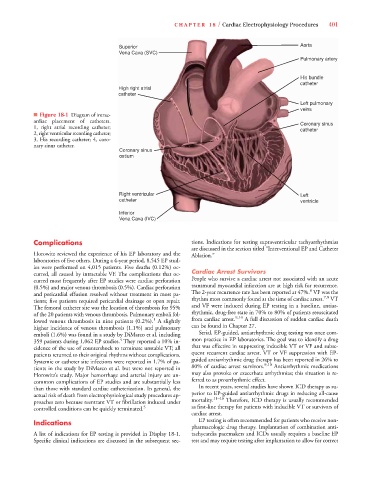
                   ■ Figure 18-1  Diagram of intrac-
                   ardiac placement of catheters.                                                         Coronary sinus
                   1, right atrial recording catheter;                                                    catheter
                   2, right ventricular recording catheter;
                   3, His recording catheter; 4, coro-
                   nary sinus catheter.
                                               Coronary sinus
                                               ostium
                                               Right ventricular                                          Left
                                               catheter                                                   ventricle
                                               Inferior
                                               Vena Cava (IVC)


                   Complications                                       tions. Indications for testing supraventricular tachyarrhythmias
                                                                       are discussed in the section titled “Interventional EP and Catheter
                   Horowitz reviewed the experience of his EP laboratory and the  Ablation.”
                   laboratories of five others. During a 4-year period, 8,545 EP stud-
                   ies were performed on 4,015 patients. Five deaths (0.12%) oc-
                   curred, all caused by intractable VF. The complications that oc-  Cardiac Arrest Survivors
                   curred most frequently after EP studies were cardiac perforation  People who survive a cardiac arrest not associated with an acute
                   (0.5%) and major venous thrombosis (0.5%). Cardiac perforation  transmural myocardial infarction are at high risk for recurrence.
                                                                                                             6
                   and pericardial effusion resolved without treatment in most pa-  The 2-year recurrence rate has been reported at 47%. VF was the
                                                                                                                  7,8
                   tients; five patients required pericardial drainage or open repair.  rhythm most commonly found at the time of cardiac arrest.  VT
                   The femoral catheter site was the location of thrombosis for 95%  and VF were induced during EP testing in a baseline, antiar-
                   of the 20 patients with venous thrombosis. Pulmonary emboli fol-  rhythmic, drug-free state in 70% to 80% of patients resuscitated
                                                                                     9,10
                                                          1
                   lowed venous thrombosis in nine patients (0.2%). A slightly  from cardiac arrest.  A full discussion of sudden cardiac death
                   higher incidence of venous thrombosis (1.1%) and pulmonary  can be found in Chapter 27.
                   emboli (1.6%) was found in a study by DiMarco et al. including  Serial, EP-guided, antiarrhythmic drug testing was once com-
                                               4
                   359 patients during 1,062 EP studies. They reported a 10% in-  mon practice in EP laboratories. The goal was to identify a drug
                   cidence of the use of countershock to terminate unstable VT; all  that was effective in suppressing inducible VT or VF and subse-
                   patients returned to their original rhythms without complications.  quent recurrent cardiac arrest. VT or VF suppression with EP-
                   Systemic or catheter site infections were reported in 1.7% of pa-  guided antiarrhythmic drug therapy has been reported in 26% to
                                                                                              9,10
                   tients in the study by DiMarco et al. but were not reported in  80% of cardiac arrest survivors.  Antiarrhythmic medications
                   Horowitz’s study. Major hemorrhage and arterial injury are un-  may also provoke or exacerbate arrhythmias; this situation is re-
                   common complications of EP studies and are substantially less  ferred to as proarrhythmic effect.
                   than those with standard cardiac catheterization. In general, the  In recent years, several studies have shown ICD therapy as su-
                   actual risk of death from electrophysiological study procedures ap-  perior to EP-guided antiarrhythmic drugs in reducing all-cause
                                                                              11–16
                   proaches zero because reentrant VT or fibrillation induced under  mortality.  Therefore, ICD therapy is usually recommended
                   controlled conditions can be quickly terminated. 5  as first-line therapy for patients with inducible VT or survivors of
                                                                       cardiac arrest.
                   Indications                                           EP testing is often recommended for patients who receive non-
                                                                       pharmacologic drug therapy. Implantation of combination anti-
                   A list of indications for EP testing is provided in Display 18-1.  tachycardia pacemakers and ICDs usually requires a baseline EP
                   Specific clinical indications are discussed in the subsequent sec-  test and may require testing after implantation to allow for correct

