


Page 426 - Cardiac Nursing
P. 426
/09
                                /30
                                        P
                                      :57
                               6
                       0-4
                    p40
                           qxd
                         19.
                                                    pta
                                                  2 A
                                                        Inc
                                                      ra
                                                40
                                            P
                                          M
                                             a
                                             a
            K34
               0-c
                 18_
         LWB K34 0-c 18_ p40 0-4 19. qxd  6 /30 /09  7 7 :57  P M  P a g g e e  40 2 A pta ra  Inc . .
         LWB
         LWBK340-c18_p400-419.qxd  6/30/09  7:57 PM Page 402 Aptara Inc.
                  402    P A R T  III / Assessment of Heart Disease


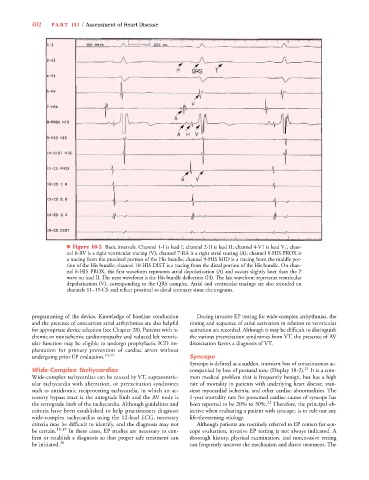
                              ■ Figure 18-2  Basic intervals. Channel 1-I is lead I; channel 2-II is lead II; channel 4-V1 is lead V 1 ; chan-
                              nel 6-RV is a right ventricular tracing (V); channel 7-RA is a right atrial tracing (A); channel 8-HIS PROX is
                              a tracing from the proximal portion of the His bundle; channel 9-HIS MID is a tracing from the middle por-
                              tion of the His bundle; channel 10-HIS DIST is a tracing from the distal portion of the His bundle. On chan-
                              nel 8-HIS PROX, the first waveform represents atrial depolarization (A) and occurs slightly later than the P
                              wave on lead II. The next waveform is the His bundle deflection (H). The last waveform represents ventricular
                              depolarization (V), corresponding to the QRS complex. Atrial and ventricular tracings are also recorded on
                              channels 11–15-CS and reflect proximal to distal coronary sinus electrograms.


                  programming of the device. Knowledge of baseline conduction  During invasive EP testing for wide-complex arrhythmias, the
                  and the presence of concurrent atrial arrhythmias are also helpful  timing and sequence of atrial activation in relation to ventricular
                  for appropriate device selection (see Chapter 28). Patients with is-  activation are recorded. Although it may be difficult to distinguish
                  chemic or nonischemic cardiomyopathy and reduced left ventric-  the various preexcitation syndromes from VT, the presence of AV
                  ular function may be eligible to undergo prophylactic ICD im-  dissociation favors a diagnosis of VT.
                  plantation  for  primary  prevention of cardiac arrest without
                  undergoing prior EP evaluation. 16,17               Syncope
                                                                      Syncope is defined as a sudden, transient loss of consciousness ac-
                  Wide-Complex Tachycardias                           companied by loss of postural tone (Display 18-2). 21  It is a com-
                  Wide-complex tachycardias can be caused by VT, supraventric-  mon medical problem that is frequently benign, but has a high
                  ular tachycardia with aberration, or preexcitation syndromes  rate of mortality in patients with underlying heart disease, tran-
                  such as antidromic reciprocating tachycardia, in which an ac-  sient myocardial ischemia, and other cardiac abnormalities. The
                  cessory bypass tract is the antegrade limb and the AV node is  1-year mortality rate for presumed cardiac causes of syncope has
                  the retrograde limb of the tachycardia. Although guidelines and  been reported to be 20% to 30%. 22  Therefore, the principal ob-
                  criteria have been established to help practitioners diagnose  jective when evaluating a patient with syncope, is to rule out any
                  wide-complex tachycardias using the 12-lead ECG, necessary  life-threatening etiology.
                  criteria may be difficult to identify, and the diagnosis may not  Although patients are routinely referred to EP centers for syn-
                  be certain. 18,19  In these cases, EP studies are necessary to con-  cope evaluation, invasive EP testing is not always indicated. A
                  firm or establish a diagnosis so that proper safe treatment can  thorough history, physical examination, and noninvasive testing
                  be initiated. 20                                    can frequently uncover the mechanism and direct treatment. The

