


Page 428 - Cardiac Nursing
P. 428
P
                                      :57
                                  /09
                                          M
                                             a
                                             a
                                            P
                         19.
                       0-4
                    p40
                         19.
                                /30
                               6
                           qxd
            K34
               0-c
                 18_
            K34
         LWBK340-c18_18_p400-419.qxd  6/30/09  7:57 PM Page 404 Aptara Inc.
         LWB
         LWB K34 0-c 18_ p40 0-4 19. qxd  6 /30 /09  7 7 :57  P M  P a g g e e  40 4 A pta ra  Inc . .
                                                40
                                                  4 A
                                                    pta
                                                    pta
                                                        Inc
                                                      ra
                  404    P A R T  III / Assessment of Heart Disease
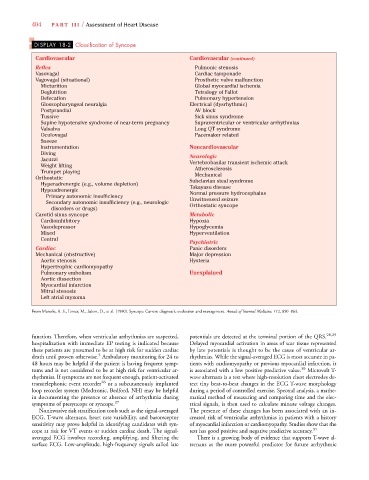
                   DISPLAY 18-2 Classification of Syncope
                    Cardiovascular                                    Cardiovascular (continued)
                    Reflex                                               Pulmonic stenosis
                    Vasovagal                                           Cardiac tamponade
                    Vagovagal (situational)                             Prosthetic valve malfunction
                     Micturition                                        Global myocardial ischemia
                     Deglutition                                        Tetralogy of Fallot
                     Defecation                                         Pulmonary hypertension
                     Glossopharyngeal neuralgia                       Electrical (dysrhythmic)
                     Postprandial                                       AV block
                     Tussive                                            Sick sinus syndrome
                     Supine hypotensive syndrome of near-term pregnancy  Supraventricular or ventricular arrhythmias
                     Valsalva                                           Long QT syndrome
                     Oculovagal                                         Pacemaker related
                     Sneeze
                     Instrumentation                                  Noncardiovascular
                     Diving                                           Neurologic
                     Jacuzzi                                          Vertebrobasilar transient ischemic attack
                     Weight lifting                                     Atherosclerosis
                     Trumpet playing
                                                                        Mechanical
                    Orthostatic                                       Subclavian steal syndrome
                     Hyperadrenergic (e.g., volume depletion)         Takayasu disease
                     Hypoadrenergic                                   Normal pressure hydrocephalus
                       Primary autonomic insufficiency                 Unwitnessed seizure
                       Secondary autonomic insufficiency (e.g., neurologic  Orthostatic syncope
                         disorders or drugs)
                    Carotid sinus syncope                             Metabolic
                     Cardioinhibitory                                 Hypoxia
                     Vasodepressor                                    Hypoglycemia
                     Mixed                                            Hyperventilation
                     Central
                                                                      Psychiatric
                    Cardiac                                           Panic disorders
                    Mechanical (obstructive)                          Major depression
                     Aortic stenosis                                  Hysteria
                     Hypertrophic cardiomyopathy
                     Pulmonary embolism                               Unexplained
                     Aortic dissection
                     Myocardial infarction
                     Mitral stenosis
                     Left atrial myxoma
                  From Manolis, A. S., Linzer, M., Salem, D., et al. (1990). Syncope: Current diagnostic evaluation and management. Annals of Internal Medicine, 112, 850–863.
                  function. Therefore, when ventricular arrhythmias are suspected,  potentials are detected at the terminal portion of the QRS. 28,29
                  hospitalization with immediate EP testing is indicated because  Delayed myocardial activation in areas of scar tissue represented
                  these patients are presumed to be at high risk for sudden cardiac  by late potentials is thought to be the cause of ventricular ar-
                                        5
                  death until proven otherwise. Ambulatory monitoring for 24 to  rhythmias. While the signal-averaged ECG is most accurate in pa-
                  48 hours may be helpful if the patient is having frequent symp-  tients with cardiomyopathy or previous myocardial infarction, it
                  toms and is not considered to be at high risk for ventricular ar-  is associated with a low positive predictive value. 30  Microvolt T-
                  rhythmias. If symptoms are not frequent enough, patient-activated  wave alternans is a test where high-resolution chest electrodes de-
                  transtelephonic event recorder 26  or a subcutaneously implanted  tect tiny beat-to-beat changes in the ECG T-wave morphology
                  loop recorder system (Medtronic, Bedford, NH) may be helpful  during a period of controlled exercise. Spectral analysis, a mathe-
                  in documenting the presence or absence of arrhythmia during  matical method of measuring and comparing time and the elec-
                  symptoms of presyncope or syncope. 27               trical signals, is then used to calculate minute voltage changes.
                     Noninvasive risk stratification tools such as the signal-averaged  The presence of these changes has been associated with an in-
                  ECG, T-wave alternans, heart rate variability, and baroreceptor  creased risk of ventricular arrhythmias in patients with a history
                  sensitivity may prove helpful in identifying candidates with syn-  of myocardial infarction or cardiomyopathy. Studies show that the
                  cope at risk for VT events or sudden cardiac death. The signal-  test has good positive and negative predictive accuracy. 31
                  averaged ECG involves recording, amplifying, and filtering the  There is a growing body of evidence that supports T-wave al-
                  surface ECG. Low-amplitude, high-frequency signals called late  ternans as the more powerful predictor for future arrhythmic

