


Page 430 - Cardiac Nursing
P. 430
/30
                               6
                                  /09
                                        P
                                      :57
                       0-4
                    p40
                         19.
                           qxd
                         19.
                                                    pta
                                                  6 A
                                                    pta
                                                        Inc
                                                      ra
                                            P
                                          M
                                             a
                                                40
                                             a
            K34
               0-c
                 18_
            K34
         LWBK340-c18_18_p400-419.qxd  6/30/09  7:57 PM Page 406 Aptara Inc.
         L L LWB
         LWB K34 0-c 18_ p40 0-4 19. qxd  6 /30 /09  7 7 :57  P M  P a g g e e  40 6 A pta ra  Inc . .
                  406    P A R T  III / Assessment of Heart Disease
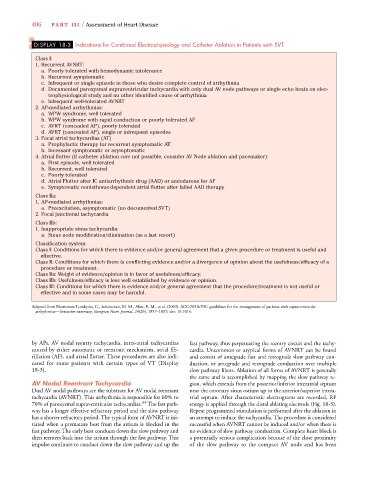
                   DISPLAY 18-3 Indications for Combined Electrophysiology and Catheter Ablation in Patients with SVT
                    Class I:
                    1. Recurrent AVNRT:
                     a. Poorly tolerated with hemodynamic intolerance
                     b. Recurrent symptomatic
                     c. Infrequent or single episode in those who desire complete control of arrhythmia
                     d. Documented paroxysmal supraventricular tachycardia with only dual AV node pathways or single echo beats on elec-
                        trophysiological study and no other identified cause of arrhythmia
                     e. Infrequent well-tolerated AVNRT
                    2. AP-mediated arrhythmias:
                     a. WPW syndrome, well tolerated
                     b. WPW syndrome with rapid conduction or poorly tolerated AF
                     c. AVRT (concealed AP), poorly tolerated
                     d. AVRT (concealed AP), single or infrequent episodes
                    3. Focal atrial tachycardias (AT)
                     a. Prophylactic therapy for recurrent symptomatic AT
                     b. Incessant symptomatic or asymptomatic
                    4. Atrial flutter (if catheter ablation cure not possible, consider AV Node ablation and pacemaker):
                     a. First episode, well tolerated
                     b. Recurrent, well tolerated
                     c. Poorly tolerated
                     d. Atrial Flutter after IC antiarrhythmic drug (AAD) or amiodarone for AF
                     e. Symptomatic nonisthmus-dependent atrial flutter after failed AAD therapy
                    Class IIa:
                    1. AP-mediated arrhythmias:
                     a. Preexcitation, asymptomatic (no documented SVT)
                    2. Focal junctional tachycardia
                    Class IIb:
                    1. Inappropriate sinus tachycardia:
                     a. Sinus node modification/elimination (as a last resort)
                    Classification system:
                    Class I: Conditions for which there is evidence and/or general agreement that a given procedure or treatment is useful and
                     effective.
                    Class II: Conditions for which there is conflicting evidence and/or a divergence of opinion about the usefulness/efficacy of a
                     procedure or treatment.
                    Class IIa: Weight of evidence/opinion is in favor of usefulness/efficacy.
                    Class IIb: Usefulness/efficacy is less well established by evidence or opinion.
                    Class III: Conditions for which there is evidence and/or general agreement that the procedure/treatment is not useful or
                     effective and in some cases may be harmful.
                  Adapted from Blomstrom-Lundqvist, C., Scheinman, M. M., Aliot, E. M., et al. (2003). ACC/AHA/ESC guidelines for the management of patients with supraventricular
                    arrhythmias—Executive summary. European Heart Journal, 24(20), 1857–1897; doi: 10.1016.


                  by APs, AV nodal reentry tachycardia, intra-atrial tachycardias  fast pathway, thus perpetuating the reentry circuit and the tachy-
                  caused by either automatic or reentrant mechanism, atrial fib-  cardia. Uncommon or atypical forms of AVNRT can be found
                  rillation (AF), and atrial flutter. These procedures are also indi-  and consist of antegrade fast and retrograde slow pathway con-
                  cated  for some  patients with certain types of VT  (Display   duction, or antegrade and retrograde conduction over multiple
                  18-3).                                              slow pathway fibers. Ablation of all forms of AVNRT is generally
                                                                      the same and is accomplished by mapping the slow pathway re-
                  AV Nodal Reentrant Tachycardia                      gion, which extends from the posterior/inferior interatrial septum
                  Dual AV nodal pathways are the substrate for AV nodal reentrant  near the coronary sinus ostium up to the anterior/superior intera-
                  tachycardia (AVNRT). This arrhythmia is responsible for 60% to  trial septum. After characteristic electrograms are recorded, RF
                                                      44
                  70% of paroxysmal supraventricular tachycardias. The fast path-  energy is applied through the distal ablating electrode (Fig. 18-3).
                  way has a longer effective refractory period and the slow pathway  Repeat programmed stimulation is performed after the ablation in
                  has a shorter refractory period. The typical form of AVNRT is ini-  an attempt to induce the tachycardia. The procedure is considered
                  tiated when a premature beat from the atrium is blocked in the  successful when AVNRT cannot be induced and/or when there is
                  fast pathway. The early beat conducts down the slow pathway and  no evidence of slow pathway conduction. Complete heart block is
                  then reenters back into the atrium through the fast pathway. This  a potentially serious complication because of the close proximity
                  impulse continues to conduct down the slow pathway and up the  of the slow  pathway to the compact AV node and has been

