


Page 445 - Cardiac Nursing
P. 445
LWBK340-c19_p420-438.qxd  09/09/2009  08:27 AM  Page 421 Aptara


                                                                                   C HAP TE R 1 9 / Exercise Testing  421

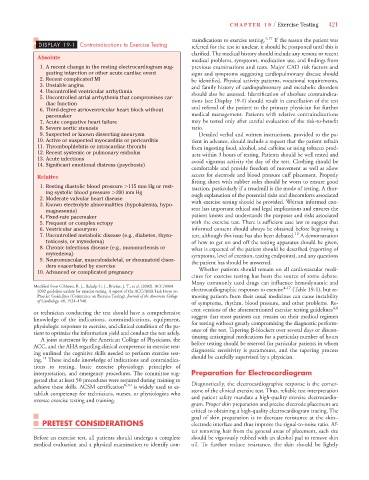
                                                                       traindications to exercise testing. 4,17  If the reason the patient was
                     DISPLAY 19-1  Contraindications to Exercise Testing  referred for the test in unclear, it should be postponed until this is
                                                                       clarified. The medical history should include any remote or recent
                    Absolute
                                                                       medical problems, symptoms, medication use, and findings from
                     1. A recent change in the resting electrocardiogram sug-  previous examinations and tests. Major CAD risk factors and
                       gesting infarction or other acute cardiac event  signs and symptoms suggesting cardiopulmonary disease should
                     2. Recent complicated MI                          be identified. Physical activity patterns, vocational requirements,
                     3. Unstable angina                                and family history of cardiopulmonary and metabolic disorders
                     4. Uncontrolled ventricular arrhythmia            should also be assessed. Identification of absolute contraindica-
                     5. Uncontrolled atrial arrhythmia that compromises car-  tions (see Display 19-1) should result in cancellation of the test
                       diac function
                     6. Third-degree atrioventricular heart block without  and referral of the patient to the primary physician for further
                       pacemaker                                       medical management. Patients with relative contraindications
                     7. Acute congestive heart failure                 may be tested only after careful evaluation of the risk-to-benefit
                     8. Severe aortic stenosis                         ratio.
                     9. Suspected or known dissecting aneurysm           Detailed verbal and written instructions, provided to the pa-
                    10. Active or suspected myocarditis or pericarditis  tient in advance, should include a request that the patient refrain
                    11. Thrombophlebitis or intracardiac thrombi       from ingesting food, alcohol, and caffeine or using tobacco prod-
                    12. Recent systemic or pulmonary embolus           ucts within 3 hours of testing. Patients should be well rested and
                    13. Acute infections                               avoid vigorous activity the day of the test. Clothing should be
                    14. Significant emotional distress (psychosis)
                                                                       comfortable and provide freedom of movement as well as allow
                                                                       access for electrode and blood pressure cuff placement. Properly
                    Relative
                                                                       fitting shoes with rubber soles should be worn to ensure good
                     1. Resting diastolic blood pressure  115 mm Hg or rest-  traction, particularly if a treadmill is the mode of testing. A thor-
                       ing systolic blood pressure  200 mm Hg          ough explanation of the potential risks and discomforts associated
                     2. Moderate valvular heart disease                with exercise testing should be provided. Written informed con-
                     3. Known electrolyte abnormalities (hypokalemia, hypo-
                       magnesemia)                                     sent has important ethical and legal implications and ensures the
                     4. Fixed-rate pacemaker                           patient knows and understands the purposes and risks associated
                     5. Frequent or complex ectopy                     with the exercise test. There is sufficient case law to suggest that
                     6. Ventricular aneurysm                           informed consent should always be obtained before beginning a
                                                                                                        12
                     7. Uncontrolled metabolic disease (e.g., diabetes, thyro-  test, although this issue has also been debated. A demonstration
                       toxicosis, or myxedema)                         of how to get on and off the testing apparatus should be given,
                     8. Chronic infectious disease (e.g., mononucleosis or  what is expected of the patient should be described (reporting of
                       myxedema)                                       symptoms, level of exertion, testing endpoints), and any questions
                     9. Neuromuscular, musculoskeletal, or rheumatoid disor-  the patient has should be answered.
                       ders exacerbated by exercise
                    10. Advanced or complicated pregnancy                Whether patients should remain on all cardiovascular medi-
                                                                       cines for exercise testing has been the source of some debate.
                                                                       Many commonly used drugs can influence hemodynamic and
                   Modified from Gibbons, R. J., Balady, G. J., Bricker, J. T., et al. (2002). ACC/AHA  4,17
                    2002 guideline update for exercise testing. A report of the ACC/AHA Task Force on  electrocardiographic responses to exercise  (Table 19-1), but re-
                    Practice Guidelines (Committee on Exercise Testing). Journal of the American College  moving patients from their usual medicines can cause instability
                    of Cardiology,40, 1531–1540.
                                                                       of symptoms, rhythm, blood pressure, and other problems. Re-
                                                                       cent versions of the aforementioned exercise testing guidelines 4,8
                   or technician conducting the test should have a comprehensive
                   knowledge of the indications, contraindications, equipment,  suggest that most patients can remain on their medical regimen
                   physiologic responses to exercise, and clinical condition of the pa-  for testing without greatly compromising the diagnostic perform-
                   tient to optimize the information yield and conduct the test safely.  ance of the test. Tapering  -blockers over several days or discon-
                     A joint statement by the American College of Physicians, the  tinuing antianginal medications for a particular number of hours
                   ACC, and the AHA regarding clinical competence in exercise test-  before testing should be reserved for particular patients in whom
                   ing outlined the cognitive skills needed to perform exercise test-  diagnostic sensitivity is paramount, and the tapering process
                   ing. 11  These include knowledge of indications and contraindica-  should be carefully supervised by a physician.
                   tions to testing,  basic exercise physiology, principles of
                   interpretation, and emergency procedures. The committee sug-  Preparation for Electrocardiogram
                   gested that at least 50 procedures were required during training to
                   achieve these skills. ACSM certification 8,10  is widely used to es-  Diagnostically, the electrocardiographic response is the corner-
                   tablish competency for technicians, nurses, or physiologists who  stone of the clinical exercise test. Thus, reliable test interpretation
                   oversee exercise testing and training.              and patient safety mandate a high-quality exercise electrocardio-
                                                                       gram. Proper skin preparation and precise electrode placement are
                                                                       critical to obtaining a high-quality electrocardiogram tracing. The
                                                                       goal of skin preparation is to decrease resistance at the skin–
                      PRETEST CONSIDERATIONS                           electrode interface and thus improve the signal-to-noise ratio. Af-
                                                                       ter removing hair from the general areas of placement, each site
                   Before an exercise test, all patients should undergo a complete  should be vigorously rubbed with an alcohol pad to remove skin
                   medical evaluation and a physical examination to identify con-  oil. To  further reduce resistance, the skin should  be  lightly

