


Page 450 - Cardiac Nursing
P. 450
LWBK340-c19_p420-438.qxd  09/09/2009  08:27 AM  Page 426 Aptara


                  426    PA R T  III / Assessment of Heart Disease


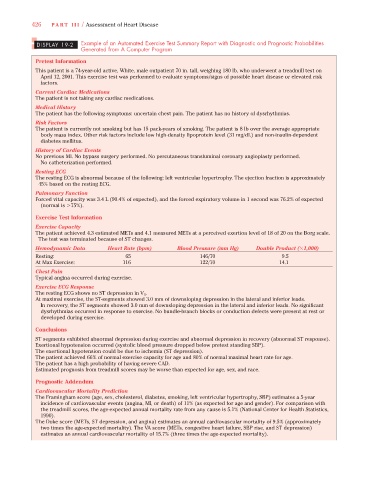
                    DISPLAY 19-2  Example of an Automated Exercise Test Summary Report with Diagnostic and Prognostic Probabilities
                                  Generated from A Computer Program
                    Pretest Information
                    This patient is a 74-year-old active, White, male outpatient 70 in. tall, weighing 180 lb, who underwent a treadmill test on
                     April 12, 2001. This exercise test was performed to evaluate symptoms/signs of possible heart disease or elevated risk
                     factors.
                    Current Cardiac Medications
                    The patient is not taking any cardiac medications.
                    Medical History
                    The patient has the following symptoms: uncertain chest pain. The patient has no history of dysrhythmias.
                    Risk Factors
                    The patient is currently not smoking but has 15 pack-years of smoking. The patient is 8 lb over the average appropriate
                     body mass index. Other risk factors include low high-density lipoprotein level (31 mg/dL) and non-insulin-dependent
                     diabetes mellitus.
                    History of Cardiac Events
                    No previous MI. No bypass surgery performed. No percutaneous transluminal coronary angioplasty performed.
                     No catheterization performed.
                    Resting ECG
                    The resting ECG is abnormal because of the following: left ventricular hypertrophy. The ejection fraction is approximately
                     45% based on the resting ECG.
                    Pulmonary Function
                    Forced vital capacity was 3.4 L (90.4% of expected), and the forced expiratory volume in 1 second was 76.2% of expected
                     (normal is  75%).
                    Exercise Test Information
                    Exercise Capacity
                    The patient achieved 4.3 estimated METs and 4.1 measured METs at a perceived exertion level of 18 of 20 on the Borg scale.
                     The test was terminated because of ST changes.
                                                                                                         (
                    Hemodynamic Data       Heart Rate (bpm)       Blood Pressure (mm Hg)    Double Product ( 1,000)
                                                                                                         (
                    Resting:                     65                      146/70                     9.5
                    At Max Exercise:            116                      122/70                    14.1
                    Chest Pain
                    Typical angina occurred during exercise.
                    Exercise ECG Response
                    The resting ECG shows no ST depression in V 5 .
                    At maximal exercise, the ST-segments showed 3.0 mm of downsloping depression in the lateral and inferior leads.
                     In recovery, the ST segments showed 3.0 mm of downsloping depression in the lateral and inferior leads. No significant
                     dysrhythmias occurred in response to exercise. No bundle-branch blocks or conduction defects were present at rest or
                     developed during exercise.
                    Conclusions
                    ST segments exhibited abnormal depression during exercise and abnormal depression in recovery (abnormal ST response).
                    Exertional hypotension occurred (systolic blood pressure dropped below pretest standing SBP).
                    The exertional hypotension could be due to ischemia (ST depression).
                    The patient achieved 66% of normal exercise capacity for age and 80% of normal maximal heart rate for age.
                    The patient has a high probability of having severe CAD.
                    Estimated prognosis from treadmill scores may be worse than expected for age, sex, and race.

                    Prognostic Addendum
                    Cardiovascular Mortality Prediction
                    The Framingham score (age, sex, cholesterol, diabetes, smoking, left ventricular hypertrophy, SBP) estimates a 5-year
                     incidence of cardiovascular events (angina, MI, or death) of 11% (as expected for age and gender). For comparison with
                     the treadmill scores, the age-expected annual mortality rate from any cause is 5.1% (National Center for Health Statistics,
                     1990).
                    The Duke score (METs, ST depression, and angina) estimates an annual cardiovascular mortality of 9.5% (approximately
                     two times the age-expected mortality). The VA score (METs, congestive heart failure, SBP rise, and ST depression)
                     estimates an annual cardiovascular mortality of 15.7% (three times the age-expected mortality).

