


Page 446 - Cardiac Nursing
P. 446
7 A
                    p42
                                                  e 4
                       0-4
                               0
                                  9/2
                                    009
                                                    22
                                9/0
                                                       Apt
                                                    22
                         38.
                                               P
                           qxd
                         38.
                                                 g
                                                         ara
                                               P
                                             M
         LWBK340-c19_19_p420-438.qxd  09/09/2009  08:27 AM  Page 422 Aptara
         L L LWB
                 19_
            K34
            K34
         LWB K34 0-c 19_ p42 0-4 38. qxd  0 9/0 9/2 009  0 0 8:2 7 A M  P a a g e 4 22  Apt ara
                                        8:2
               0-c
                  422    P A R T  III / Assessment of Heart Disease
                  Table 19-1 ■ COMMON DRUGS AND THEIR IMPACT ON EXERCISE TESTING
                  Drug             Indications       Heart Rate      Blood Pressure  Electrocardiogram  Exercise Capacity
                   -Blockers       Angina, hypertension,  Rest: ↓, exercise: ↓  Rest: ↓, exercise: ↓  ↓ Signs of ischemia  ↑ In those with angina,
                                    MI, arrhythmias,                                                    ↓ in those without
                                    tremors, migraine                                                   angina
                                    headache
                  Calcium channel  Angina, coronary artery  Rest: ↓, exercise: ↓  Rest: ↓, exercise: ↓  ↓ Signs of ischemia  ↑ In those with angina,
                    blockers        spasm, hypertension                                                 minimal effect in
                                                                                                        those without angina
                  Digoxin          CHF, arrhythmias  No change       Rest: ↓, Exercise: ↓  Will cause false-positive  ↑ In those with CHF
                                                                                      responses
                  Nitrates         Angina            No change       Rest: ↓, Exercise: ↓  Delayed signs of ischemia  ↑ In those with angina
                                                                                                        (and CHF)
                  abraded using an abrasive pad or other product designed for this  For this reason, diagnostic ST-segment changes should always be
                  purpose. Finally, each electrode should be carefully placed in the  made relative to the resting baseline position (i.e., upright rather
                  proper location to ensure good skin contact with both the con-  than supine position for treadmill and cycle ergometry).
                  ducting gel and adhesive surfaces of the electrode.
                                                 18
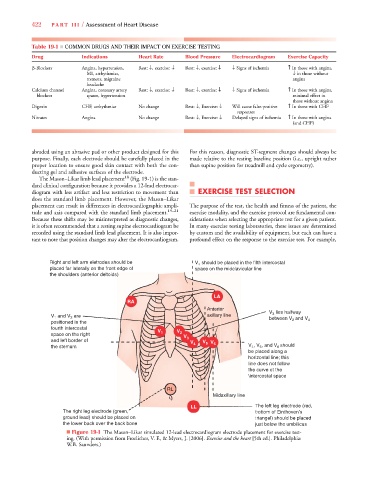
                     The Mason–Likar limb lead placement (Fig. 19-1) is the stan-
                  dard clinical configuration because it provides a 12-lead electrocar-
                  diogram with less artifact and less restriction to movement than  EXERCISE TEST SELECTION
                  does the standard limb placement. However, the Mason–Likar
                  placement can result in differences in electrocardiographic ampli-  The purpose of the test, the health and fitness of the patient, the
                  tude and axis compared with the standard limb placement. 19–21  exercise modality, and the exercise protocol are fundamental con-
                  Because these shifts may be misinterpreted as diagnostic changes,  siderations when selecting the appropriate test for a given patient.
                  it is often recommended that a resting supine electrocardiogram be  In many exercise testing laboratories, these issues are determined
                  recorded using the standard limb lead placement. It is also impor-  by custom and the availability of equipment, but each can have a
                  tant to note that position changes may alter the electrocardiogram.  profound effect on the response to the exercise test. For example,
                        Right and left arm eletrodes should be          V  should be placed in the fifth intercostal
                                                                         4
                        placed far laterally on the front edge of       space on the midclavicular line
                        the shoulders (anterior deltoids))

                                                                              LA
                                                  RA
                                                                            Anterior
                                                                            A A  o              V  lies halfway
                                                                                                 3
                                                                               ry
                                                                              lla
                         V and V  are                                       axiillary y y line  between V and V
                          1
                               2
                         positioned in the                                                              2    4
                         fourth intercostal
                                                            V 1   V 2
                         space on the right
                                                                    V 3
                         and left border of
                                                                           5
                                                                      V 4  V V 6
                         the stemum                                                      V , V , and V should
                                                                                          4
                                                                                                   6
                                                                                             5
                                                                                         be placed along a
                                                                                         horizontal line; this
                                                                                         line does not follow
                                                                                         the curve ot the
                                                                                         \intercostal space
                                                               RL
                                                                              Mid daxillary lin ne
                                                                      LL                   The left leg electrode (red,
                             The right leg electrode (green,                               bottom of Einthoven’s
                             ground lead) should be placed on                              triangel) should be placed
                             the lower back over the back bone                             just below the umbilicus
                              ■ Figure 19-1 The Mason–Likar simulated 12-lead electrocardiogram electrode placement for exercise test-
                              ing. (With permission from Froelicher, V. F., & Myers, J. [2006]. Exercise and the heart [5th ed.]. Philadelphia:
                              W.B. Saunders.)

