


Page 448 - Cardiac Nursing
P. 448
Apt
                                                         ara
                                                    24
                       0-4
                    p42
                                               P
                                               P
                                                    24
                                                 g
                                                  e 4
                                    009
                                  9/2
                                        8:2
                                             M
                                           7 A
                         38.
                         38.
                           qxd
                                9/0
                               0
            K34
               0-c
                 19_
            K34
         L L LWB K34 0-c 19_ p42 0-4 38. qxd  0 9/0 9/2 009  0 0 8:2 7 A M  P a a g e 4 24  Apt ara
         LWB
         LWBK340-c19_19_p420-438.qxd  09/09/2009  08:27 AM  Page 424 Aptara
                  424    P A R T  III / Assessment of Heart Disease


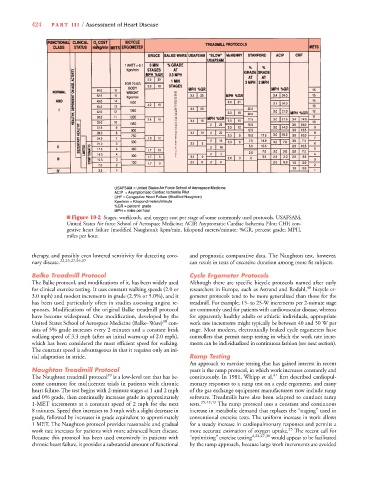
                              ■ Figure 19-2 Stages, workloads, and oxygen cost per stage of some commonly used protocols. USAFSAM,
                              United States Air force School of Aerospace Medicine; ACIP, Asyptomatic Cardiac Ischemia Pilot; CHF, con-
                              gestive heart failure (modified Naughton); kpm/min, kilopond meters/minute; %GR, percent grade; MPH,
                              miles per hour.


                  therapy, and possibly even lowered sensitivity for detecting coro-  and prognostic comparative data. The Naughton test, however,
                  nary disease. 22,25,27,36,37                        can result in tests of excessive duration among more fit subjects.

                  Balke Treadmill Protocol                            Cycle Ergometer Protocols
                  The Balke protocol, and modifications of it, has been widely used  Although there are specific bicycle protocols named after early
                  for clinical exercise testing. It uses constant walking speeds (2.0 or  researchers in Europe, such as Astrand and Rodahl, 40  bicycle er-
                  3.0 mph) and modest increments in grade (2.5% or 5.0%), and it  gometer protocols tend to be more generalized than those for the
                  has been used particularly often in studies assessing angina re-  treadmill. For example, 15- to 25-W increments per 2-minute stage
                  sponses. Modifications of the original Balke treadmill protocol  are commonly used for patients with cardiovascular disease, whereas
                  have become widespread. One modification, developed by the  for apparently healthy adults or athletic individuals, appropriate
                                                             38
                  United States School of Aerospace Medicine (Balke–Ware) con-  work rate increments might typically be between 40 and 50 W per
                  sists of 5% grade increases every 2 minutes and a constant brisk  stage. Most modern, electronically braked cycle ergometers have
                  walking speed of 3.3 mph (after an initial warm-up of 2.0 mph),  controllers that permit ramp testing in which the work rate incre-
                  which has been considered the most efficient speed for walking.  ments can be individualized in continuous fashion (see next section).
                  The constant speed is advantageous in that it requires only an ini-
                  tial adaptation in stride.                          Ramp Testing
                                                                      An approach to exercise testing that has gained interest in recent
                  Naughton Treadmill Protocol                         years is the ramp protocol, in which work increases constantly and
                  The Naughton treadmill protocol 39  is a low-level test that has be-  continuously. In 1981, Whipp et al. 41  first described cardiopul-
                  come common for multicenter trials in patients with chronic  monary responses to a ramp test on a cycle ergometer, and many
                  heart failure. The test begins with 2-minute stages at 1 and 2 mph  of the gas exchange equipment manufacturers now include ramp
                  and 0% grade, then continually increases grade in approximately  software. Treadmills have also been adapted to conduct ramp
                  1-MET increments at a constant speed of 2 mph for the next  tests. 25,42,43  The ramp protocol uses a constant and continuous
                  8 minutes. Speed then increases to 3 mph with a slight decrease in  increase in metabolic demand that replaces the “staging” used in
                  grade, followed by increases in grade equivalent to approximately  conventional exercise tests. The uniform increase in work allows
                  1 MET. The Naughton protocol provides reasonable and gradual  for a steady increase in cardiopulmonary responses and permits a
                  work rate increases for patients with more advanced heart disease.  more accurate estimation of oxygen uptake. 25  The recent call for
                  Because this protocol has been used extensively in patients with  “optimizing” exercise testing 4,22,27,30  would appear to be facilitated
                  chronic heart failure, it provides a substantial amount of functional  by the ramp approach, because large work increments are avoided

