


Page 517 - Cardiac Nursing
P. 517
P
                                                 g
                                               P
                                           8 A
                                             M
                                                       Apt
                                                         ara
                                                    93
                                                  e 4
                                                    93
                         10.
                           qxd
                         10.
                       0-5
                    p46
                                    009
                                        8:2
                                  9/2
                               0
                                9/0
            K34
            K34
                 21_
               0-c
         LWB K34 0-c 21_ p46 0-5 10. qxd  0 9/0 9/2 009  0 0 8:2 8 A M  P a a g e 4 93  Apt ara
         LWBK340-c21_21_p460-510.qxd  09/09/2009  08:28 AM  Page 493 Aptara
         L L LWB
                                                                           C HAPTER 2 1 / Hemodynamic Monitoring   493
                   Hg, while the CI increased there was no improvement in indi-  Technical Aspects of Monitoring
                   cators of tissue perfusion. 96  Therefore, standard hemodynamic  Components of a continuous   monitoring system include the
                   indices may not be sensitive to changes in tissue oxygenation,  fiberoptic PA catheter, the optical module, and the microprocessor.
                                          #
                                      #
                   and the use of global (  ,   , serum lactate, and   or  The fiberoptic catheter is a quadruple-lumen PA catheter with
                       ) and regional indices (transcutaneous O 2 and CO 2 sat-
                   Scvo 2                                              fiberoptic channels running the length of the catheter. The optical
                   uration, near-infrared spectroscopy (NIRS) and sublingual  module contains diodes that emit light pulses through one of the
                   microcirculation assessment) may offer additional targeted  fiberoptic channels in the tip of the catheter. The second fiberop-
                   information.                                        tic channel returns reflected light to a photodetector in the optical
                                                                       module (reflected spectrometry). The amount of light reflected de-
                                                                       pends on the amount of saturated Hgb, because oxygenated and
                   Global Indicators of Oxygen
                   Supply and Demand                                   deoxygenated Hgb have different reflections. The light is relayed
                                                                       electronically to the microprocessor, which interprets the light sig-
                   Oxygen delivery depends on the amount of O 2 in the blood and  nal and determines the ratio between oxygenated and deoxy-
                   how much blood is delivered to the tissues (CO). The O 2 deliv-  genated blood. The   is based on this ratio.
                       #
                                             #
                   ery (  ) and O 2 consumption (  ) equations are outlined in
                   Table 21-11. An understanding of the factors that affect   and  Indications
                    #
                                  g
                                  g
                       is important to guide therapeutic decision, although the use  Continuous   monitoring has been recommended for moni-
                   Vo 2     #      #
                   of absolute   and   values as endpoints for resuscitation has  toring and as an outcome measure in patients with sepsis/septic
                   not been found to improve outcomes.                 shock, cardiac surgery, complicated MI (i.e., cardiogenic shock),
                                                                       or patients with respiratory failure requiring PEEP.   monitor-
                                                                       ing is also recommended in the absence of hypotension when
                   Mixed Venous Oxygen Saturation                      shock is suspected by history and physical examination. 166
                   Although CO provides important information about the capacity  Clinical Application
                   of the cardiopulmonary system to deliver O 2 to the tissues, it does
                   not necessarily depict the adequacy of O 2 supply at the tissue  The   normally ranges from 70% to 75%, which is associated
                   level. The   , which is a global measure of the balance between  with a   of 40 mm Hg. An   of less than 40% is usually
                                                                                                  #
                   total body O 2 delivery and consumption, 431  is affected by factors  accompanied by anaerobic metabolism, and an   between
                                                              #
                   that affect O 2 delivery (CO, Hb, Sa o2 ) and consumption (  ) as  40% and 60% indicates inadequate   or excessive O 2 demand.
                   described by the following equation:                In response to increased O 2 demand, the body either increases
                                          #                            CO to deliver more O 2 or increases the extraction of O 2 from the
                                                                       blood. Although the   reflects the O 2 balance for the entire
                                          Vo 2
                            Svo 2   Sa O2   a    1.36   Hgb b          body, it does not provide information on the adequacy of oxy-
                                          CO
                                                                       genation for individual organs.
                     The assumption is that if the Hgb and Sa o2 are not changing;  When the Sa o2 is maintained near 100%, there is a strong re-
                   the change in   reflects a change in CO. However, a decreased  lationship between the   and the O 2 extraction ratio (O 2 ER),
                                                              #
                       may also be caused by arterial hypoxemia, increased   , or  as defined by the equation:
                   Svo 2
                   a decreased Hgb; and in patients with severe HF (EF   30%) the            1   O 2 ER.
                       is not an adequate indicator of changes in CO. 432  Con-        Svo 2
                   Svo 2
                   versely, in septic shock an increased   may indicate inadequate  Increased O 2 extraction decreases Hgb saturation, which is re-
                   O 2 utilization. 431                                flected as a decrease in   . In general, as long as O 2 delivery is
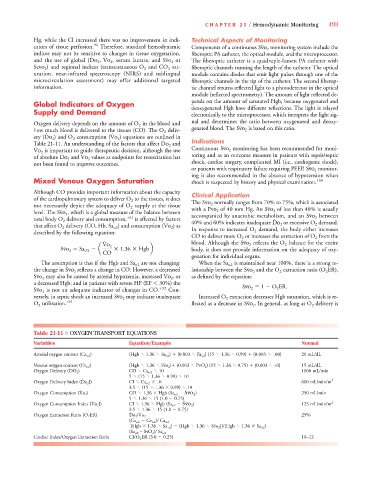
                   Table 21-11 ■ OXYGEN TRANSPORT EQUATIONS
                   Variables                      Equation/Example                                         Normal
                   Arterial oxygen content (Ca o2 )  (Hgb   1.36   Sa o2 )
 (0.003   Pa o2 ) (15   1.36   0.99)
 (0.003   100)  20 mL/dL
                   Venous oxygen content (Cv o2 )  (Hgb   1.36   Svo 2 )
 (0.003   PvO 2 ) (15   1.36   0.75)
 (0.003   40)  15 mL/dL
                               #
                   Oxygen Delivery (  )           CO   Ca o2   10                                          1000 mL/min
                                   #              5   (15   1.36   0.99)   10
                   Oxygen Delivery Index (  )     CI   Ca o2   10                                          600 mL/min/m 2
                                  #               3.5   (15   1.36   0.99)   10
                   Oxygen Consumption (  )        CO   1.36   Hgb (Sa o2   Svo 2 )                         250 mL/min
                                      #           5   1.36   15 (1.0   0.75)
                   Oxygen Consumption Index (  )  CI   1.36   Hgb (Sa o2   Svo 2 )                         125 mL/min/m 2
                                                  3.5   1.36   15 (1.0   0.75)
                                                      #
                                                   #
                   Oxygen Extraction Ratio (O 2 ER)  2 /Vo 2                                               25%
                                                  (Ca o2   Cv o2 )/ Ca o2
                                                                                )]/(Hgb   1.36   Sa o2 )
                                                  [(Hgb   1.36   Sa o2 )   (Hgb   1.36   Svo 2
                                                  (Sa o2 –  2 )/ Sa o2
                   Cardiac Index/Oxygen Extraction Ratio  CI/O 2 ER (3.0   0.25)                           10–12

