


Page 520 - Cardiac Nursing
P. 520
9/0
                               0
                                  9/2
                                        8:2
                                    009
                       0-5
                    p46
                         10.
                           qxd
                         10.
                                                    96
                                                  e 4
                                                    96
                                                         ara
                                                       Apt
                                             M
                                           8 A
                                               P
                                                 g
                                               P
         LWBK340-c21_21_p460-510.qxd  09/09/2009  08:28 AM  Page 496 Aptara
         L L LWB
         LWB K34 0-c 21_ p46 0-5 10. qxd  0 9/0 9/2 009  0 0 8:2 8 A M  P a a g e 4 96  Apt ara
            K34
                 21_
               0-c
            K34
                  496    P A R T  III / Assessment of Heart Disease
                   DISPLAY 21-8  Integrated Approach to Fluid         functional indices were not used as part of an integrated plan of
                                 Resuscitation                        care. 479
                                                                        Research is now being conducted to evaluate the use of func-
                    1. Is there an indication of end-organ hypoperfusion?  tional indices or less invasive CO monitoring as part of an inte-
                    2. Measure MAP/functional indicators
                    3. If functional indicator   threshold—give 500 mL bolus  grated plan of care. For example, high-risk surgical patients were
                     over 15 minutes and reassess                     randomized to receive postoperative fluid resuscitation guided by
                    4. Repeat boluses every 15 minutes until functional indica-  CVP (fluid boluses administered to achieve a sustained increased
                     tor   threshold, then stop                       in CVP of 2 mm Hg lasting for at least 20 minutes) compared
                    5. If MAP remains   60 mm Hg after initial fluid bolus—  with patients receiving fluids to increase their SV by  10% for
                                                                                                       #
                     start norepinephrine                             at least 20 minutes and dopexamine if their   did not exceed
                                                                                 2
                    6. If functional indicator   threshold and vasopressor  600 mL/min/m . Patients in the goal-directed group had few com-
                     therapy is still required—evaluate cardiac contractility  plications and a shorter length of stay. Although this study used an
                     (echo)                                           LiDCO monitor, which provides functional indices, because many
                    7. If contractility is impaired -consider dobutamine
                                                                      of the patients were extubated early, the functional indices were not
                                                                      used as part of the protocol to determine if fluid therapy was the
                  Adapted from Pinsky, M. (2002). Functional hemodynamic monitoring: Applied physi-  appropriate intervention. It would be interesting to determine the
                    ology at the bedside. In J. L. Vincent (Ed.), Intensive care medicine. Annual update
                    2002 (pp. 537–552). Berlin, Germany: Springer-Verlag.  effect of additional tailoring of fluid administration using prospec-
                                                                      tive functional indices, rather than retrospectively depending on
                                                                      the SV response.
                  and UOP   0.5 mL/kg/h. Further research to evaluate protocols  Pinsky 255  proposed an algorithm that integrates functional
                  to achieve these endpoints and the effect of this goal-directed ap-  and standard hemodynamic indices to guide resuscitation (Dis-
                  proach needs to be conducted.                       play 21-8). Functional and standard hemodynamic indices can
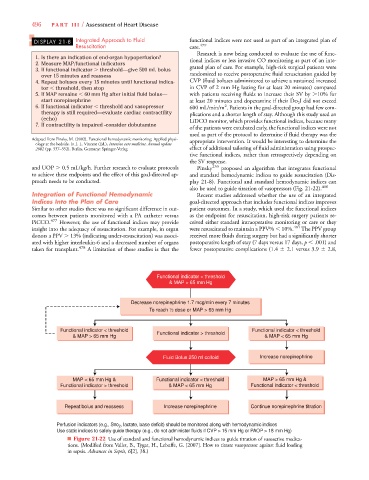
                                                                      also be used to guide titration of vasopressors (Fig. 21-22). 480
                  Integration of Functional Hemodynamic                 Recent studies addressed whether the use of an integrated
                  Indices Into the Plan of Care                       goal-directed approach that includes functional indices improves
                  Similar to other studies there was no significant difference in out-  patient outcomes. In a study, which used the functional indices
                  comes between patients monitored with a PA catheter versus  as the endpoint for resuscitation, high-risk surgery patients re-
                  PiCCO. 477  However, the use of functional indices may provide  ceived either standard intraoperative monitoring or care or they
                  insight into the adequacy of resuscitation. For example, in organ  were resuscitated to maintain a PPV%   10%. 481  The PPV group
                  donors a PPV   13% (indicating under-resuscitation) was associ-  received more fluids during surgery but had a significantly shorter
                  ated with higher interleukin-6 and a decreased number of organs  postoperative length of stay (7 days versus 17 days, p   .001) and
                  taken for transplant. 478  A limitation of these studies is that the  fewer postoperative complications (1.4   2.1 versus 3.9   2.8,
                                                           Functional indicator < threshold
                                                               & MAP > 65 mm Hg
                                                        se norepinephrine 1.7 mcg/min every 7 minutes
                                                         To reach ½ dose or MAP > 65 mm Hg
                            Functional indicator < threshold  Functional indicator > threshold  Functional indicator < threshold
                                & MAP > 65 mm Hg                                               & MAP < 65 mm Hg


                                                             Fluid Bolus 250 ml colloid      Increase norepinephrine


                                MAP < 65 mm Hg &           Functional indicator < threshold   MAP > 65 mm Hg &
                            Functional indicator > threshold   & MAP < 65 mm Hg           Functional indicator < threshold


                             Repeat bolus and reassess        Increase norepinephrine     Continue norepinephrine titration


                                               , lactate, base deficit) should be monitored along with hemodynamic indices
                          Perfusion indicators (e.g., Svo 2
                          Use static indices to safely guide therapy (e.g., do not administer fluids if CVP > 15 mm Hg or PAOP > 18 mm Hg)
                              ■ Figure 21-22 Use of standard and functional hemodynamic indices to guide titration of vasoactive medica-
                              tions. (Modified from Vallet, B., Tygat, H., Lebuffe, G. [2007]. How to titrate vasopressor against fluid loading
                                                  6
                                                  6
                              in sepsis. Advances in Sepsis, 6[2], 38.)

