


Page 518 - Cardiac Nursing
P. 518
M
                                               P
                                        8:2
                                           8 A
                                               P
                                                    94
                                                    94
                                                 g
                                                  e 4
                         10.
                         10.
                       0-5
                    p46
                           qxd
                                  9/2
                                    009
                               0
                                9/0
            K34
            K34
                 21_
               0-c
         LWBK340-c21_21_p460-510.qxd  09/09/2009  08:28 AM  Page 494 Aptara
                                                         ara
                                                       Apt
         L L LWB
         LWB K34 0-c 21_ p46 0-5 10. qxd  0 9/0 9/2 009  0 0 8:2 8 A M  P a a g e 4 94  Apt ara
                  494    P A R T  III / Assessment of Heart Disease
                              SvO  low
                                 2
                    SaO  low           SaO  normal
                                           2
                       2
                    Hypoxemia          Increased O ER
                                                2
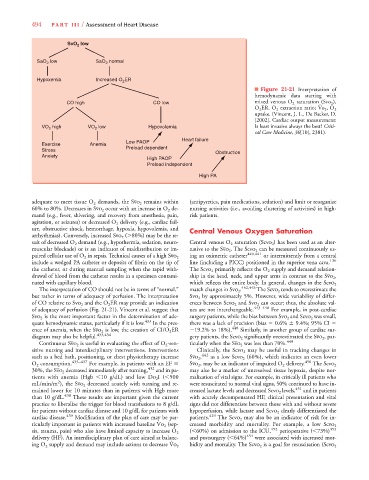
                                                                                           ■ Figure 21-21 Interpretation of
                                                                                           hemodynamic data starting with
                                                                                                                 #
                              CO high                     CO low                           mixed venous O 2 saturation (Svo 2 ),
                                                                                           O 2 ER, O 2 extraction ratio;   2 , O 2
                                                                                           uptake. (Vincent, J. L., De Backer, D.
                                                                                           [2002]. Cardiac output measurement:
                      VO  high       VO  low             Hypovolemia                       Is least invasive always the best? Criti-
                        2
                                       2
                                                                                           cal Care Medicine, 30[10], 2381).
                                                                   Heart failure
                                                 Low PAOP
                      Exercise       Anemia
                      Stress                     Preload dependent
                                                                              Obstruction
                      Anxiety
                                                        High PAOP
                                                        Preload independent
                                                                         High PA
                  adequate to meet tissue O 2 demands, the   2  remains within  (antipyretics, pain medications, sedation) and limit or reorganize
                  60% to 80%. Decreases in   2  occur with an increase in O 2 de-  nursing activities (i.e., avoiding clustering of activities) in high-
                  mand (e.g., fever, shivering, and recovery from anesthesia, pain,  risk patients.
                  agitation, or seizures) or decreased O 2 delivery (e.g., cardiac fail-
                  ure, obstructive shock, hemorrhage, hypoxia, hypovolemia, and  Central Venous Oxygen Saturation
                  arrhythmias). Conversely, increased   ( 80%) may be the re-
                  sult of decreased O 2 demand (e.g., hypothermia, sedation, neuro-  Central venous O 2 saturation (  2 ) has been used as an alter-
                  muscular blockade) or is an indicator of maldistribution or im-  native to the   . The   can be measured continuously us-
                                                                      ing an oximetric catheter 440,441  or intermittently from a central
                  paired cellular use of O 2 in sepsis. Technical causes of a high Svo 2
                  include a wedged PA catheter or deposits of fibrin on the tip of  line (including a PICC) positioned in the superior vena cava. 130
                  the catheter, or during manual sampling when the rapid with-  The   primarily reflects the O 2 supply and demand relation-
                  drawal of blood from the catheter results in a specimen contami-  ship in the head, neck, and upper arms in contrast to the   ,
                  nated with capillary blood.                         which reflects the entire body. In general, changes in the Scvo 2
                     The interpretation of CO should not be in terms of “normal,”  match changes in   . 442,443  The   2  tends to overestimate the
                  but rather in terms of adequacy of perfusion. The interpretation  Svo 2  by approximately 5%. However, wide variability of differ-
                  of CO relative to   2  and the O 2 ER may provide an indication  ences between   2  and   2  can occur; thus, the absolute val-
                  of adequacy of perfusion (Fig. 21-21). Vincent et al. suggest that  ues are not interchangeable. 443–448  For example, in post-cardiac
                       is the most important factor in the determination of ade-  surgery patients, while the bias between   and   was small,
                  Svo 2
                  quate hemodynamic status, particularly if it is low. 433  In the pres-  there was a lack of precision (bias   0.6%   9.4%; 95% CI
                  ence of anemia, when the   2  is low, the creation of CI/O 2 ER   19.2% to 18%). 448  Similarly, in another group of cardiac sur-
                  diagram may also be helpful. 433,434                gery patients, the   significantly overestimated the   , par-
                     Continuous   is useful in evaluating the effect of O 2 -sen-  ticularly when the   was less than 70%. 449
                  sitive nursing and interdisciplinary interventions. Interventions  Clinically, the   may be useful in tracking changes in
                  such as a bed bath, positioning, or chest physiotherapy increase  Svo  , 2  442  as a low   2  (60%), which indicates an even lower
                  O 2 consumption. 435–437  For example, in patients with an EF    Svo 2 , may be an indicator of impaired O 2 delivery. 450  The Scvo 2
                  30%, the   decreased immediately after turning, 432  and in pa-  may also be a marker of unresolved tissue hypoxia, despite nor-
                                                         #
                  tients with anemia (Hgb   10 g/dL) and low   ( 500  malization of vital signs. For example, in critically ill patients who
                           2
                  mL/min/m ), the    decreased acutely with turning and re-  were resuscitated to normal vital signs, 50% continued to have in-
                  mained lower for 10 minutes than in patients with Hgb more  creased lactate levels and decreased   2  levels, 451  and in patients
                  than 10 g/dL. 438  These results are important given the current  with acutely decompensated HF, clinical presentation and vital
                  practice to liberalize the trigger for blood transfusions to 8 g/dL  signs did not differentiate between those with and without severe
                  for patients without cardiac disease and 10 g/dL for patients with  hypoperfusion, while lactate and   clearly differentiated the
                  cardiac disease. 439  Modification of the plan of care may be par-  patients. 429  The   may also be an indicator of risk for in-
                                                            y
                                                            y
                                                            #
                  ticularly important in patients with increased baseline   (sep-  creased morbidity and mortality. For example, a  low  Scvo 2
                                                                      ( 60%) on admission to the ICU, 452  perioperative ( 73%) 453
                  sis, trauma, pain) who also have limited capacity to increase O 2
                  delivery (HF). An interdisciplinary plan of care aimed at balanc-  and postsurgery ( 64%) 454  were associated with increased mor-
                                                                #
                                                                      bidity and mortality. The
                  ing O 2 supply and demand may include actions to decrease Vo 2              is a goal for resuscitation (Scvo 2

