


Page 612 - Cardiac Nursing
P. 612
94.
                                      1:4
                        94.
                                                    t
                                                   p
                                                  A
                                                88
                                                  A
                                                   p
                                                   p
                                     0
                                     0
                                  009
                                6/2
                                6/2
                                                     ara
                                                    t
                                                     ara
                                        3 P
                                      1:4
                           xd
                           xd
                          q
                          q
                          q
                              0/0
                              0/0
                             3
                              3
                             3
                                              g
                                              g
                                              e 5
                                                88
                                              e 5
                                          M
                                          M
                                            Pa
                                              g
                                            Pa
                    55
                                  009
                 24_
                    55
                   p
                   p
                                        3 P
         LWBK340-c24_
         LWB
         LWB K34 0-c 24_ pp555-594.qxd  30/06/2009  01:43 PM  Page 588 Aptara
            K34
                      5-5
               0-c
                      5-5
                  588    PA R T  I V / Pathophysiology and Management of Heart Disease
                  are hypoperfused and have pulmonary congestion (cold and wet).  hemodynamically directed pharmacologic protocol for acute HF
                  For patients with adequate intravascular volume, inotropic agents  and cardiogenic shock therapy.
                  should be initiated. Inotropic agents are used to increase systemic
                  and coronary artery perfusion pressure. Dobutamine can im-  Goal 3: Reduce Myocardial Work
                  prove myocardial contractility and increase cardiac output and is  The efficacy of vasodilators has been shown in the treatment of
                  usually the agent of choice in patients with systolic pressures  cardiogenic shock. The major physiologic effect of vasodilators is
                  greater than 80 mm Hg. Dobutamine can precipitate tach-  a reduction in LV end-diastolic pressure and SVR, with a subse-
                  yarrhythmias and exacerbate hypotension. Dopamine is prefer-  quent increase in stroke volume and improved LV function. In-
                  able in patients with systolic pressures less than 80 mm Hg.  travenous nitroprusside remains the drug of choice in cardiogenic
                  Tachycardia and increased peripheral resistance is dose depend-  shock, because it acts rapidly and has a balanced effect, dilating
                                                   1
                  ent, and can exacerbate myocardial ischemia. In some situations,  both veins and arterioles, thereby reducing both preload and af-
                  a combination of dopamine and dobutamine can be more effec-  terload. Nitroglycerin can also be used, but it is predominantly a
                  tive than one agent alone. When hypotension remains refractory,  venous vasodilator, and large doses are sometimes required to re-
                  NE may be necessary. Other agents used for positive inotropic ef-  duce SVR (afterload). Intravenous nitroglycerin may be preferred
                  fect include phosphodiesterase inhibitors, such as milrinone.  in patients with acute MI because of its favorable effect on coro-
                     Afterload reduction by peripheral vasodilators appears particu-  nary blood flow. 1
                  larly well suited to reducing PAWP and SVR and improving CI.  Mechanical support of circulation may be used in the reduc-
                  Inotropic agents are also used to increase systemic and coronary  tion of LV workload in cardiogenic shock. The IABP is used to re-
                  artery perfusion pressure. Intra-aortic  balloon pump (IABP)  duce afterload and improve cardiac output at the time of systolic
                                               1
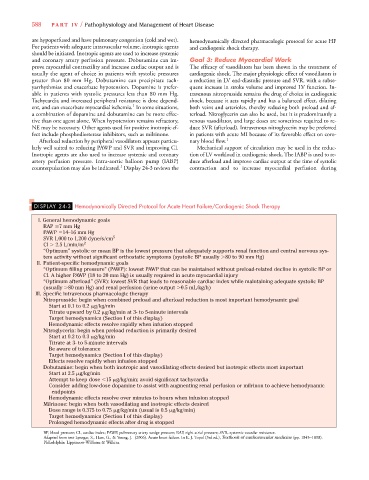
                  counterpulsation may also be indicated. Display 24-3 reviews the  contraction and to increase myocardial perfusion  during
                   DISPLAY 24-3 Hemodynamically Directed Protocol for Acute Heart Failure/Cardiogenic Shock Therapy
                     I. General hemodynamic goals
                      RAP  7 mm Hg
                      PAWP  14–16 mm Hg
                      SVR 1,000 to 1,200 dyne/s/cm 5
                      CI   2.5 L/min/m 2
                      “Optimum” systolic or mean BP is the lowest pressure that adequately supports renal function and central nervous sys-
                      tem activity without significant orthostatic symptoms (systolic BP usually  80 to 90 mm Hg)
                    II. Patient-specific hemodynamic goals
                      “Optimum filling pressure” (PAWP): lowest PAWP that can be maintained without preload-related decline in systolic BP or
                      CI. A higher PAWP (18 to 20 mm Hg) is usually required in acute myocardial injury
                      “Optimum afterload” (SVR): lowest SVR that leads to reasonable cardiac index while maintaining adequate systolic BP
                      (usually  80 mm Hg) and renal perfusion (urine output  0.5 mL/kg/h)
                    III. Specific intravenous pharmacologic therapy
                      Nitroprusside: begin when combined preload and afterload reduction is most important hemodynamic goal
                        Start at 0.1 to 0.2  g/kg/min
                        Titrate upward by 0.2  g/kg/min at 3- to 5-minute intervals
                        Target hemodynamics (Section I of this display)
                        Hemodynamic effects resolve rapidly when infusion stopped
                      Nitroglycerin: begin when preload reduction is primarily desired
                        Start at 0.2 to 0.3  g/kg/min
                        Titrate at 3- to 5-minute intervals
                        Be aware of tolerance
                        Target hemodynamics (Section I of this display)
                        Effects resolve rapidly when infusion stopped
                      Dobutamine: begin when both inotropic and vasodilating effects desired but inotropic effects most important
                        Start at 2.5  g/kg/min
                        Attempt to keep dose  15  g/kg/min; avoid significant tachycardia
                        Consider adding low-dose dopamine to assist with augmenting renal perfusion or milrinon to achieve hemodynamic
                         endpoints
                        Hemodynamic effects resolve over minutes to hours when infusion stopped
                      Milrinone: begin when both vasodilating and inotropic effects desired
                        Dose range is 0.375 to 0.75  g/kg/min (usual is 0.5  g/kg/min)
                        Target hemodynamics (Section I of this display)
                        Prolonged hemodynamic effects after drug is stopped
                      BP, blood pressure; CI, cardiac index; PAWP, pulmonary artery wedge pressure; RAP, right atrial pressure; SVR, systemic vascular resistance.
                      Adapted from text Lyengar, S., Hass, G., & Young, J.  (2006). Acute heart failure. In E. J. Topol (3rd ed.), Textbook of cardiovascular medicine (pp. 1845–1898).
                      Philadelphia: Lippincott-Williams & Wilkins.

