


Page 610 - Cardiac Nursing
P. 610
0
                                      1:4
                    55
                                     0
                      5-5
                      5-5
                                  009
                                          M
                                          M
                                            Pa
                                        3 P
                    55
                                      1:4
                                        3 P
                        94.
                             3
                             3
                              3
                              0/0
                                6/2
                                6/2
                              0/0
                          q
                          q
                        94.
                          q
                           xd
                           xd
                                  009
                                            Pa
                                                     ara
                 24_
                 24_
                                                    t
                                                    t
                                                     ara
               0-c
         LWB
         LWB
         LWBK340-c24_ p p pp555-594.qxd  30/06/2009  01:43 PM  Page 586 Aptara
               0-c
            K34
            K34
                                                86
                                              e 5
                                              e 5
                                                  A
                                                  A
                                                86
                                                   p
                                                   p
                                              g
                                              g
                                              g
                                                   p
                  586    PA R T  I V / Pathophysiology and Management of Heart Disease
                                     Establish diagnosis
                                 Determine hemodynamic status
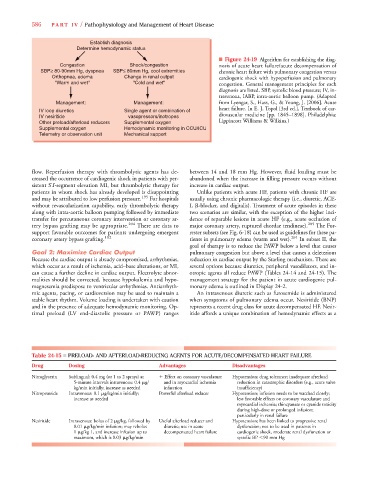
                                                                                ■ Figure 24-19 Algorithm for establishing the diag-
                            Congestion            Shock/congestion              nosis of acute heart failure/acute decompensation of
                     SBP≥ 80-90mm Hg, dyspnea  SBP≤ 80mm Hg, cool extremities   chronic heart failure with pulmonary congestion versus
                         Orthopnea, edema        Change in renal output         cardiogenic shock with hypoperfusion and pulmonary
                          "Warm and wet"           "Cold and wet"               congestion. General management principles for each
                                                                                diagnosis are listed. SBP, systolic blood pressure; IV, in-
                                                                                travenous, IABP, intra-aortic balloon pump. (Adapted
                          Management:               Management:                 from Lyengar, S., Hass, G., & Young, J. [2006]. Acute
                                                                                heart failure. In E. J. Topol [3rd ed.], Textbook of car-
                     IV loop diuretics           Single agent or combination of
                     IV nesiritide                  vasopressors/inotropes      diovascular medicine [pp. 1845–1898]. Philadelphia:
                     Other preload/afterload reducers  Supplemental oxygen      Lippincott Williams & Wilkins.)
                     Supplemental oxygen         Hemodynamic monitoring in CCU/ICU
                     Telemetry or observation unit  Mechanical support
                  flow. Reperfusion therapy with thrombolytic agents has de-  between 14 and 18 mm Hg. However, fluid loading must be
                  creased the occurrence of cardiogenic shock in patients with per-  abandoned when the increase in filling pressure occurs without
                  sistent ST-segment elevation MI, but thrombolytic therapy for  increase in cardiac output.
                  patients in whom shock has already developed is disappointing  Unlike patients with acute HF, patients with chronic HF are
                  and may be attributed to low perfusion pressure. 195  For hospitals  usually using chronic pharmacologic therapy (i.e., diuretic, ACE-
                  without revascularization capability, early thrombolytic therapy  I,  -blocker, and digitalis). Treatment of acute episodes in these
                  along with intra-aortic balloon pumping followed by immediate  two scenarios are similar, with the exception of the higher inci-
                  transfer for percutaneous coronary intervention or coronary ar-  dence of reparable lesions in acute HF (e.g., acute occlusion of
                  tery bypass grafting may be appropriate. 204  There are data to  major coronary artery, ruptured chordae tendineae). 205  The For-
                  support favorable outcomes for patients undergoing emergent  rester subsets (see Fig. 6-18) can be used as guidelines for these pa-
                  coronary artery bypass grafting. 192                tients in pulmonary edema (warm and wet). 201  In subset II, the
                                                                      goal of therapy is to reduce the PAWP below a level that causes
                  Goal 2: Maximize Cardiac Output                     pulmonary congestion but above a level that causes a deleterious
                  Because the cardiac output is already compromised, arrhythmias,  reduction in cardiac output by the Starling mechanism. There are
                  which occur as a result of ischemia, acid–base alterations, or MI,  several options because diuretics, peripheral vasodilators, and in-
                  can cause a further decline in cardiac output. Electrolyte abnor-  otropic agents all reduce PAWP (Tables 24-14 and 24-15). The
                  malities should be corrected, because hypokalemia and hypo-  management strategy for the patient in acute cardiogenic pul-
                  magnesemia predispose to ventricular arrhythmias. Antiarrhyth-  monary edema is outlined in Display 24-2.
                  mic agents, pacing, or cardioversion may be used to maintain a  An intravenous diuretic such as furosemide is administered
                  stable heart rhythm. Volume loading is undertaken with caution  when symptoms of pulmonary edema occur. Nesiritide (BNP)
                  and in the presence of adequate hemodynamic monitoring. Op-  represents a recent drug class for acute decompensated HF. Nesir-
                  timal preload (LV end-diastolic pressure or PAWP) ranges  itide affords a unique combination of hemodynamic effects as a
                  Table 24-15 ■ PRELOAD- AND AFTERLOAD-REDUCING AGENTS FOR ACUTE/DECOMPENSATED HEART FAILURE
                  Drug         Dosing                       Advantages              Disadvantages
                  Nitroglycerin  Sublingual: 0.4 mg (or 1 to 2 sprays) at
 Effect on coronary vasculature   Hypotension; drug tolerance; inadequate afterload
                                5-minute intervals intravenous: 0.4  g/  and in myocardial ischemia   reduction in catastrophic disorders (e.g., acute valve
                                kg/min initially; increase as needed  infarction      insufficiency)
                  Nitroprusside  Intravenous: 0.1  g/kg/min initially;   Powerful afterload reducer  Hypotension; infusion needs to be watched closely;
                                increase as needed                                    less favorable effects on coronary vasculature and
                                                                                      myocardial ischemia; thiocyanate or cyanide toxicity
                                                                                      during high-dose or prolonged infusion;
                                                                                      particularly in renal failure
                  Nesiritide   Intravenous: bolus of 2  g/kg, followed by   Useful afterload reducer and   Hypotension; has been linked to progressive renal
                                0.01  g/kg/min infusion; may rebolus   diuretic; use in acute   dysfunction; not to be used in patients in
                                1  g/kg 1, and increase infusion up to   decompensated heart failure  cardiogenic shock, moderate renal dysfunction or
                                maximum, which is 0.03  g/kg/min                      systolic BP  90 mm Hg

