


Page 609 - Cardiac Nursing
P. 609
LWBK340-c24_p555-594.qxd  30/06/2009  01:43 PM  Page 585 Aptara


                                                                   C HAP TE R 24 / Heart Failure and Cardiogenic Shock  585

                   tion (cool and dry) as seen in patients with hypovolemia. Subset  with patients with severe hypoxemia, hypercarbia, or metabolic
                   II describes the patient with pulmonary edema with an elevated  acidosis, then endotracheal intubation may be required with me-
                   PAWP but without peripheral hypoperfusion (warm and wet),  chanical ventilation. A PA catheter may be placed. Volume ex-
                   which may be seen in acute HF or decompensated chronic HF.  pansion may be needed to restore adequate circulation to main-
                   Subset IV describes the patient with pulmonary edema with hy-  tain a PAWP of 14 to 16 mm Hg. Vasopressor support should be
                   poperfusion (cold and wet), as seen in cardiogenic shock. 201  used only after preload is adequate to restore the blood pressure.
                     Assessment of tissue metabolism, which is  determined  by  The choice of a particular vasopressor/inotropic agent depends on
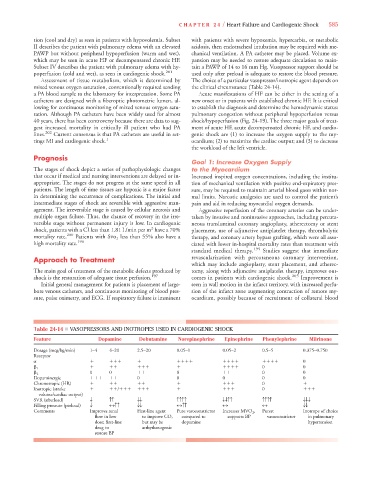
                   mixed venous oxygen saturation, conventionally required sending  the clinical circumstance (Table 24-14).
                   a PA blood sample to the laboratory for interpretation. Some PA  Acute manifestations of HF can be either in the setting of a
                   catheters are designed with a fiberoptic photometric lumen, al-  new onset or in patients with established chronic HF. It is critical
                   lowing for continuous monitoring of mixed venous oxygen satu-  to establish the diagnosis and determine the hemodynamic status:
                   ration. Although PA catheters have been widely used for almost  pulmonary congestion without peripheral hypoperfusion versus
                   40 years, there has been controversy because there are data to sug-  shock/hypoperfusion (Fig. 24-19). The three major goals of treat-
                   gest increased mortality in critically ill patient who  had PA  ment of acute HF, acute decompensated chronic HF, and cardio-
                   lines. 202  Current consensus is that PA catheters are useful in set-  genic shock are (1) to increase the oxygen supply to the my-
                   tings MI and cardiogenic shock. 1                   ocardium; (2) to maximize the cardiac output; and (3) to decrease
                                                                       the workload of the left ventricle.
                   Prognosis
                                                                       Goal 1: Increase Oxygen Supply
                   The stages of shock depict a series of pathophysiologic changes  to the Myocardium
                   that occur if medical and nursing interventions are delayed or in-  Increased inspired oxygen concentrations, including the institu-
                   appropriate. The stages do not progress at the same speed in all  tion of mechanical ventilation with positive end-expiratory pres-
                   patients. The length of time tissues are hypoxic is a major factor  sure, may be required to maintain arterial blood gases within nor-
                   in determining the occurrence of complications. The initial and  mal limits. Narcotic analgesics are used to control the patient’s
                   intermediate stages of shock are reversible with aggressive man-  pain and aid in reducing myocardial oxygen demands.
                   agement. The irreversible stage is caused by cellular necrosis and  Aggressive reperfusion of the coronary arteries can be under-
                   multiple organ failure. Thus, the chance of recovery in the irre-  taken by invasive and noninvasive approaches, including percuta-
                   versible stage without permanent injury is low. In cardiogenic  neous transluminal coronary angioplasty, atherectomy or stent
                                                         2
                   shock, patients with a CI less than 1.81 L/min per m have a 70%  placement, use of adjunctive antiplatelet therapy, thrombolytic
                   mortality rate. 200  Patients with   2  less than 55% also have a  therapy, and coronary artery bypass grafting, which were all asso-
                   high mortality rate. 190                            ciated with lower in-hospital mortality rates than treatment with
                                                                       standard medical therapy. 195  Studies suggest that immediate
                   Approach to Treatment                               revascularization with percutaneous coronary intervention,
                                                                       which may include angioplasty, stent placement, and atherec-
                   The main goal of treatment of the metabolic defects produced by  tomy, along with adjunctive antiplatelet therapy, improves out-
                   shock is the restoration of adequate tissue perfusion. 197  comes in patients with cardiogenic shock. 203  Improvement is
                     Initial general management for patients is placement of large-  seen in wall motion in the infarct territory, with increased perfu-
                   bore venous catheters, and continuous monitoring of blood pres-  sion of the infarct zone augmenting contraction of remote my-
                   sure, pulse oximetry, and ECG. If respiratory failure is imminent  ocardium, possibly because of recruitment of collateral blood


                   Table 24-14 ■ VASOPRESSORS AND INOTROPES USED IN CARDIOGENIC SHOCK
                   Feature              Dopamine      Dobutamine  Norepinephrine  Epinephrine  Phenylephrine  Milrinone
                   Dosage (mcg/kg/min)  1–4  4–20    2.5–20       0.05–1         0.05–2       0.5–5        0.375–0.750
                   Receptor


         0


         0            0
                     1
                                     0      0

           0

           0            0
                     2
                   Dopaminergic


       0            0              0            0            0
                   Chronotropic (HR)


          0
                   Inotropic (stroke


/


          0
                     volume/cardiac output)
                   SVR (afterload)   T      cc       TT           cccc           TTcc         cccc         TTT
                   Filling pressure (preload)  T  4cc  TT         4cc            4            4            TT
                   Comments          Improves renal  First-line agent  Pure vasoconstrictor   Increases MVO 2 ,  Purest  Inotrope of choice
                                       flow in low     to improve CO,   compared to   supports BP   vasoconstrictor  in pulmonary
                                       dose; first-line   but may be   dopamine                               hypertension
                                                         y
                                                         y
                                       drug to        arrhythmogenic
                                       restore BP

