


Page 611 - Cardiac Nursing
P. 611
M
                                        3 P
                                        3 P
                                          M
                                              g
                                            Pa
                                            Pa
                                      1:4
                                  009
                                6/2
                                6/2
                                  009
                                      1:4
                                     0
                                     0
                                                   p
                                                   p
                                                   p
                                                    t
                                                     ara
                                                     ara
                                                    t
                                                  A
                                              e 5
                                              g
                                              g
                                              e 5
                                                  A
                                                87
                                                87
                              0/0
                             3
                              3
                    55
                    55
                          q
                          q
                          q
                           xd
                      5-5
                           xd
                        94.
                              0/0
                             3
         LWBK340-c24_
         LWB K34 0-c 24_ p p pp555-594.qxd  30/06/2009  01:43 PM  Page 587 Aptara
                      5-5
                 24_
                        94.
               0-c
         LWB
            K34
                                                                   C HAPTER 24 / Heart Failure and Cardiogenic Shock  587
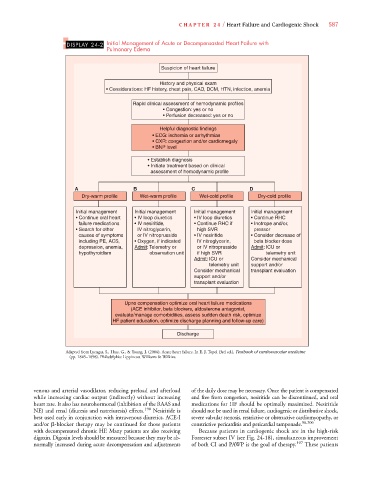
                              DISPLAY 24-2  Initial Management of Acute or Decompensasted Heart Failure with
                                           Pulmonary Edema
                                                             Suspicion of heart failure
                                                            History and physical exam
                                           • Considerations: HF history, chest pain, CAD, DCM, HTN, infection, anemia
                                                   Rapid clinical assessment of hemodynamic profiles
                                                             • Congestion: yes or no
                                                             • Perfusion decreased: yes or no
                                                            Helpful diagnostic findings
                                                          • ECG: ischemia or arrhythmias
                                                          • CXR: congestion and/or cardiomegaly
                                                          • BNP level
                                                        • Establish diagnosis
                                                        • Initiate treatment based on clinical
                                                          assessment of hemodynamic profile
                                A                   B                  C                  D
                                   Dry-warm profile   Wet-warm profile   Wet-cold profile   Dry-cold profile
                                 Initial management  Initial management  Initial management  Initial management
                                 • Continue oral heart  • IV loop diuretics  • IV loop diuretics  • Continue RHC
                                   failure medications  • IV nesiritide,  • Continue RHC if  • Inotrope and/or,
                                 • Search for other    IV nitroglycerin,    high SVR        pressor
                                   causes of symptoms    or IV nitroprusside  • IV nesiritide  • Consider decrease of
                                   including PE, ACS,  • Oxygen, if indicated    IV nitroglycerin,    beta blocker dose
                                   depression, anemia,  Admit: Telemetry or    or IV nitroprusside  Admit: ICU or
                                   hypothyroidism              observation unit    if high SVR             telemetry unit
                                                                       Admit: ICU or      Consider mechanical
                                                                                  telemetry unit  support and/or
                                                                       Consider mechanical  transplant evaluation
                                                                       support and/or
                                                                       transplant evaluation
                                                 Upno compensation optimize oral heart failure medications
                                                   (ACE inhibitor, beta blockers, aldosterone antagonist,
                                              evaluate/manage comorbidities, assess sudden death risk, optimize
                                             HF patient education, optimize discharge planning and follow-up care)
                                                                  Discharge
                              Adapted from Lyengar, S., Hass, G., & Young, J. (2006). Acute heart failure. In E. J. Topol (3rd ed.), Textbook of cardiovascular medicine
                               (pp. 1845–1898). Philadelphia: Lippincott Williams & Wilkins.
                   venous and arterial vasodilator, reducing preload and afterload  of the daily dose may be necessary. Once the patient is compensated
                   while increasing cardiac output (indirectly) without increasing  and free from congestion, nesiritide can be discontinued, and oral
                   heart rate. It also has neurohormonal (inhibition of the RAAS and  medications for HF should be optimally maximized. Nesiritide
                   NE) and renal (diuresis and natreiuresis) effects. 190  Nesiritide is  should not be used in renal failure, cardiogenic or distributive shock,
                   best used early in conjunction with intravenous diuretics. ACE-I  severe valvular stenosis, restrictive or obstructive cardiomyopathy, or
                   and/or  -blocker therapy may be continued for those patients  constrictive pericarditis and pericardial tamponade. 98,206
                   with decompensated chronic HF. Many patients are also receiving  Because patients in cardiogenic shock are in the high-risk
                   digoxin. Digoxin levels should be measured because they may be ab-  Forrester subset IV (see Fig. 24-18), simultaneous improvement
                   normally increased during acute decompensation and adjustments  of both CI and PAWP is the goal of therapy. 197  These patients

