


Page 62 - Cardiac Nursing
P. 62
92806_c01.qxd  11/21/11  10:30 AM  Page 38


                     38   PA R T  I / Anatomy and Physiology

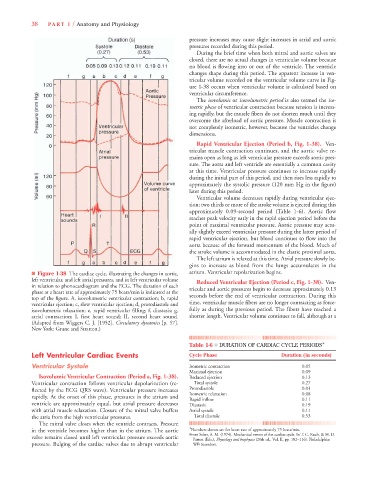
                                                                        pressure increases may cause slight increases in atrial and aortic
                                                                        pressures recorded during this period.
                                                                           During the brief time when both mitral and aortic valves are
                                                                        closed, there are no actual changes in ventricular volume because
                                                                        no blood is flowing into or out of the ventricle. The ventricle
                                                                        changes shape during this period. The apparent increase in ven-
                                                                        tricular volume recorded on the ventricular volume curve in Fig-
                                                                        ure 1-38 occurs when ventricular volume is calculated based on
                                                                        ventricular circumference.
                                                                           The isovolumic or isovolumetric period is also termed the iso-
                                                                        metric phase of ventricular contraction because tension is increas-
                                                                        ing rapidly, but the muscle fibers do not shorten much until they
                                                                        overcome the afterload of aortic pressure. Muscle contraction is
                                                                        not completely isometric, however, because the ventricles change
                                                                        dimensions.
                                                                           Rapid Ventricular Ejection (Period b, Fig. 1-38). Ven-
                                                                        tricular muscle contraction continues, and the aortic valve re-
                                                                        mains open as long as left ventricular pressure exceeds aortic pres-
                                                                        sure. The aorta and left ventricle are essentially a common cavity
                                                                        at this time. Ventricular pressure continues to increase rapidly
                                                                        during the initial part of this period, and then rises less rapidly to
                                                                        approximately the systolic pressure (120 mm Hg in the figure)
                                                                        later during this period.
                                                                           Ventricular volume decreases rapidly during ventricular ejec-
                                                                        tion; two thirds or more of the stroke volume is ejected during this
                                                                        approximately 0.09-second period (Table 1-6). Aortic flow
                                                                        reaches peak velocity early in the rapid ejection period before the
                                                                        point of maximal ventricular pressure. Aortic pressure may actu-
                                                                        ally slightly exceed ventricular pressure during the latter period of
                                                                        rapid ventricular ejection, but blood continues to flow into the
                                                                        aorta because of the forward momentum of the blood. Much of
                                                                        the stroke volume is accommodated in the elastic proximal aorta.
                                                                           The left atrium is relaxed at this time. Atrial pressure slowly be-
                                                                        gins to increase as blood from the lungs accumulates in the
                     ■ Figure 1-38 The cardiac cycle, illustrating the changes in aortic,  atrium. Ventricular repolarization begins.
                     left ventricular, and left atrial pressures, and in left ventricular volume  Reduced Ventricular Ejection (Period c, Fig. 1-38). Ven-
                     in relation to phonocardiogram and the ECG. The duration of each  tricular and aortic pressures begin to decrease approximately 0.13
                     phase at a heart rate of approximately 75 beats/min is indicated at the
                     top of the figure. A, isovolumetric ventricular contraction; b, rapid  seconds before the end of ventricular contraction. During this
                     ventricular ejection; c, slow ventricular ejection; d, protodiastole and  time, ventricular muscle fibers are no longer contracting as force-
                     isovolumetric relaxation; e, rapid ventricular filling; f, diastasis; g,  fully as during the previous period. The fibers have reached a
                     atrial contraction; I, first heart sound; II, second heart sound.  shorter length. Ventricular volume continues to fall, although at a
                     (Adapted from Wiggers C. J. [1952]. Circulatory dynamics [p. 57].
                     New York: Grune and Stratton.)

                                                                        Table 1-6 ■ DURATION OF CARDIAC CYCLE PERIODS*
                     Left Ventricular Cardiac Events                    Cycle Phase                   Duration (in seconds)
                     Ventricular Systole                                Isometric contraction                0.05
                                                                        Maximal ejection                     0.09
                       Isovolumic Ventricular Contraction (Period a, Fig. 1-38).  Reduced ejection           0.13
                     Ventricular contraction follows ventricular depolarization (re-  Total systole          0.27
                     flected by the ECG QRS wave). Ventricular pressure increases  Protodiastole              0.04
                     rapidly. At the onset of this phase, pressures in the atrium and  Isometric relaxation  0.08
                                                                                                             0.11
                                                                        Rapid inflow
                     ventricle are approximately equal, but atrial pressure decreases  Diastasis             0.19
                     with atrial muscle relaxation. Closure of the mitral valve buffers  Atrial systole      0.11
                     the atria from the high ventricular pressures.       Total diastole                     0.53
                       The mitral valve closes when the ventricle contracts. Pressure
                     in the ventricle becomes higher than in the atrium. The aortic  *Numbers shown are for heart rate of approximately 75 beats/min.
                                                                        From Scher, A. M. (1974). Mechanical events of the cardiac cycle. In T. C. Ruch, & H. D.
                     valve remains closed until left ventricular pressure exceeds aortic
                                                                         Patton (Eds.), Physiology and biophysics (20th ed., Vol. II, pp. 102–116). Philadelphia:
                     pressure. Bulging of the cardiac valves due to abrupt ventricular  WB Saunders.

