


Page 58 - Cardiac Nursing
P. 58
92806_c01.qxd  11/21/11  10:30 AM  Page 34


                     34   PA R T  I / Anatomy and Physiology


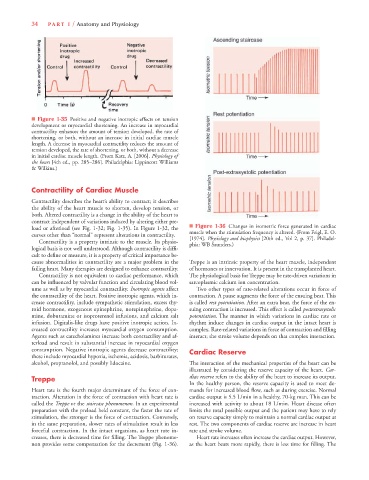
                     ■ Figure 1-35 Positive and negative inotropic effects on tension
                     development or myocardial shortening. An increase in myocardial
                     contractility enhances the amount of tension developed, the rate of
                     shortening, or both, without an increase in initial cardiac muscle
                     length. A decrease in myocardial contractility reduces the amount of
                     tension developed, the rate of shortening, or both, without a decrease
                     in initial cardiac muscle length. (From Katz, A. [2006]. Physiology of
                     the heart [4th ed., pp. 285–286]. Philadelphia: Lippincott Williams
                     & Wilkins.)


                     Contractility of Cardiac Muscle

                     Contractility describes the heart’s ability to contract; it describes
                     the ability of the heart muscle to shorten, develop tension, or
                     both. Altered contractility is a change in the ability of the heart to
                     contract independent of variations induced by altering either pre-
                     load or afterload (see Fig. 1-32; Fig. 1-35). In Figure 1-32, the  ■ Figure 1-36 Changes in isometric force generated in cardiac
                     curves other than “normal” represent alterations in contractility.  muscle when the stimulation frequency is altered. (From Feigl, E. O.
                       Contractility is a property intrinsic to the muscle. Its physio-  [1974]. Physiology and biophysics [20th ed., Vol 2, p. 37]. Philadel-
                                                                        phia: WB Saunders.)
                     logical basis is not well understood. Although contractility is diffi-
                     cult to define or measure, it is a property of critical importance be-
                     cause abnormalities in contractility are a major problem in the  Treppe is an intrinsic property of the heart muscle, independent
                     failing heart. Many therapies are designed to enhance contractility.  of hormones or innervation. It is present in the transplanted heart.
                       Contractility is not equivalent to cardiac performance, which  The physiological basis for Treppe may be rate-driven variations in
                     can be influenced by valvular function and circulating blood vol-  sarcoplasmic calcium ion concentration.
                     ume as well as by myocardial contractility. Inotropic agents affect  Two other types of rate-related alterations occur in force of
                     the contractility of the heart. Positive inotropic agents, which in-  contraction. A pause augments the force of the ensuing beat. This
                     crease contractility, include sympathetic stimulation, excess thy-  is called rest potentiation. After an extra beat, the force of the en-
                     roid hormone, exogenous epinephrine, norepinephrine, dopa-  suing contraction is increased. This effect is called postextrasystolic
                     mine, dobutamine or isoproterenol infusions, and calcium salt  potentiation. The manner in which variations in cardiac rate or
                     infusion. Digitalis-like drugs have positive inotropic action. In-  rhythm induce changes in cardiac output in the intact heart is
                     creased contractility increases myocardial oxygen consumption.  complex. Rate-related variations in force of contraction and filling
                     Agents such as catecholamines increase both contractility and af-  interact; the stroke volume depends on that complex interaction.
                     terload and result in substantial increase in myocardial oxygen
                     consumption. Negative inotropic agents decrease contractility;  Cardiac Reserve
                     these include myocardial hypoxia, ischemia, acidosis, barbiturates,
                     alcohol, propranolol, and possibly lidocaine.      The interaction of the mechanical properties of the heart can be
                                                                        illustrated by considering the reserve capacity of the heart. Car-
                     Treppe                                             diac reserve refers to the ability of the heart to increase its output.
                                                                        In the healthy person, the reserve capacity is used to meet de-
                     Heart rate is the fourth major determinant of the force of con-  mands for increased blood flow, such as during exercise. Normal
                     traction. Alteration in the force of contraction with heart rate is  cardiac output is 5.5 L/min in a healthy, 70-kg man. This can be
                     called the Treppe or the staircase phenomenon. In an experimental  increased with activity to about 18 L/min. Heart disease often
                    preparation with the preload held constant, the faster the rate of  limits the total possible output and the patient may have to rely
                    stimulation, the stronger is the force of contraction. Conversely,  on reserve capacity simply to maintain a normal cardiac output at
                    in the same preparation, slower rates of stimulation result in less  rest. The two components of cardiac reserve are increase in heart
                    forceful contraction. In the intact organism, as heart rate in-  rate and stroke volume.
                    creases, there is decreased time for filling. The Treppe phenome-  Heart rate increases often increase the cardiac output. However,
                    non provides some compensation for the decrement (Fig. 1-36).  as the heart beats more rapidly, there is less time for filling. The

