


Page 67 - Cardiac Nursing
P. 67
0/2
                                0/2
                              6/3
                              6/3
                                  009
                                     1
                                      5:3
                                  009
                                     1
                             0
                          q
                          q
                        68.
                        68.
                          q
                              0
                             0
                           xd
                           xd
                                      5:3
                                                p
                                                p
                                              3 A
                                              3 A
                                                p
                                                  r
                                                  r
                                                 ta
                                                 ta
                                            e 4
                                         Pa
                                         Pa
                                        3
                                        3
                                         Pa
                                           g
                                            e 4
                                           g
                                           g
               0-c
            K34
                   p
                 02_
                 02_
               0-c
                    04
                      2-0
                      2-0
         LWBK340-c02_ p pp042-068.qxd  06/30/2009  15:33  Page 43 Aptara a a
                    04
            K34
                                                   C HAPTER 2 / Systemic and Pulmonary Circulation and Oxygen Delivery  43
                                        Artery                                         Vein
                                                           Elastic tissue
                                                           Tunica interna
                         Vein
                         V V
                                                           Tunica media                                      Vein
                                                           Tunica externa
                                                             Blood flow
                                                 Arteriole                Venule
                                                                Capillary
                                             Endothelium
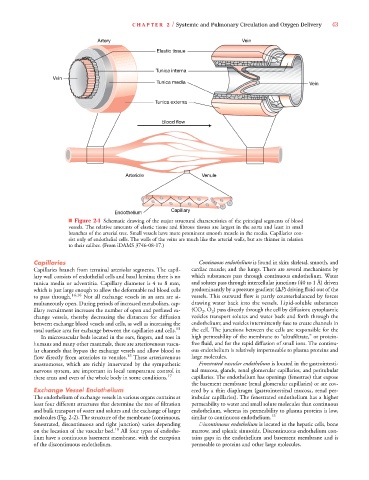
                              ■ Figure 2-1 Schematic drawing of the major structural characteristics of the principal segments of blood
                              vessels. The relative amounts of elastic tissue and fibrous tissues are largest in the aorta and least in small
                              branches of the arterial tree. Small vessels have more prominent smooth muscle in the media. Capillaries con-
                              sist only of endothelial cells. The walls of the veins are much like the arterial walls, but are thinner in relation
                              to their caliber. (From iDAMS 3746-08-17.)
                   Capillaries                                           Continuous endothelium is found in skin; skeletal, smooth, and
                   Capillaries branch from terminal arteriolar segments. The capil-  cardiac muscle; and the lungs. There are several mechanisms by
                   lary wall consists of endothelial cells and basal lamina; there is no  which substances pass through continuous endothelium. Water
                   tunica media or adventitia. Capillary diameter is 4 to 8 mm,  and solutes pass through intercellular junctions (40 to 1 Å) driven
                                                                                                    P
                                                                                                    P
                   which is just large enough to allow the deformable red blood cells  predominantly by a pressure gradient (	P) driving fluid out of the
                   to pass through. 14,16  Not all exchange vessels in an area are si-  vessels. This outward flow is partly counterbalanced by forces
                   multaneously open. During periods of increased metabolism, cap-  drawing water back into the vessels. Lipid-soluble substances
                   illary recruitment increases the number of open and perfused ex-  (CO 2 , O 2 ) pass directly through the cell by diffusion; cytoplasmic
                   change vessels, thereby decreasing the distances for diffusion  vesicles transport solutes and water back and forth through the
                   between exchange blood vessels and cells, as well as increasing the  endothelium; and vesicles intermittently fuse to create channels in
                   total surface area for exchange between the capillaries and cells. 13  the cell. The junctions between the cells are responsible for the
                     In microvascular beds located in the ears, fingers, and toes in  high permeability of the membrane to “ultrafiltrate,” or protein-
                   humans and many other mammals, there are arteriovenous vascu-  free fluid, and for the rapid diffusion of small ions. The continu-
                   lar channels that bypass the exchange vessels and allow blood to  ous endothelium is relatively impermeable to plasma proteins and
                   flow directly from arterioles to venules. 13  These arteriovenous  large molecules.
                   anastomoses, which are richly innervated by the sympathetic  Fenestrated vascular endothelium is located in the gastrointesti-
                   nervous system, are important in local temperature control in  nal mucosa, glands, renal glomerular capillaries, and peritubular
                   these areas and even of the whole body in some conditions. 17  capillaries. The endothelium has openings (fenestrae) that expose
                                                                       the basement membrane (renal glomerular capillaries) or are cov-
                   Exchange Vessel Endothelium                         ered by a thin diaphragm (gastrointestinal mucosa, renal per-
                   The endothelium of exchange vessels in various organs contains at  itubular capillaries). The fenestrated endothelium has a higher
                   least four different structures that determine the rate of filtration  permeability to water and small solute molecules than continuous
                   and bulk transport of water and solutes and the exchange of larger  endothelium, whereas its permeability to plasma proteins is low,
                   molecules (Fig. 2-2). The structure of the membrane (continuous,  similar to continuous endothelium. 13
                   fenestrated, discontinuous and tight junction) varies depending  Discontinuous endothelium is located in the hepatic cells, bone
                   on the location of the vascular bed. 18  All four types of endothe-  marrow, and splenic sinusoids. Discontinuous endothelium con-
                   lium have a continuous basement membrane, with the exception  tains gaps in the endothelium and basement membrane and is
                   of the discontinuous endothelium.                   permeable to proteins and other large molecules.

