


Page 60 - Cardiac Nursing
P. 60
92806_c01.qxd  11/21/11  10:30 AM  Page 36


                     36   PA R T  I / Anatomy and Physiology

                     Each cardiac contraction involves ionic movement across cell  tension–time index are often used to estimate MV ˙ O 2 . The
                     membranes. The oxygen required for electrical depolarization and  pressure–rate product is calculated by multiplying the heart rate
                     repolarization is small, 61  accounted for by the cycling of pumps  by the systolic or mean arterial pressure and dividing by 100. The
                     that maintain sodium, potassium, and other ionic distributions.  tension–time index (more appropriately should be called the
                       In addition to these two fairly constant and low requirements  pressure–time index) is calculated by multiplying the area under
                     for oxygen, factors related to activity and the state of the heart that  the left ventricular pressure curve by heart rate. Both pressure–rate
                     determine how much oxygen the heart needs. These factors,  product and tension–time index take heart rate (a major MV ˙ O 2
                     which include intramyocardial tension, heart rate, shortening,  determinant) into account. Because pressure, not tension, is in-
                     and contractile state, constitute the major determinants of my-  cluded in these indicators, the other factors in the Laplace equa-
                     ocardial oxygen consumption (MV ˙ O 2 ).           tion (i.e., ventricular cavity radius, ventricular wall thickness)
                                                                        must be constant if these indices are to accurately predict MV ˙ O 2 .
                     Intramyocardial Tension
                     The law of Laplace is used to calculate intramyocardial tension.  Myocardial Oxygen Supply
                     This law states that intramyocardial tension is proportional to the
                     internal pressure within the ventricular cavity times the ventricu-  Control of Coronary Blood Flow
                     lar cavity radius; it is inversely proportional to the ventricular wall  Flow of blood in the coronary circulation is, as in all vascular beds,
                     thickness. An increase in left ventricular afterload causes the left  proportional to the perfusion pressure and inversely proportional
                     ventricle to develop more pressure during the systolic period,  to the resistance of the bed. Resistance in the coronary bed is al-
                     thereby increasing intramyocardial tension and oxygen consump-  tered by compression on it during systole and by metabolic, neu-
                     tion. An increase in the preload or filling pressures of the left ven-  ral, and hormonal factors. Coronary artery disease can impose sig-
                     tricle increases tension because both internal pressure and the ra-  nificant resistance.
                     dius of the ventricular cavity are increased and the thickness is  The pressure difference that drives cardiac perfusion is the gra-
                     decreased. Again, MV ˙ O 2 is increased.           dient between aortic pressure and right atrial pressure because
                                                                        most of the coronary perfusion returns to the right atrium. Be-
                     Heart Rate                                         cause the heart develops its own perfusion pressure, a fall in aor-
                     Increased heart rate (at the same preload and afterload) increases  tic pressure can reduce coronary perfusion, which in turn may fur-
                     MV ˙ O 2 . Each beat represents the generation of tension by the my-  ther decrease cardiac function and pressure development. A cycle
                     ocardium.                                          of deterioration may result. The coronary circulation, however, is
                                                                        autoregulated. This means that changes in the perfusion pressure
                     Shortening                                         over a range of pressures (approximately 60 to 180 mm Hg) make
                     In an isotonic twitch, there is a component of the oxygen con-  little difference in the amount of blood flowing to the heart if the
                     sumption that is proportional to the amount of shortening by a  other factors influencing perfusion are held constant.
                     muscle. That is, there is a metabolic cost that is related to shorten-  During systole, myocardial wall tension is high. This com-
                     ing. This is sometimes called the Fenn effect and is a characteristic  presses the coronary arteries, preventing perfusion. Thus, the heart
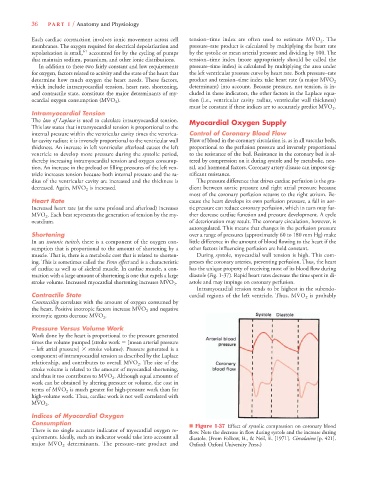
                     of cardiac as well as of skeletal muscle. In cardiac muscle, a con-  has the unique property of receiving most of its blood flow during
                     traction with a large amount of shortening is one that expels a large  diastole (Fig. 1-37). Rapid heart rates decrease the time spent in di-
                     stroke volume. Increased myocardial shortening increases MV ˙ O 2 .  astole and may impinge on coronary perfusion.
                                                                           Intramyocardial tension tends to be highest in the subendo-
                     Contractile State                                  cardial regions of the left ventricle. Thus, MV ˙ O 2 is probably
                     Contractility correlates with the amount of oxygen consumed by
                     the heart. Positive inotropic factors increase MV ˙ O 2 and negative
                     inotropic agents decrease MV ˙ O 2 .

                     Pressure Versus Volume Work
                     Work done by the heart is proportional to the pressure generated
                     times the volume pumped (stroke work   [mean arterial pressure
                     – left atrial pressure]   stroke volume). Pressure generated is a
                     component of intramyocardial tension as described by the Laplace
                     relationship, and contributes to overall MV ˙ O 2 . The size of the
                     stroke volume is related to the amount of myocardial shortening,
                     and thus it too contributes to MV ˙ O 2 . Although equal amounts of
                     work can be obtained by altering pressure or volume, the cost in
                     terms of MV ˙ O 2 is much greater for high-pressure work than for
                     high-volume work. Thus, cardiac work is not well correlated with
                     MV ˙ O 2 .

                     Indices of Myocardial Oxygen
                     Consumption                                        ■ Figure 1-37 Effect of systolic compression on coronary blood
                     There is no single accurate indicator of myocardial oxygen re-  flow. Note the decrease in flow during systole and the increase during
                     quirements. Ideally, such an indicator would take into account all  diastole. (From Folkow, B., & Neil, E. [1971]. Circulation [p. 421].
                     major MV ˙ O 2 determinants.  The pressure–rate product and  Oxford: Oxford University Press.)

