


Page 648 - Cardiac Nursing
P. 648
624    P AR T IV / Pathophysiology and Management of Heart Disease


            DISPLAY 26-1  Major Indications for Intra-aortic Balloon
                         Pump Therapy in 16,909 Patient (1996
                         to 2000)
            Hemodynamic support during or after cardiac
              catheterization (21%)
            Cardiogenic shock (19%)
            Weaning from cardiopulmonary bypass (13%)
            Refractory unstable angina (12%)
            Refractory heart failure (6.5%)
            Mechanical complications of acute myocardial
              infarction (5.5%)
            Intractable ventricular arrhythmias (1.7%)


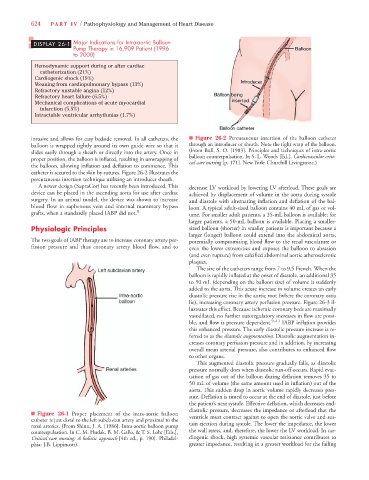
           invasive and allows for easy bedside removal. In all catheters, the  n Figure 26-2 Percutaneous insertion of the balloon catheter
           balloon is wrapped tightly around its own guide wire so that it  through an introducer or sheath. Note the right wrap of the balloon.
           slides easily through a sheath or directly into the artery. Once in  (From Bull, S. O. [1983]. Principles and techniques of intra-aortic
                                                               balloon counterpulsation. In S. L. Woods [Ed.], Cardiovascular criti-
           proper position, the balloon is inflated, resulting in unwrapping of
                                                               cal care nursing [p. 171]. New York: Churchill Livingstone.)
           the balloon, allowing inflation and deflation to commence. This
           catheter is secured to the skin by sutures. Figure 26-2 illustrates the
           percutaneous insertion technique utilizing an introducer sheath.
              A newer design (SupraCor) has recently been introduced. This  decrease LV workload by lowering LV afterload. These goals are
           device can be placed in the ascending aorta for use after cardiac  achieved by displacement of volume in the aorta during systole
           surgery. In an animal model, the device was shown to increase  and diastole with alternating inflation and deflation of the bal-
           blood flow in saphenous vein and internal mammary bypass  loon. A typical adult-sized balloon contains 40 mL of gas or vol-
           grafts, when a standardly placed IABP did not. 8    ume. For smaller adult patients, a 35-mL balloon is available; for
                                                               larger patients, a 50-mL balloon is available. Placing a smaller-
           Physiologic Principles                              sized balloon (shorter) in smaller patients is important because a
                                                               larger (longer) balloon could extend into the abdominal aorta,
           The two goals of IABP therapy are to increase coronary artery per-  potentially compromising blood flow to the renal vasculature or
           fusion pressure and thus coronary artery blood flow, and to   even the lower extremities and exposes the balloon to abrasion
                                                               (and even rupture) from calcified abdominal aortic atherosclerotic
                                                               plaques.
                                                                 The size of the catheters range from 7 to 9.5 French. When the
                                                               balloon is rapidly inflated at the onset of diastole, an additional 35
                                                               to 50 mL (depending on the balloon size) of volume is suddenly
                                                               added to the aorta. This acute increase in volume creates an early
                                                               diastolic pressure rise in the aortic root (where the coronary ostia
                                                               lie), increasing coronary artery perfusion pressure. Figure 26-3 il-
                                                               lustrates this effect. Because ischemic coronary beds are maximally
                                                               vasodilated, no further autoregulatory increases in flow are possi-
                                                               ble, and flow is pressure dependent. 9–11  IABP inflation provides
                                                               this enhanced pressure. The early diastolic pressure increase is re-
                                                               ferred to as the diastolic augmentation. Diastolic augmentation in-
                                                               creases coronary perfusion pressure and in addition, by increasing
                                                               overall mean arterial pressure, also contributes to enhanced flow
                                                               to other organs.
                                                                 This augmented diastolic pressure gradually falls, as diastolic
                                                               pressure normally does when diastolic run-off occurs. Rapid evac-
                                                               uation of gas out of the balloon during deflation removes 35 to
                                                               50 mL of volume (the same amount used in inflation) out of the
                                                               aorta. This sudden drop in aortic volume rapidly decreases pres-
                                                               sure. Deflation is timed to occur at the end of diastole, just before
                                                               the patient’s next systole. Effective deflation, which decreases end-
                                                               diastolic pressure, decreases the impedance or afterload that the
           n Figure 26-1 Proper placement of the intra-aortic balloon
           catheter is just distal to the left subclavian artery and proximal to the  ventricle must contract against to open the aortic valve and sus-
           renal arteries. (From Shinn, J. A. [1986]. Intra-aortic balloon pump  tain ejection during systole. The lower the impedance, the lower
           counterpulsation. In C. M. Hudak, B. M. Gallo, & T. S. Lohr [Eds.],  the wall stress, and, therefore, the lower the LV workload. In car-
           Critical care nursing: A holistic approach [4th ed., p. 190]. Philadel-  diogenic shock, high systemic vascular resistance contributes to
           phia: J.B. Lippincott).                             greater impedance, resulting in a greater workload for the failing

